Department of Internal Medicine IV, Wilhelminenspital, Vienna, Austria.
Division of Gastroenterology and Hepatology, Department of Internal Medicine III, Medical University of Vienna, Vienna, Austria.
PLoS One. 2020 Mar 10;15(3):e0229239. doi: 10.1371/journal.pone.0229239. eCollection 2020.
Directly acting antivirals (DAA) against hepatitis C virus (HCV) infection have facilitated sustained virologic response (SVR) rates >90% in clinical studies. Yet, real life data regarding DAA treatment in people who inject drugs (PWIDs) are scarce. We evaluated the effectiveness of glecaprevir/pibrentasvir (G/P) in difficult-to-treat PWIDs with presumed high risk of non-adherence to DAA therapy using the concept of directly observed therapy involving their opioid substitution therapy (OST) facility.
N = 145 patients (m/f: 91/54; median age: 41.1 (IQR 19.5) years; HCV-genotype (GT) 1/2/3/4: 82/1/56/5, GT3: 38.6%; cirrhosis: n = 6; 4.1%) treated with G/P were included. PWIDs at high risk for non-adherence to DAA therapy received HCV treatment together with their OST under the supervision of medical staff ("directly observed therapy", DOT). The effectiveness of G/P given as DOT in PWIDs with presumed high risk of non-adherence to DAA therapy was compared to patients with suspected "excellent compliance" in the "standard setting" (SS) of G/P prescription at a tertiary care center and self-managed G/P intake at home. Treatment duration was 8-16 weeks according to the G/P drug label.
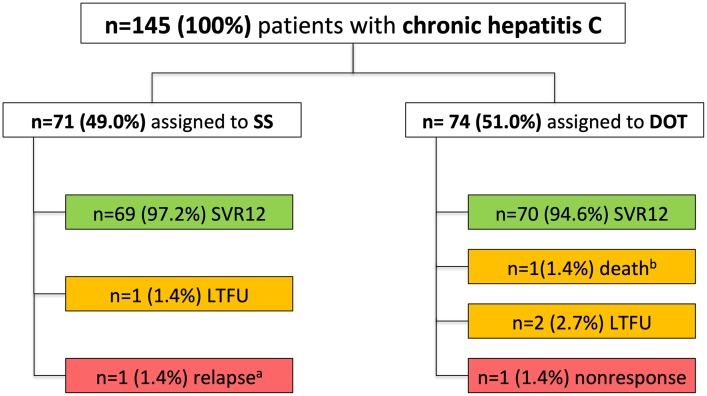
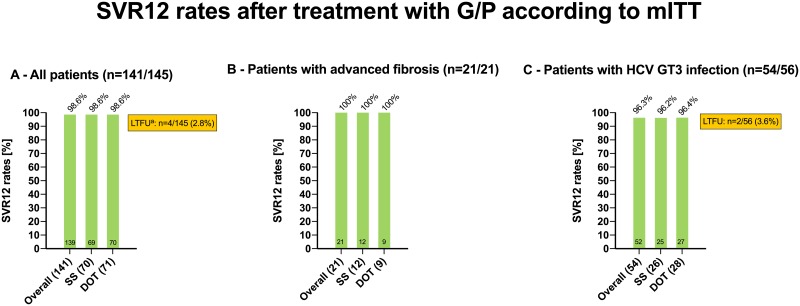
DOT-patients (n = 74/145; 51.0%) were younger than SS-patients (median 38.7, IQR 12.5 vs. median 50.6, IQR 20.3 years), all had psychiatric co-morbidities and most had a poor socioeconomic status. 50/74 (67.6%) reported ongoing intravenous drug use (IDU). SVR was achieved in n = 70/74 (94.6%) patients with n = 3 being lost to follow-up (FU) and n = 1 showing nonresponse to therapy. SS-patients achieved SVR in 97.2% (69/71) with n = 1 patient being lost to FU and n = 1 patient with GT3 showing HCV relapse.
G/P given as DOT along with OST in PWIDs with high risk of non-adherence to DAA therapy resulted in similarly high SVR rates (94.6%) as in patients with presumed "excellent compliance" under standard drug intake.
直接作用抗病毒药物(DAA)治疗丙型肝炎病毒(HCV)感染,在临床试验中实现了超过 90%的持续病毒学应答(SVR)率。然而,关于在吸毒者(PWIDs)中使用 DAA 治疗的真实数据却很少。我们使用涉及阿片类药物替代疗法(OST)设施的直接观察治疗的概念,评估了难治疗的 PWIDs 使用 glecaprevir/pibrentasvir(G/P)治疗的效果,这些 PWIDs 可能存在不遵守 DAA 治疗的高风险。
纳入了 145 名接受 G/P 治疗的患者(男/女:91/54;中位年龄:41.1(IQR 19.5)岁;HCV 基因型(GT)1/2/3/4:82/1/56/5,GT3:38.6%;肝硬化:n=6;4.1%)。高风险不遵守 DAA 治疗的 PWIDs 在医疗人员的监督下(直接观察治疗,DOT)同时接受 HCV 治疗和 OST。将 G/P 作为 DOT 在高风险不遵守 DAA 治疗的 PWIDs 中的有效性,与在三级护理中心的 G/P 处方标准设置(SS)中疑似“良好依从性”的患者(n=71)和在家中自我管理 G/P 摄入的患者(n=54)进行比较。根据 G/P 药物标签,治疗持续时间为 8-16 周。
DOT 患者(n=74/145;51.0%)比 SS 患者(中位数 38.7,IQR 12.5 与中位数 50.6,IQR 20.3 岁)年轻,均患有精神共病,大多数社会经济地位较差。50/74(67.6%)报告正在进行静脉内药物使用(IDU)。74 名患者中的 70 名(94.6%)达到 SVR,3 名患者失访(FU),1 名患者对治疗无反应。71 名 SS 患者中有 69 名(97.2%)达到 SVR,1 名患者失访,1 名 GT3 患者 HCV 复发。
在高风险不遵守 DAA 治疗的 PWIDs 中,与 OST 一起使用 G/P 进行 DOT 治疗,其 SVR 率(94.6%)与标准药物摄入下疑似“良好依从性”的患者相似。