Department of Internal Medicine IV, Klinik Ottakring, Vienna, Austria.
Division of Gastroenterology and Hepatology, Department of Internal Medicine III, Medical University of Vienna, Vienna, Austria.
PLoS One. 2021 Jun 4;16(6):e0252274. doi: 10.1371/journal.pone.0252274. eCollection 2021.
BACKGROUND & AIMS: We evaluated the effectiveness of sofosbuvir/velpatasvir (SOF/VEL) in difficult-to-treat PWIDs with presumed high risk for non-adherence to antiviral therapy using an innovative concept involving their opioid agonist therapy (OAT) facility.
N = 221 patients (m/f: 168/53; median age: 44.7 years (IQR 16.9); HCV-genotype 3: 45.2%; cirrhosis: 33.9%) treated with SOF/VEL were included. PWIDs at high risk for non-adherence to DAA therapy (n = 122) received HCV treatment alongside OAT under the supervision of medical staff ("directly observed therapy", DOT). These patients were compared to patients with presumed excellent drug compliance, who were treated in a "standard setting" (SS) of SOF/VEL prescription at a tertiary care center (n = 99).
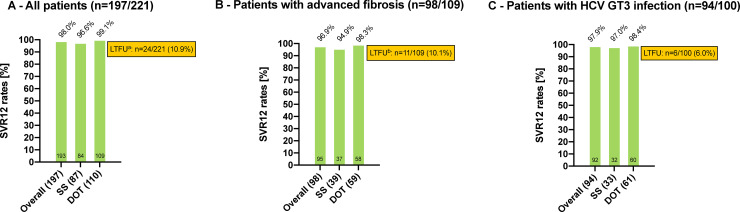
DOT-patients (n = 122/221; 55.2%) were younger than SS-patients (median age: 41.3 vs. 53.0 years), all had psychiatric comorbidities and most had a poor socioeconomic status. 83/122 (68.0%) reported ongoing intravenous drug use. Within the DOT-group, SVR12 was achieved in 99.1% (95% CI: 95.0-100; n = 109/110) with one patient experiencing treatment failure, while n = 12/122 (9.8%) patients were excluded due to loss of follow-up (FU). 5 patients showed HCV reinfection after achieving SVR12. SS-patients achieved SVR in 96.6% (95% CI: 90.3-99.3%; n = 84/87) after exclusion of 10/99 (10.1%) patients who were lost to FU and 2 patients who died prior to SVR12 due to reasons not related to DAA therapy.
SOF/VEL given as DOT along with OAT in PWIDs at high risk of non-adherence to antiviral therapy including those with ongoing intravenous drug use resulted in excellent SVR rates similar to patients with presumed "excellent compliance" under standard drug intake.
我们评估了索磷布韦/维帕他韦(SOF/VEL)在通过创新概念,即使用阿片类药物激动剂治疗(OAT)设施,对那些难以治疗、且可能不遵医嘱进行抗病毒治疗的高危阿片类药物使用障碍者(PWIDs)中的有效性。
共纳入 221 例接受 SOF/VEL 治疗的患者(男/女:168/53;中位年龄:44.7 岁(IQR 16.9);丙型肝炎病毒基因型 3:45.2%;肝硬化:33.9%)。122 例存在抗病毒治疗不依从高风险的 PWIDs 在医护人员的监督下同时接受 HCV 治疗和 OAT(“直接观察治疗”,DOT)。这些患者与被认为具有良好药物依从性的患者进行比较,后者在一家三级护理中心以 SOF/VEL 处方的“标准设置”(SS)进行治疗(n=99)。
DOT 患者(n=122/221;55.2%)比 SS 患者(n=99/221;44.8%)更年轻(中位年龄:41.3 岁 vs. 53.0 岁),均存在精神共病,且大多数社会经济地位较差。83/122(68.0%)例报告持续静脉药物使用。DOT 组中,109/110(99.1%)例患者达到了 SVR12,其中 1 例患者发生治疗失败,12/122(9.8%)例患者因失访(FU)而被排除。5 例患者在达到 SVR12 后出现 HCV 再感染。SS 患者在排除了 10/99(10.1%)例失访和 2 例因与 DAA 治疗无关的原因在 SVR12 前死亡的患者后,达到 SVR12 的比例为 96.6%(95%CI:90.3-99.3%;n=84/87)。
SOF/VEL 作为 DOT 与 OAT 联合应用于高抗病毒治疗不依从风险的 PWIDs,包括那些持续静脉药物使用者,可获得类似被认为“依从性良好”的患者的优异 SVR 率。