Reserach and Evaluation, Forum for Health Reserach and Development, Dharan, Nepal
Centre for Primary Health Care and Equity, University of New South Wales, Sydney, New South Wales, Australia.
BMJ Open. 2020 Mar 9;10(3):e035700. doi: 10.1136/bmjopen-2019-035700.
To understand the facilitators and barriers to the self-management of chronic obstructive pulmonary disease (COPD) in rural Nepal.
Community and primary care centres in rural Nepal.
A total of 14 participants (10 people with COPD and 4 health care providers) were interviewed.
People with COPD and healthcare provider's experience of COPD self-management in rural Nepal.
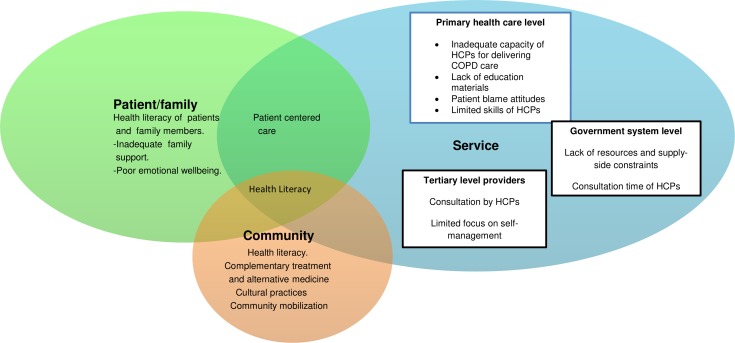
Facilitators and barriers affecting COPD self-management in Nepal operated at the patient-family, community and service provider levels. People with COPD were found to have a limited understanding of COPD and medications. Some participants reported receiving inadequate family support and described poor emotional health. At the community level, widespread use of complementary and alternative treatment was found to be driven by social networks and was used instead of western medicine. There were limited quality controls in place to monitor the safe use of alternative treatment. While a number of service level factors were identified by all participants, the pertinent concerns were the levels of trust and respect between doctors and their patients. Service level factors included patients' demands for doctor time and attention, limited confidence of people with COPD in communicating confidently and openly with their doctor, limited skills and expertise of the doctors in promoting behavioural change, frustration with doctors prescribing too many medicines and the length of time to diagnose the disease. These service level factors were underpinned by resource constraints operating in rural areas. These included inadequate infrastructure and resources, limited skills of primary level providers and lack of educational materials for COPD.
The study findings suggest the need for a more integrated model of care with multiple strategies targeting all three levels in order to improve the self-management practices among people with COPD.
了解尼泊尔农村地区慢性阻塞性肺疾病(COPD)自我管理的促进因素和障碍。
尼泊尔农村的社区和初级保健中心。
共采访了 14 名参与者(10 名 COPD 患者和 4 名医疗保健提供者)。
COPD 患者和医疗保健提供者在尼泊尔农村地区 COPD 自我管理的经验。
影响尼泊尔 COPD 自我管理的促进因素和障碍在患者-家庭、社区和服务提供者层面发挥作用。COPD 患者对 COPD 和药物的了解有限。一些参与者报告说家庭支持不足,并描述了较差的情绪健康状况。在社区层面,发现广泛使用补充和替代疗法是由社交网络驱动的,并且被用于替代西药。没有适当的质量控制来监测替代疗法的安全使用。虽然所有参与者都确定了一些服务层面的因素,但相关的问题是医生和患者之间的信任和尊重程度。服务层面的因素包括患者对医生时间和关注的需求、COPD 患者与医生自信和公开沟通的信心有限、医生在促进行为改变方面的技能和专业知识有限、对医生开太多药的不满以及诊断疾病所需的时间。这些服务层面的因素受到农村地区资源限制的影响。这些限制包括基础设施和资源不足、初级保健提供者技能有限以及 COPD 教育材料缺乏。
研究结果表明,需要建立一种更综合的护理模式,采用多种策略针对所有三个层面,以提高 COPD 患者的自我管理实践。