Department of Cardiology, Heart Center, Zhujiang Hospital, Southern Medical University, Guangzhou, Guangdong 510280, People's Republic of China.
Laboratory of Heart Center and Department of Cardiology, Heart Center, Zhujiang Hospital, Southern Medical University, Guangzhou, Guangdong 510280, People's Republic of China.
Drug Des Devel Ther. 2020 Feb 24;14:731-744. doi: 10.2147/DDDT.S231916. eCollection 2020.
This study was to investigate the mechanism of inflammatory pathology modification induced by ox-LDL in endothelial cells.
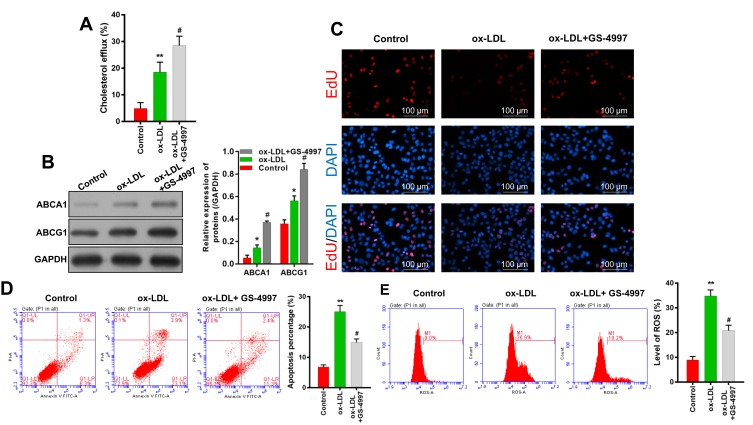
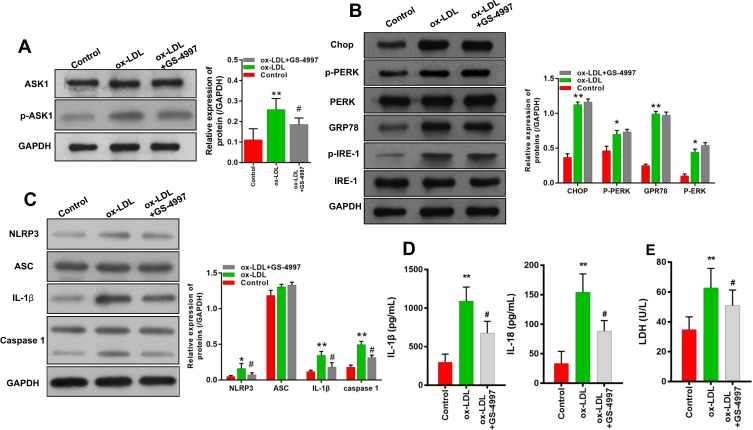
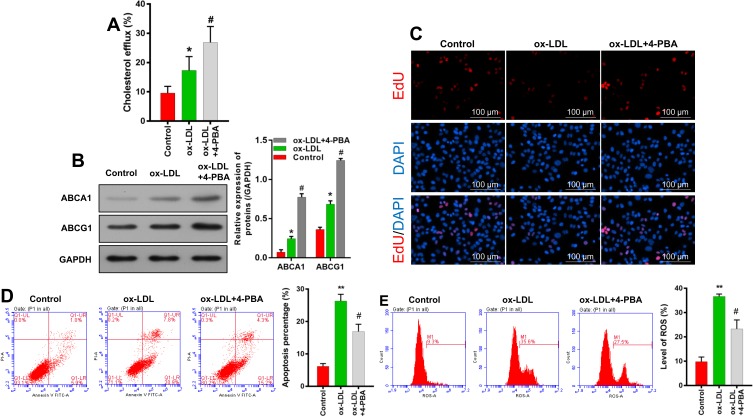
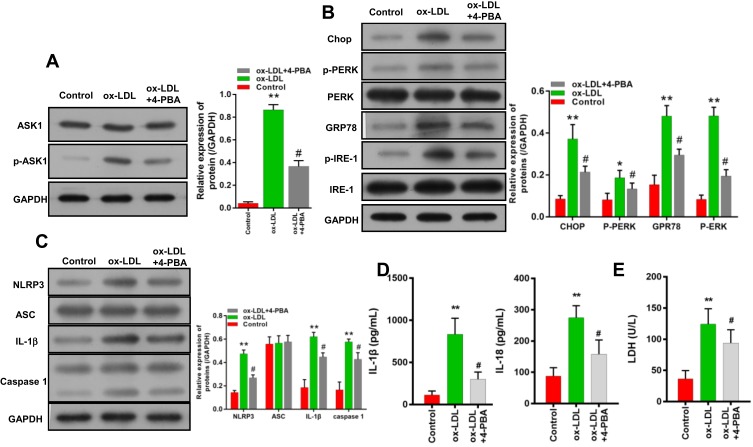
In this study, we firstly investigated the efflux of cholesterol of endothelial cells under the treatment of ox-LDL, and cell proliferation, ROS production, cell apoptosis was measured. Further, proteins of ASK1, NLRP3 inflammasomes and endoplasmic reticulum stress response were detected. Afterwards, ASK1 inhibitor (GS-4997) or endoplasmic reticulum stress (ERS) inhibitor (4-PBA) was used to measure the performance of endothelial cells.
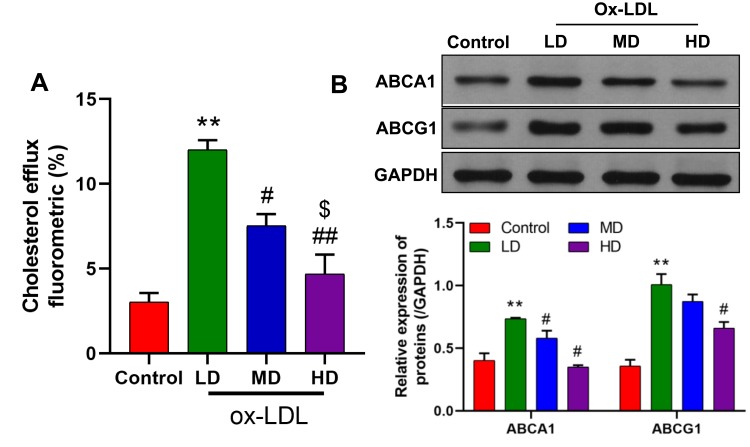
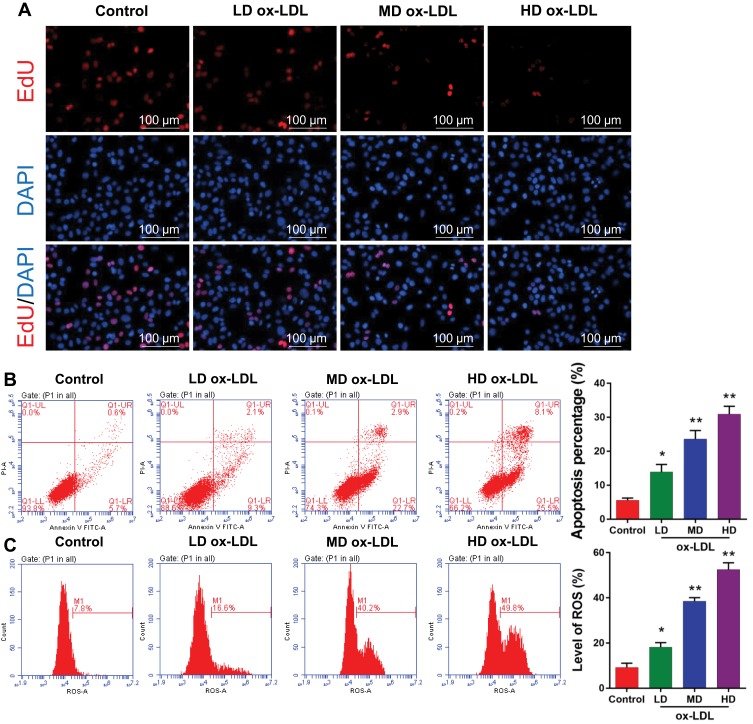
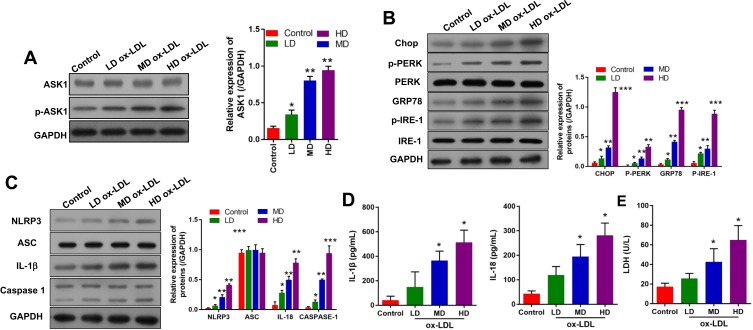
In this study, endothelial cells were treated with ox-LDLs alone or in combination with a GS-4997 or 4-PBA. Results showed that ox-LDLs attenuated the efflux of cholesterol from endothelial cells in a dose-dependent manner. Ox-LDLs inhibited the proliferation of endothelial cells, and induced their apoptosis and production of reactive oxygen species (ROS). Additionally, ox-LDLs upregulated the levels of phosphorylated ASK1, ERS-related proteins (chop, p-PERK, GRP78, and p-IRE-1), and inflammation-associated proteins (NLRP3, IL-1β, and caspase 1) in endothelial cells. Moreover, we proved that GS-4997 could partly reverse ox-LDL-mediated cell proliferation, apoptosis, ROS production, and inflammation in endothelial cells, and increase cholesterol efflux. We also found that 4-PBA could attenuate the effects of ox-LDLs on endothelial cell cholesterol efflux, proliferation, apoptosis, ROS production, and inflammation.
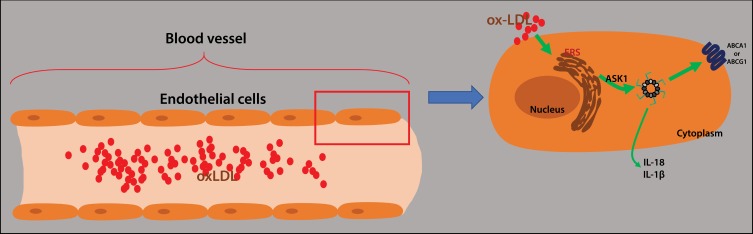
Our results suggest that cholesterol efflux from endothelial cells is reduced by ox-LDLs, and these reductions in cholesterol efflux are accompanied by increased NLRP3 inflammasome signaling, ASK1 and higher levels of endoplasmic reticulum stress. Our results suggest this axis as potential targets for treating atherosclerosis.
本研究旨在探讨 ox-LDL 诱导内皮细胞炎症病理学改变的机制。
本研究首先观察 ox-LDL 处理下内皮细胞胆固醇流出情况,并检测细胞增殖、ROS 生成、细胞凋亡情况,进一步检测 ASK1、NLRP3 炎性小体和内质网应激反应相关蛋白。然后,采用 ASK1 抑制剂(GS-4997)或内质网应激(ERS)抑制剂(4-PBA)观察内皮细胞的表型。
本研究采用 ox-LDL 单独或联合 ASK1 抑制剂(GS-4997)或 ERS 抑制剂(4-PBA)处理内皮细胞。结果表明,ox-LDL 呈剂量依赖性抑制内皮细胞胆固醇流出。ox-LDL 抑制内皮细胞增殖,并诱导其凋亡和产生活性氧(ROS)。此外,ox-LDL 上调内皮细胞中磷酸化 ASK1、ERS 相关蛋白(chop、p-PERK、GRP78 和 p-IRE-1)和炎症相关蛋白(NLRP3、IL-1β 和 caspase 1)的水平。此外,我们证明 GS-4997 可以部分逆转 ox-LDL 介导的内皮细胞增殖、凋亡、ROS 生成和炎症,增加胆固醇流出。我们还发现 4-PBA 可以减轻 ox-LDL 对内皮细胞胆固醇流出、增殖、凋亡、ROS 生成和炎症的影响。
我们的结果表明 ox-LDL 降低了内皮细胞胆固醇流出,胆固醇流出的减少伴随着 NLRP3 炎性小体信号的增加、ASK1 和内质网应激水平的升高。我们的结果表明,该轴可能是治疗动脉粥样硬化的潜在靶点。