Wu Fei, Sui Yujie, Wang Yinhuai, Xu Tianmin, Fan Limei, Zhu He
Department of Gynecology and Obstetrics, The Second Hospital of Jilin University, Changchun 130041, People's Republic of China.
Medical Research Center, The Second Hospital of Jilin University, Changchun 130041, People's Republic of China.
Onco Targets Ther. 2020 Jan 23;13:685-699. doi: 10.2147/OTT.S232542. eCollection 2020.
A long noncoding RNA called small nucleolar RNA host gene 7 () is known to be a key regulator of biological processes in multiple human cancer types. In this study, our aims were to determine the expression status of in cervical cancer, to figure out the detailed roles of in cervical cancer cells, and to identify the mechanism underlying the activity of in cervical cancer.
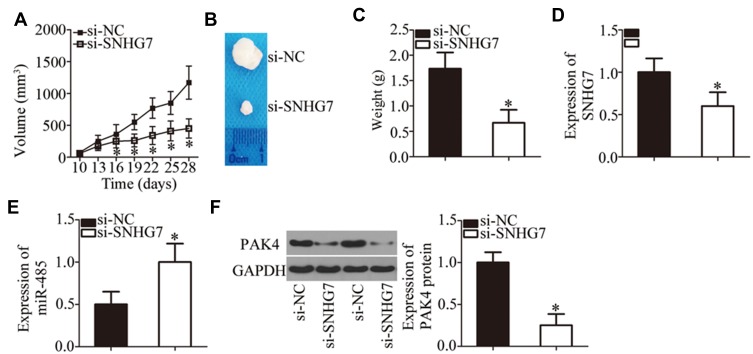
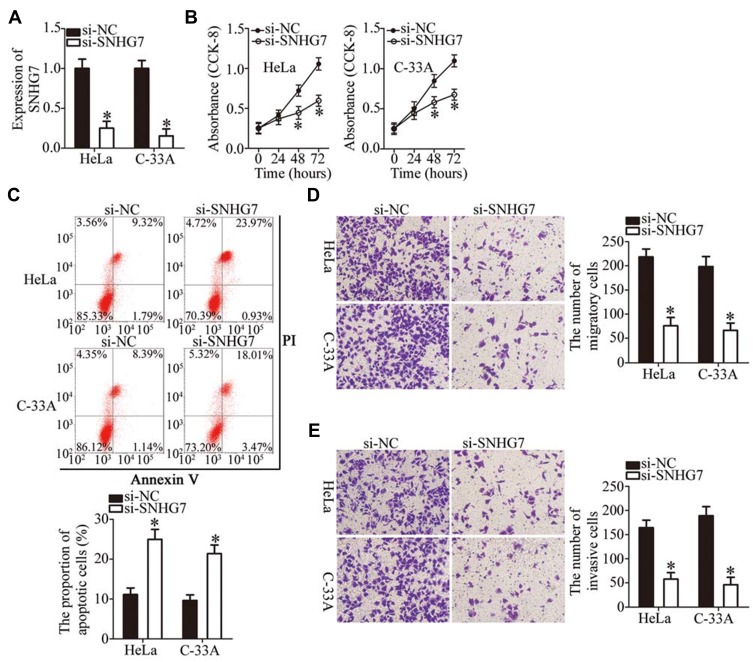
Reverse-transcription quantitative PCR was performed to measure expression in cervical cancer. A Cell Counting Kit-8 assay, flow-cytometric analysis, cell migration and invasion assays, and a tumor xenograft experiment were conducted to respectively determine the effects of on cervical cancer cell proliferation, apoptosis, migration, and invasion in vitro and tumor growth in vivo.
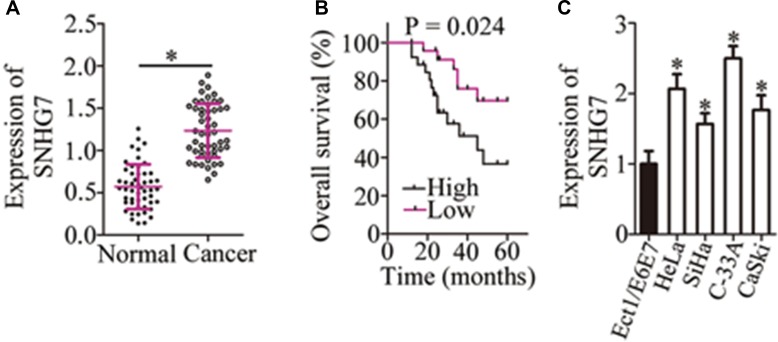
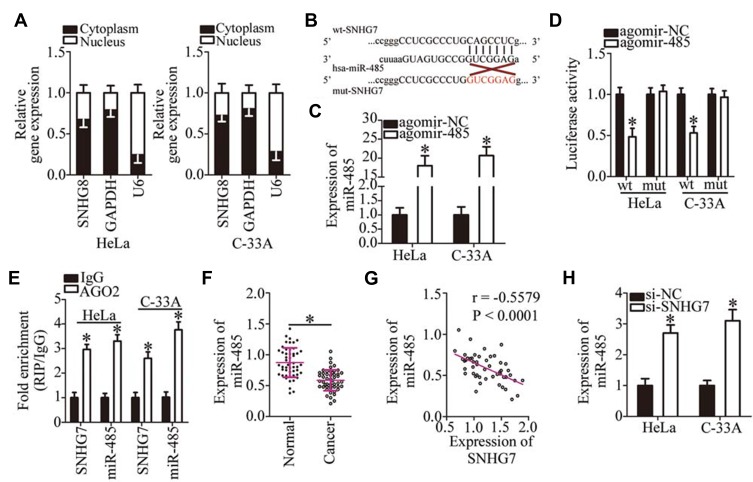
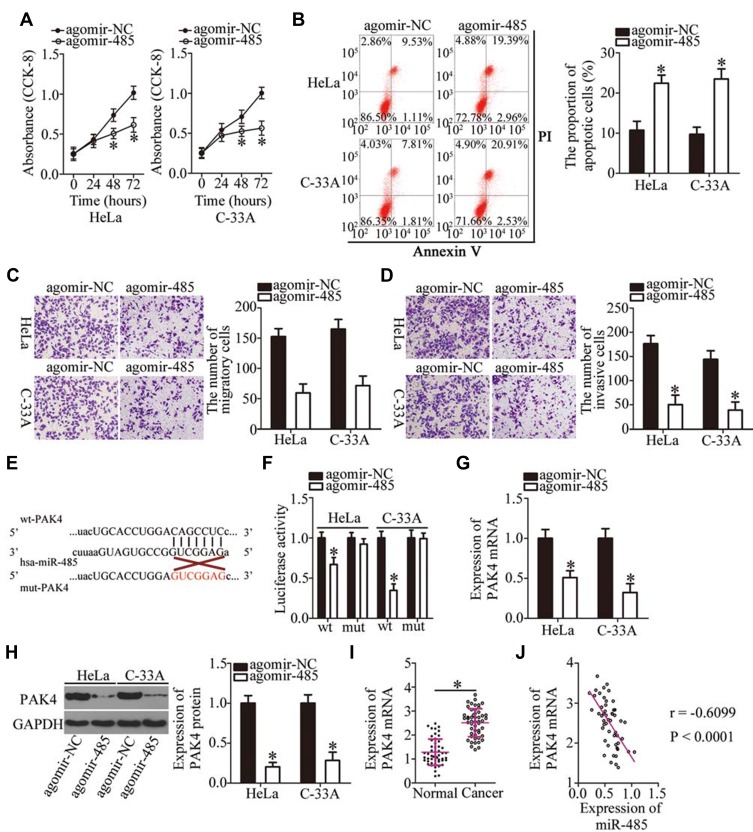
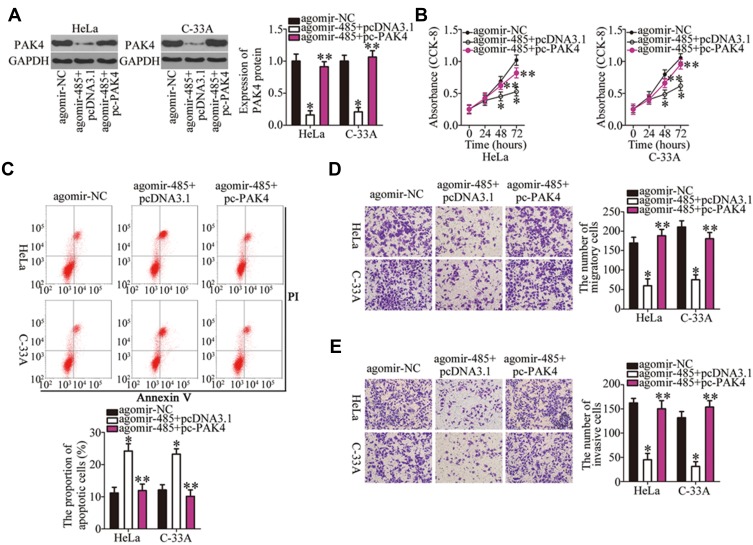
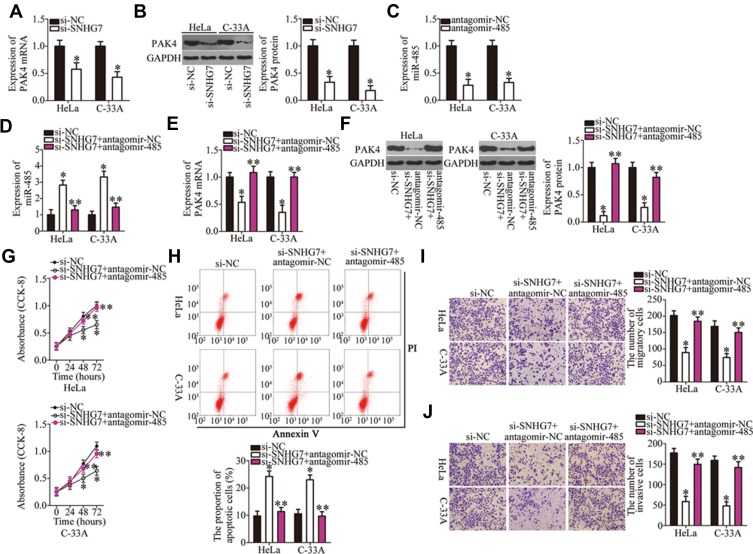
was found to be markedly upregulated in cervical cancer tissues and cell lines. Higher expression significantly correlated with FIGO stage, lymph node metastasis, the depth of cervical invasion, and shorter overall survival in patients with cervical cancer. Functional experiments indicated that a knockdown attenuated proliferation, migration, and invasiveness and promoted apoptosis of cervical cancer cells in vitro. The knockdown also slowed tumor growth in vivo. Further investigation showed that acts as a competing endogenous RNA for microRNA-485 (miR-485) in cervical cancer cells, and the inhibitory actions of the knockdown on the malignant phenotype were reversed by miR-485 inhibition. P21-activated kinase 4 () was identified as a direct target gene of miR-485 in cervical cancer, and PAK4 expression was promoted by .
functions as an oncogenic RNA in cervical cancer, competitively binds to miR-485, and thereby upregulates PAK4. This -miR-485-PAK4 regulatory network may provide insights into the pathogenesis of cervical cancer, and can help in the identification of novel diagnostic and therapeutic approaches for cervical cancer.
一种名为小核仁RNA宿主基因7()的长链非编码RNA是多种人类癌症类型生物学过程的关键调节因子。在本研究中,我们旨在确定在宫颈癌中的表达状态,弄清楚在宫颈癌细胞中的具体作用,并确定在宫颈癌中发挥作用的机制。
采用逆转录定量PCR检测宫颈癌中的表达。进行细胞计数试剂盒-8检测、流式细胞术分析、细胞迁移和侵袭检测以及肿瘤异种移植实验,分别确定对宫颈癌细胞增殖、凋亡、迁移和侵袭的体外影响以及对体内肿瘤生长的影响。
发现在宫颈癌组织和细胞系中明显上调。较高的表达与国际妇产科联盟(FIGO)分期、淋巴结转移、宫颈浸润深度显著相关,且与宫颈癌患者较短的总生存期相关。功能实验表明,敲低可减弱宫颈癌细胞的增殖、迁移和侵袭能力,并促进其体外凋亡。敲低也减缓了体内肿瘤的生长。进一步研究表明,在宫颈癌细胞中作为微小RNA-485(miR-485)的竞争性内源RNA发挥作用,抑制miR-485可逆转敲低对恶性表型的抑制作用。p21活化激酶4()被确定为宫颈癌中miR-485的直接靶基因,PAK4的表达受促进。
在宫颈癌中作为致癌RNA发挥作用,竞争性结合miR-485,从而上调PAK4。这个-miR-485-PAK4调控网络可能为宫颈癌的发病机制提供见解,并有助于确定宫颈癌新的诊断和治疗方法。