Bou Jawde Samer, Takahashi Ayuko, Bates Jason H T, Suki Béla
Biomedical Engineering, Boston University, Boston, MA, United States.
Department of Medicine, Larner College of Medicine, University of Vermont, Burlington, VT, United States.
Front Physiol. 2020 Feb 25;11:121. doi: 10.3389/fphys.2020.00121. eCollection 2020.
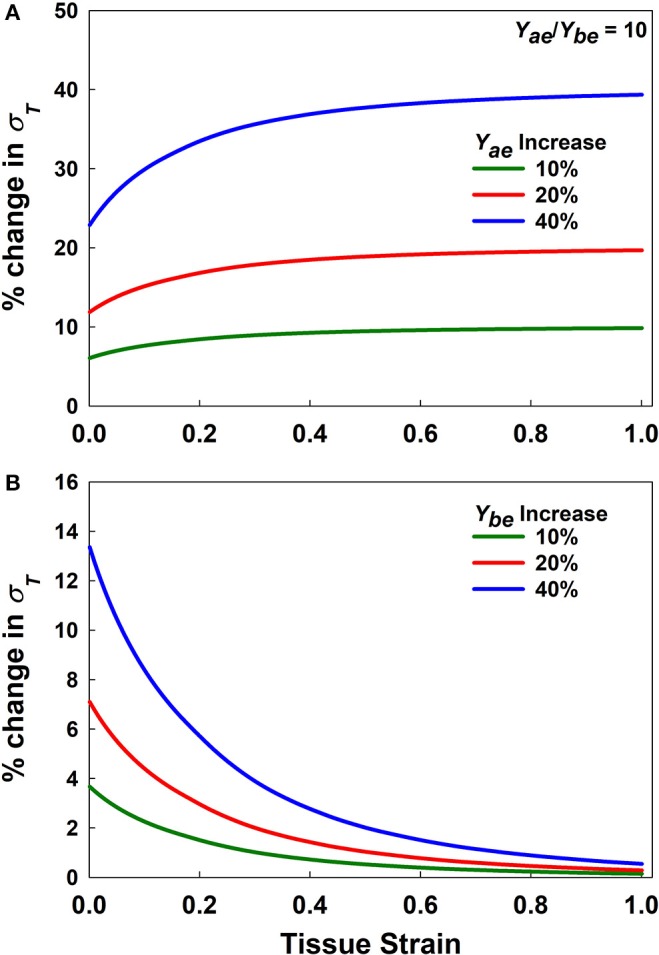
The non-linear stress-strain behavior of uniaxially-stretched lung parenchyma is thought to be an emergent phenomenon arising from the ensemble behavior of its microscopic constituents. Such behavior includes the alignment and elongation of randomly oriented alveolar walls with initially flaccid fibers in the direction of strain. To account for the link between microscopic wall behavior and the macroscopic stress-strain curve, we developed an analytical model that represents both alignment and elongation of alveolar walls during uniaxial stretching. The model includes the kinetics and mechanical behavior of randomly oriented elastic alveolar walls that have a bending stiffness at their intersections. The alignment and stretch of the walls following incremental stretch of the tissue were determined based on energy minimization, and the total stress was obtained by differentiating the total energy density with respect to strain. The stress-strain curves predicted by the model were comparable to curves generated by a previously published numerical alveolar network model. The model was also fit to experimentally measured stress-strain curves in parenchymal strips obtained from mice with decreased lung collagen content, and from young and aged mice. This yielded estimates for the elastic modulus of an alveolar wall, which increased with age from 4.4 to 5.9 kPa ( = 0.043), and for the elastic modulus of fibers within the wall, which increased with age from 311 to 620 kPa ( = 0.001). This demonstrates the possibility of estimating alveolar wall mechanical properties in biological soft tissue from its macroscopic behavior given appropriate assumptions about tissue structure.
单轴拉伸肺实质的非线性应力-应变行为被认为是由其微观成分的整体行为产生的一种涌现现象。这种行为包括随机取向的肺泡壁与初始松弛的纤维在应变方向上的排列和伸长。为了解释微观壁行为与宏观应力-应变曲线之间的联系,我们开发了一个分析模型,该模型表示单轴拉伸过程中肺泡壁的排列和伸长。该模型包括随机取向的弹性肺泡壁在其交叉处具有弯曲刚度的动力学和力学行为。基于能量最小化确定组织增量拉伸后壁的排列和拉伸,并通过对总能量密度关于应变求导获得总应力。该模型预测的应力-应变曲线与先前发表的数值肺泡网络模型生成的曲线相当。该模型还拟合了从肺胶原含量降低的小鼠以及年轻和老年小鼠获得的实质条带的实验测量应力-应变曲线。这得出了肺泡壁弹性模量的估计值,其随年龄从4.4增加到5.9 kPa( = 0.043),以及壁内纤维弹性模量的估计值,其随年龄从311增加到620 kPa( = 0.001)。这证明了在对组织结构做出适当假设的情况下,从生物软组织的宏观行为估计肺泡壁力学性能的可能性。