Edward Bartlett Chair, School of Chemical Engineering, Oklahoma State University, 420 Engineering North, Stillwater, OK, 74078, USA.
Stem Cell Res Ther. 2022 Sep 7;13(1):464. doi: 10.1186/s13287-022-03134-1.
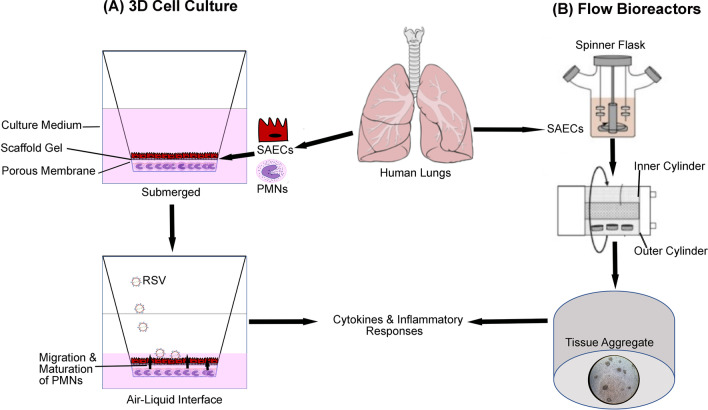
Small airway infections caused by respiratory viruses are some of the most prevalent causes of illness and death. With the recent worldwide pandemic due to the severe acute respiratory syndrome coronavirus 2 (SARS-CoV-2), there is currently a push in developing models to better understand respiratory diseases. Recent advancements have made it possible to create three-dimensional (3D) tissue-engineered models of different organs. The 3D environment is crucial to study physiological, pathophysiological, and immunomodulatory responses against different respiratory conditions. A 3D human tissue-engineered lung model that exhibits a normal immunological response against infectious agents could elucidate viral and host determinants. To create 3D small airway lung models in vitro, resident epithelial cells at the air-liquid interface are co-cultured with fibroblasts, myeloid cells, and endothelial cells. The air-liquid interface is a key culture condition to develop and differentiate airway epithelial cells in vitro. Primary human epithelial and myeloid cells are considered the best 3D model for studying viral immune responses including migration, differentiation, and the release of cytokines. Future studies may focus on utilizing bioreactors to scale up the production of 3D human tissue-engineered lung models. This review outlines the use of various cell types, scaffolds, and culture conditions for creating 3D human tissue-engineered lung models. Further, several models used to study immune responses against respiratory viruses, such as the respiratory syncytial virus, are analyzed, showing how the microenvironment aids in understanding immune responses elicited after viral infections.
呼吸道病毒引起的小气道感染是导致疾病和死亡的最常见原因之一。由于严重急性呼吸系统综合征冠状病毒 2 (SARS-CoV-2) 引发的全球大流行,目前正在大力开发模型以更好地了解呼吸道疾病。最近的进展使得创建不同器官的三维(3D)组织工程模型成为可能。3D 环境对于研究针对不同呼吸道疾病的生理、病理生理和免疫调节反应至关重要。一个能够对感染因子表现出正常免疫反应的 3D 人组织工程肺模型可以阐明病毒和宿主的决定因素。为了在体外创建 3D 小气道肺模型,在气液界面处共培养常驻上皮细胞与成纤维细胞、髓样细胞和内皮细胞。气液界面是体外开发和分化气道上皮细胞的关键培养条件。原代人上皮细胞和髓样细胞被认为是研究病毒免疫反应的最佳 3D 模型,包括迁移、分化和细胞因子的释放。未来的研究可能集中在利用生物反应器来扩大 3D 人组织工程肺模型的生产。本文综述了使用各种细胞类型、支架和培养条件来创建 3D 人组织工程肺模型的情况。此外,还分析了几种用于研究针对呼吸道病毒的免疫反应的模型,例如呼吸道合胞病毒,展示了微环境如何有助于理解病毒感染后引发的免疫反应。