Endocrinology Department, Hospital de Pediatría "Prof. Dr. Juan P. Garrahan", Buenos Aires, Argentina.
Research Institute Garrahan-CONICET, Hospital de Pediatría "Prof. Dr. Juan P. Garrahan", Buenos Aires, Argentina.
Front Endocrinol (Lausanne). 2020 Feb 25;11:72. doi: 10.3389/fendo.2020.00072. eCollection 2020.
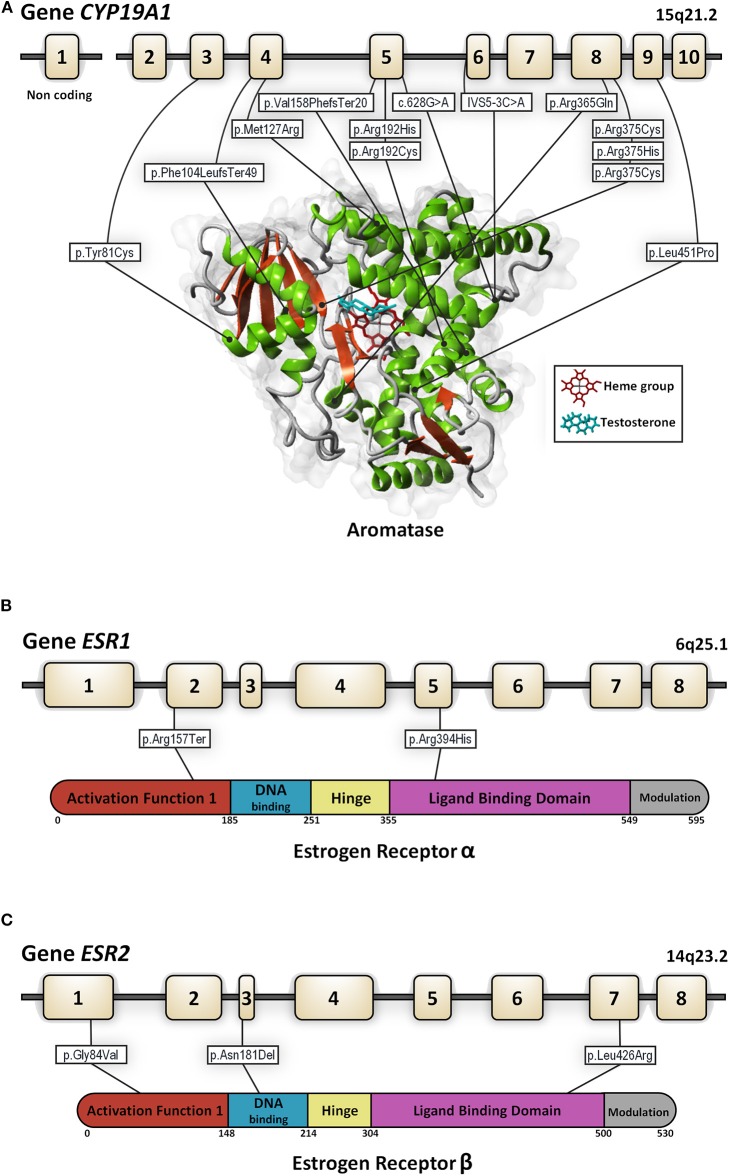
Several reports in humans as well as transgenic mouse models have shown that estrogens play an important role in male reproduction and fertility. Estrogen receptor alpha (ERα) and beta (ERβ) are expressed in different male tissues including the brain. The estradiol-binding protein GPER1 also mediates estrogen action in target tissues. In human testes a minimal ERα expression during prepuberty along with a marked pubertal up-regulation in germ cells has been reported. ERβ expression was detected mostly in spermatogonia, primary spermatocytes, and immature spermatids. In Sertoli cells ERβ expression increases with age. The aromatase enzyme (cP450arom), which converts androgens to estrogens, is widely expressed in human tissues (including gonads and hypothalamus), even during fetal life, suggesting that estrogens are also involved in human fetal physiology. Moreover, cP450arom is expressed in the early postnatal testicular Leydig cells and spermatogonia. Even though the aromatase complex is required for estrogen synthesis, its biological relevance is also related to the regulation of the balance between androgens and estrogens in different tissues. Knockout mouse models of aromatase (ArKO) and estrogen receptors (ERKOα, ERKOβ, and ERKOαβ) provide an important tool to study the effects of estrogens on the male reproductive physiology including the gonadal axis. High basal serum FSH levels were reported in adult aromatase-deficient men, suggesting that estrogens are involved in the negative regulatory gonadotropin feedback. However, normal serum gonadotropin levels were observed in an aromatase-deficient boy, suggesting a maturational pattern role of estrogen in the regulation of gonadotropin secretion. Nevertheless, the role of estrogens in primate testis development and function is controversial and poorly understood. This review addresses the role of estrogens in gonadotropin secretion and testicular physiology in male humans especially during childhood and puberty.
已有多项人体和转基因小鼠模型的报告表明,雌激素在男性生殖和生育中起着重要作用。雌激素受体 α(ERα)和β(ERβ)在包括大脑在内的不同男性组织中表达。雌激素结合蛋白 GPER1 也介导了靶组织中的雌激素作用。在人类睾丸中,据报道在青春期前有最低限度的 ERα 表达,而在生殖细胞中则有明显的青春期上调。ERβ表达主要在精原细胞、初级精母细胞和未成熟的精子中检测到。在支持细胞中,ERβ的表达随着年龄的增长而增加。芳香化酶(cP450arom)将雄激素转化为雌激素,广泛表达于人体组织(包括性腺和下丘脑),甚至在胎儿期也有表达,这表明雌激素也参与了人类胎儿的生理过程。此外,cP450arom 在出生后睾丸 Leydig 细胞和精原细胞中表达。尽管芳香酶复合物是雌激素合成所必需的,但它的生物学相关性也与不同组织中雄激素和雌激素之间的平衡调节有关。芳香酶(ArKO)和雌激素受体(ERKOα、ERKOβ 和 ERKOαβ)的基因敲除小鼠模型为研究雌激素对男性生殖生理学的影响提供了重要工具,包括性腺轴。成年芳香酶缺乏症男性的基础血清 FSH 水平较高,表明雌激素参与了负反馈调节促性腺激素。然而,在芳香酶缺乏症男孩中观察到正常的血清促性腺激素水平,这表明雌激素在调节促性腺激素分泌方面具有成熟模式的作用。然而,雌激素在灵长类动物睾丸发育和功能中的作用仍存在争议,且了解甚少。本文综述了雌激素在人类男性,特别是在儿童和青春期期间,对促性腺激素分泌和睾丸生理学的作用。