Li Qiang, Dong Heng, Yang Guangwen, Song Yuxian, Mou Yongbin, Ni Yanhong
Central Laboratory, Nanjing Stomatological Hospital, Medical School of Nanjing University, Nanjing, China.
Department of Oral Implantology, Nanjing Stomatological Hospital, Medical School of Nanjing University, Nanjing, China.
Front Oncol. 2020 Feb 25;10:212. doi: 10.3389/fonc.2020.00212. eCollection 2020.
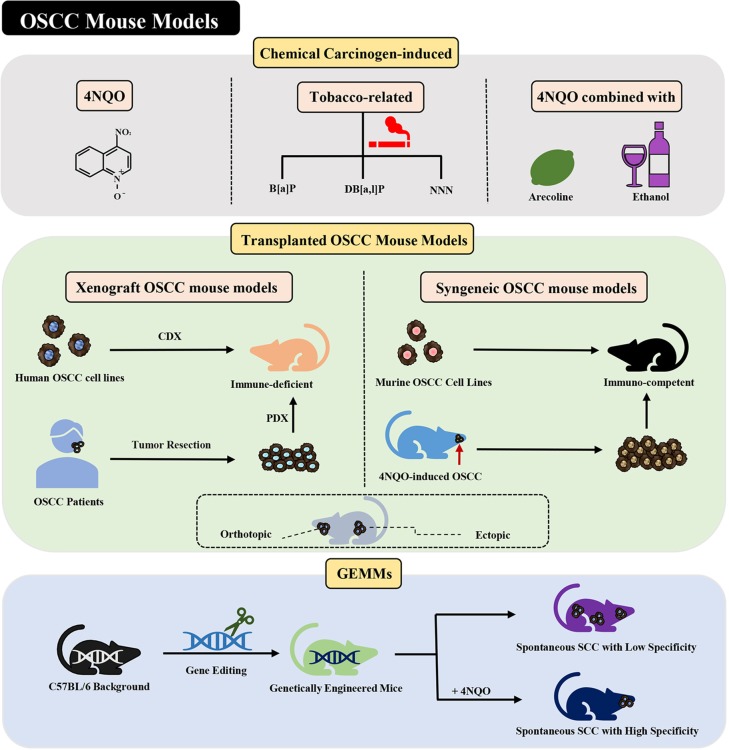
Preclinical animal models of oral squamous cell carcinoma (OSCC) have been extensively studied in recent years. Investigating the pathogenesis and potential therapeutic strategies of OSCC is required to further progress in this field, and a suitable research animal model that reflects the intricacies of cancer biology is crucial. Of the animal models established for the study of cancers, mouse tumor-bearing models are among the most popular and widely deployed for their high fertility, low cost, and molecular and physiological similarity to humans, as well as the ease of rearing experimental mice. Currently, the different methods of establishing OSCC mouse models can be divided into three categories: chemical carcinogen-induced, transplanted and genetically engineered mouse models. Each of these methods has unique advantages and limitations, and the appropriate application of these techniques in OSCC research deserves our attention. Therefore, this review comprehensively investigates and summarizes the tumorigenesis mechanisms, characteristics, establishment methods, and current applications of OSCC mouse models in published papers. The objective of this review is to provide foundations and considerations for choosing suitable model establishment methods to study the relevant pathogenesis, early diagnosis, and clinical treatment of OSCC.
近年来,口腔鳞状细胞癌(OSCC)的临床前动物模型得到了广泛研究。为推动该领域的进一步发展,有必要对OSCC的发病机制和潜在治疗策略进行研究,而一个能反映癌症生物学复杂性的合适研究动物模型至关重要。在为癌症研究建立的动物模型中,小鼠荷瘤模型因其高繁殖力、低成本、与人类的分子和生理相似性以及易于饲养实验小鼠等特点,成为最受欢迎且应用广泛的模型之一。目前,建立OSCC小鼠模型的不同方法可分为三类:化学致癌物诱导、移植和基因工程小鼠模型。这些方法各有独特的优点和局限性,如何在OSCC研究中恰当应用这些技术值得我们关注。因此,本综述全面调查并总结了已发表论文中OSCC小鼠模型的肿瘤发生机制、特点、建立方法及当前应用。本综述的目的是为选择合适的模型建立方法以研究OSCC的相关发病机制、早期诊断和临床治疗提供依据和参考。