Lipner Ettie M, O'Dell Katelyn, Brey Steven J, Ford Bonne, Pierce Jeffrey R, Fischer Emily V, Crooks James L
Department of Biomedical Research National Jewish Health Denver Colorado USA.
Department of Epidemiology Colorado School of Public Health Aurora Colorado USA.
Geohealth. 2019 Jun 3;3(6):146-159. doi: 10.1029/2018GH000142. eCollection 2019 Jun.
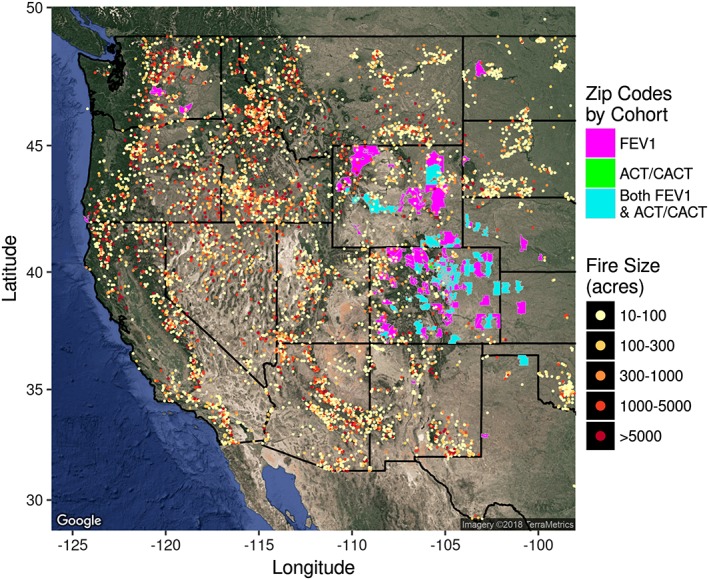
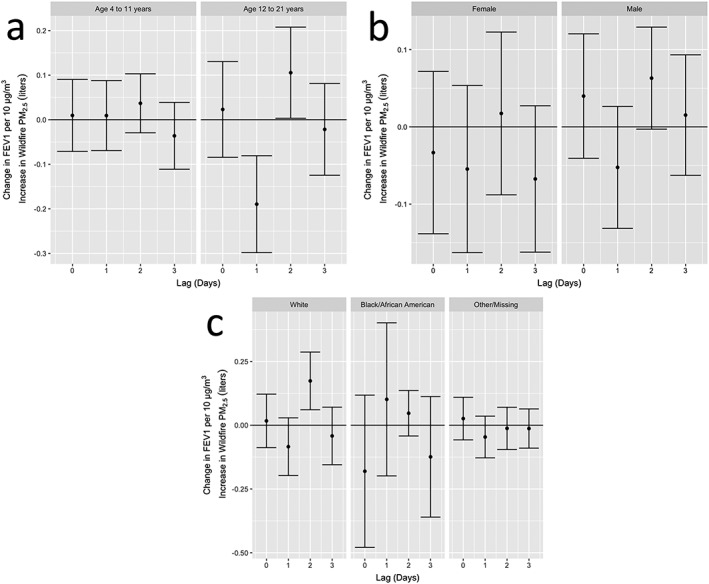
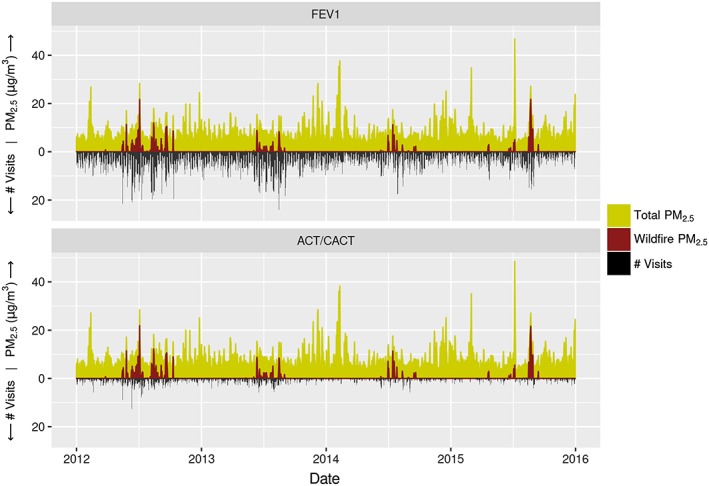
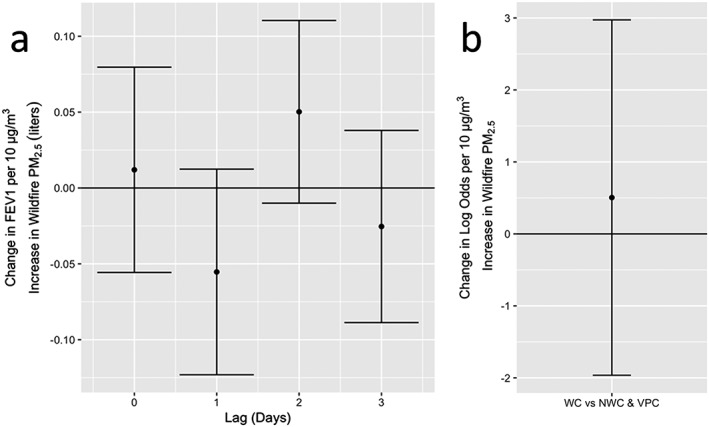
Wildfires are a growing threat in the United States. At a population level, exposure to ambient wildfire smoke is known to be associated with severe asthma outcomes such as hospitalizations. However, little work has been done on subacute clinical asthma outcomes, especially in sensitive populations. This study retrospectively investigated associations between ambient wildfire smoke exposure and measures of lung function and asthma control, Forced Expiratory Volume in 1 Second (FEV1) and the Asthma Control Test (ACT) and Children's Asthma Control Test (CACT) test scores, during nonurgent clinic visits. The study population consisted of pediatric asthma patients (ages 4-21; = 1,404 for FEV1 and = 395 for ACT/CACT) at National Jewish Health, a respiratory referral hospital in Denver, Colorado, and therefore represents a more severe asthma phenotype than the general pediatric asthma population. Wildfire smoke-related PM at patients' residential ZIP codes was characterized using satellite-derived smoke polygons from NOAA's Hazard Mapping System combined with kriging of ground-based U.S. EPA monitors. Mixed effect models were used to estimate associations between clinical outcomes and smoke PM exposure, controlling for known risk factors and confounders. Among older children aged 12-21 we found that wildfire PM was associated with lower FEV1 the next day but higher FEV1 the day after. We found no associations between wildfire PM and FEV1 in younger children or between wildfire PM and asthma control measured by the ACT/CACT in all ages. We speculate that rescue medication usage by older children may decrease respiratory symptoms caused by wildfire smoke.
野火在美国构成的威胁日益增大。在人群层面,已知暴露于环境野火烟雾与严重哮喘后果(如住院治疗)有关。然而,关于亚急性临床哮喘后果的研究较少,尤其是在敏感人群中。本研究回顾性调查了在非紧急门诊就诊期间,环境野火烟雾暴露与肺功能指标、哮喘控制情况、一秒用力呼气量(FEV1)以及哮喘控制测试(ACT)和儿童哮喘控制测试(CACT)分数之间的关联。研究人群包括科罗拉多州丹佛市一家呼吸专科医院——国家犹太健康中心的儿科哮喘患者(年龄4 - 21岁;FEV1研究对象为1404人,ACT/CACT研究对象为395人),因此代表了比一般儿科哮喘人群更严重的哮喘表型。利用美国国家海洋和大气管理局(NOAA)灾害绘图系统的卫星衍生烟雾多边形数据,并结合美国环境保护局(EPA)地面监测站的克里金插值法,对患者居住邮政编码区域内与野火烟雾相关的颗粒物进行了特征分析。采用混合效应模型来估计临床结局与烟雾颗粒物暴露之间的关联,并对已知风险因素和混杂因素进行了控制。在12 - 21岁的大龄儿童中,我们发现野火颗粒物与次日较低的FEV1相关,但与后天较高的FEV1相关。在年幼儿童中,我们未发现野火颗粒物与FEV1之间存在关联,在所有年龄段中,也未发现野火颗粒物与通过ACT/CACT衡量的哮喘控制之间存在关联。我们推测大龄儿童使用急救药物可能会减轻野火烟雾引起的呼吸道症状。