Nyenhuis Sharmilee M, Balbim Guilherme Moraes, Ma Jun, Marquez David X, Wilbur JoEllen, Sharp Lisa K, Kitsiou Spyros
Department of Medicine, University of Illinois at Chicago, Chicago, IL, United States.
Department of Kinesiology and Nutrition, University of Illinois at Chicago, Chicago, IL, United States.
JMIR Form Res. 2020 Mar 11;4(3):e13900. doi: 10.2196/13900.
Physical inactivity is associated with worse asthma outcomes. African American women experience disparities in both physical inactivity and asthma relative to their white counterparts. We conducted a modified evidence-based walking intervention supplemented with mobile health (mHealth) technologies to increase physical activity (PA).
This study aimed to assess the preliminary feasibility of a 7-week walking intervention modified for African American women with asthma.
African American women with suboptimally controlled asthma were identified from a health system serving low-income minorities. At a baseline data collection visit, participants performed spirometry and incremental shuttle walk test, completed questionnaires, and were given an accelerometer to wear for 1 week. The intervention comprised an informational study manual and 3 in-person group sessions over 7 weeks, led by a nurse interventionist, in a community setting. The supplemental mHealth tools included a wearable activity tracker device (Fitbit Charge HR) and one-way text messages related to PA and asthma 3 times per week. A secure Web-based research platform, iCardia, was used to obtain Fitbit data in real time (wear time, moderate-to-vigorous physical activity [MVPA] and sedentary time) and send text messages. The feasibility of the intervention was assessed in the domains of recruitment capability, acceptability (adherence, retention, engagement, text messaging, acceptability, complaints, and concerns), and preliminary outcome effects on PA behavior (change in steps, duration, and intensity).
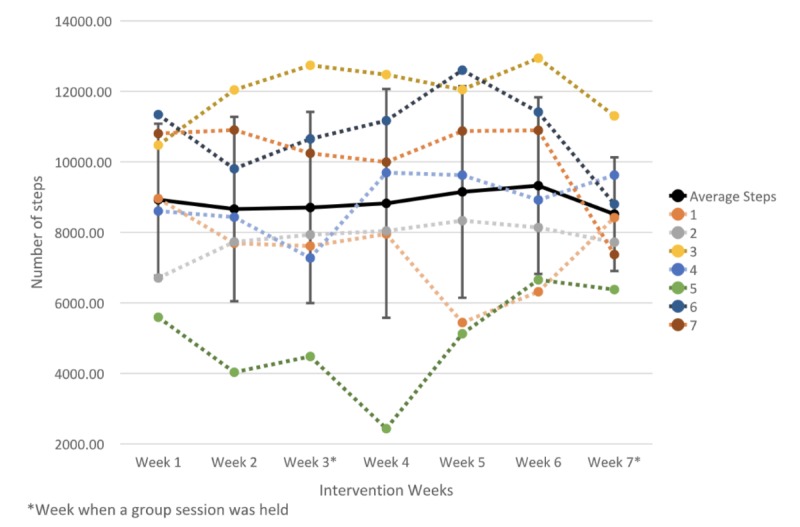
We approached 22 women, of whom 10 were eligible; 7 consented, enrolled and completed the study. Group session attendance was 71% (5/7), 86% (6/7), and 86% (6/7), respectively, across the 3 sessions. All participants completed evaluations at each group session. The women reported being satisfied or very satisfied with the program (eg, location, time, and materials). None of them had concerns about using, charging, or syncing the Fitbit device and app. Participants wore their Fitbit device for at least 10 hours per day in 44 out of the 49 intervention days. There was an increase in Fitbit-measured MVPA from week 1 (19 min/week, SD 14 min/week) to the last week of intervention (22 min/week, SD 12 min/week; Cohen d=0.24, 95% CI 0.1 to 6.4). A slight decrease in step count was observed from week 1 (8926 steps/day, SD 2156 steps/day) to the last week of intervention (8517 steps/day, SD 1612 steps/day; Cohen d=-0.21, 95% CI -876.9 to 58.9).
The initial feasibility results of a 7-week community-based walking intervention tailored for African American women with asthma and supplemented with mHealth tools are promising. Modifications to recruitment, retention, and the intervention itself are needed. These findings support the need to conduct a further modified pilot trial to collect additional data on feasibility and estimate the efficacy of the intervention on asthma and PA outcomes.
缺乏身体活动与哮喘的不良预后相关。非裔美国女性在缺乏身体活动和哮喘方面相对于白人女性存在差异。我们开展了一项经过改良的基于证据的步行干预,并辅以移动健康(mHealth)技术,以增加身体活动(PA)。
本研究旨在评估针对患有哮喘的非裔美国女性进行的为期7周的步行干预的初步可行性。
从一个服务低收入少数族裔的卫生系统中识别出哮喘控制不佳的非裔美国女性。在基线数据收集访视时,参与者进行肺活量测定和递增式往返步行测试,完成问卷调查,并佩戴加速度计1周。干预包括一本信息研究手册和在社区环境中由一名护士干预者主持的为期7周的3次面对面小组会议。补充的mHealth工具包括一个可穿戴活动追踪设备(Fitbit Charge HR)和每周3次与PA和哮喘相关的单向短信。一个安全的基于网络的研究平台iCardia用于实时获取Fitbit数据(佩戴时间、中度至剧烈身体活动[MVPA]和久坐时间)并发送短信。在招募能力、可接受性(依从性、留存率、参与度、短信、可接受性、投诉和担忧)以及对PA行为的初步结果影响(步数、持续时间和强度的变化)等方面评估干预的可行性。
我们接触了22名女性,其中10名符合条件;7名同意、入组并完成了研究。在3次会议中,小组会议的出席率分别为71%(5/7)、86%(6/7)和86%(6/7)。所有参与者在每次小组会议时都完成了评估。这些女性报告对该项目(如地点、时间和材料)感到满意或非常满意。她们中没有人对使用、充电或同步Fitbit设备及应用程序有担忧。在49个干预日中的44天里,参与者每天佩戴Fitbit设备至少10小时。从第1周(19分钟/周,标准差14分钟/周)到干预的最后一周,Fitbit测量的MVPA有所增加(22分钟/周,标准差12分钟/周;Cohen d = 0.24,95%置信区间0.1至6.4)。从第1周(8926步/天,标准差2156步/天)到干预的最后一周,步数略有下降(8517步/天,标准差1612步/天;Cohen d = -0.21,95%置信区间 -876.9至58.9)。
针对患有哮喘的非裔美国女性量身定制并辅以mHealth工具的为期7周的社区步行干预的初步可行性结果很有前景。需要对招募、留存和干预本身进行改进。这些发现支持有必要开展进一步改良的试点试验,以收集关于可行性的更多数据,并估计该干预对哮喘和PA结局的疗效。