Leon Christopher C, Gunnarsson Olle, de Oteyza Dimas G, Rosławska Anna, Merino Pablo, Grewal Abhishek, Kuhnke Klaus, Kern Klaus
Max-Planck-Institut für Festkörperforschung, D-70569 Stuttgart, Germany.
Donostia International Physics Center, E-20018 San Sebastián, Spain.
ACS Nano. 2020 Apr 28;14(4):4216-4223. doi: 10.1021/acsnano.9b09299. Epub 2020 Mar 18.
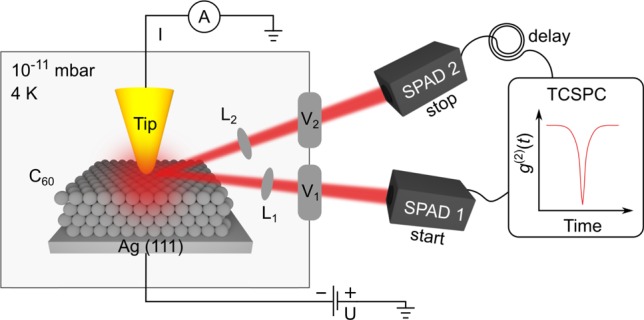
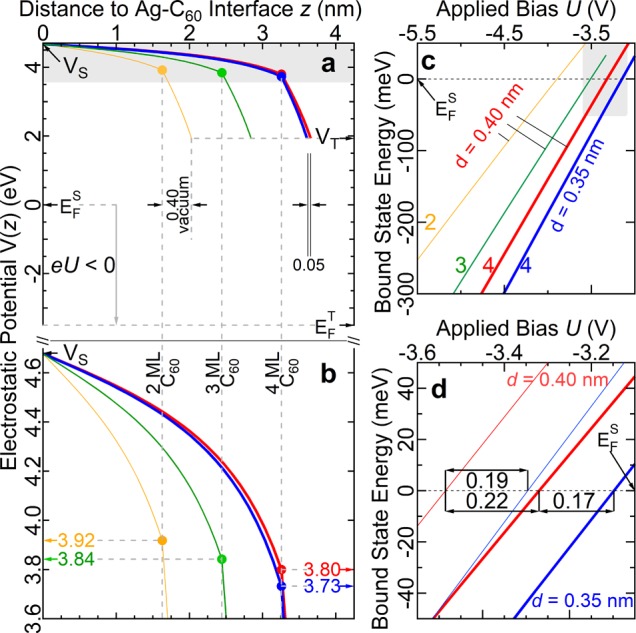
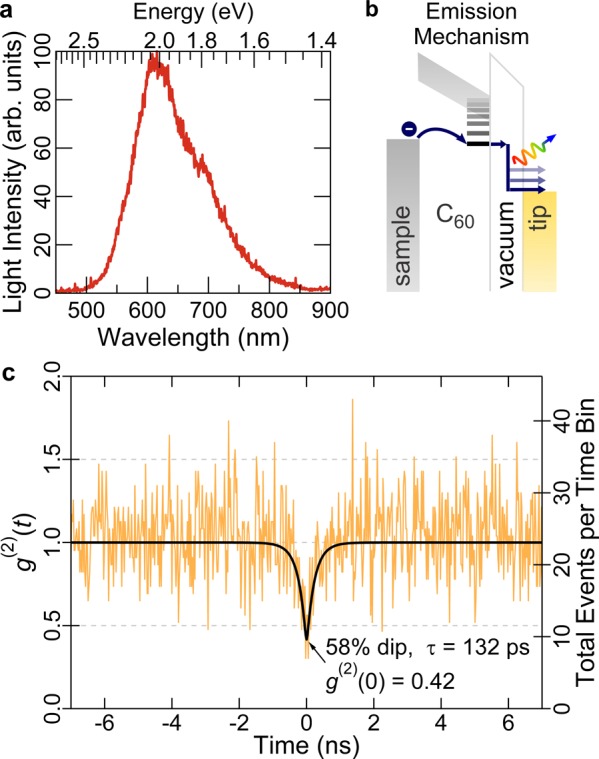
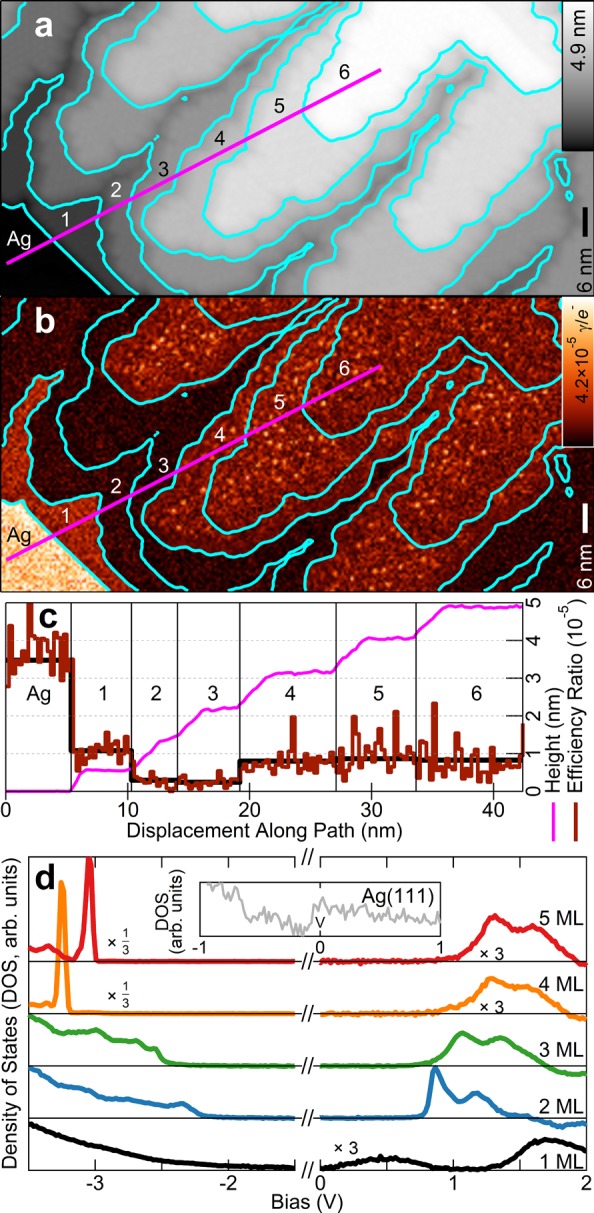
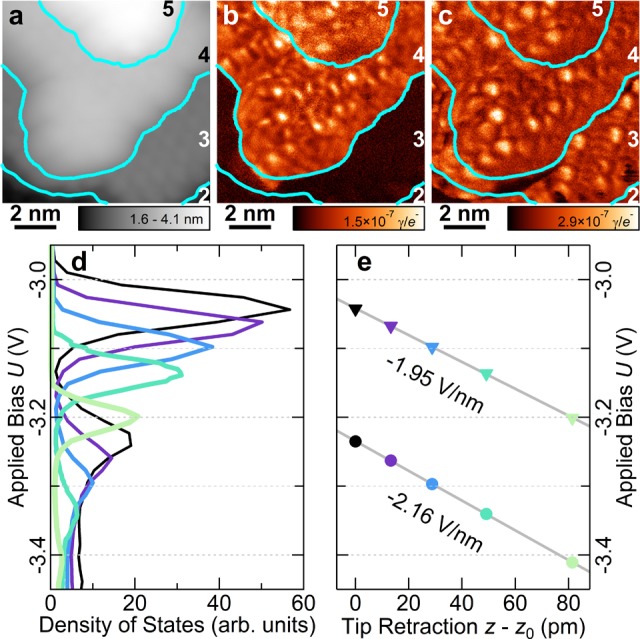
A hallmark of quantum control is the ability to manipulate quantum emission at the nanoscale. Through scanning tunneling microscopy-induced luminescence (STML), we are able to generate plasmonic light originating from inelastic tunneling processes that occur in the vacuum between a tip and a few-nanometer-thick molecular film of C deposited on Ag(111). Single photon emission, not of molecular excitonic origin, occurs with a 1/ recovery time of a tenth of a nanosecond or less, as shown through Hanbury Brown and Twiss photon intensity interferometry. Tight-binding calculations of the electronic structure for the combined tip and Ag-C system results in good agreement with experiment. The tunneling happens through electric-field-induced split-off states below the C LUMO band, which leads to a Coulomb blockade effect and single photon emission. The use of split-off states is shown to be a general technique that has special relevance for narrowband materials with a large bandgap.
量子控制的一个标志是能够在纳米尺度上操纵量子发射。通过扫描隧道显微镜诱导发光(STML),我们能够产生源自非弹性隧道过程的等离子体光,这些过程发生在尖端与沉积在Ag(111)上的几纳米厚的C分子膜之间的真空中。通过汉伯里·布朗和特威斯光子强度干涉测量法表明,单光子发射并非源于分子激子,其1/恢复时间为纳秒的十分之一或更短。对尖端与Ag-C系统组合的电子结构进行紧束缚计算,结果与实验吻合良好。隧道效应通过电场诱导的C LUMO能带以下的分裂态发生,这导致了库仑阻塞效应和单光子发射。分裂态的使用被证明是一种通用技术,对具有大带隙的窄带材料具有特殊意义。