Le Thu T K, Tran Thuy T B, Ho Huong T M, Vu An T L, McBryde Emma, Lopata Andreas L
Molecular Allergy Research Laboratory, College of Public Health, Medical and Veterinary Sciences, James Cook University, Townsville, Queensland, Australia.
Centre for Molecular Therapeutics, James Cook University, Townsville, Queensland, Australia.
World Allergy Organ J. 2020 Mar 5;13(3):100102. doi: 10.1016/j.waojou.2020.100102. eCollection 2020 Mar.
Food allergy (FA) is a serious, costly and growing health problem worldwide. FA occurs in both children and adults; however, there is a paucity of information on FA prevalence and its clinical features in the adult population, especially in Asia. We sought to assess the prevalence of FAs in Vietnamese adults and the distribution of offending food items among different regions throughout Vietnam.
A nationwide, cross-sectional, population-based survey was conducted among University students aged 16-50 years. We used a structured, anonymous questionnaire, which was modified from recently published FA epidemiologic studies and based on European Academy of Allergy and Clinical Immunology (EAACI) guidelines, to collect data on FA prevalence, clinical presentations, and implicated food groups. Statistical analysis was performed to generate the prevalence of self-reported and doctor-diagnosed FA and to examine the association of key environmental factors and FA incidence in this population.
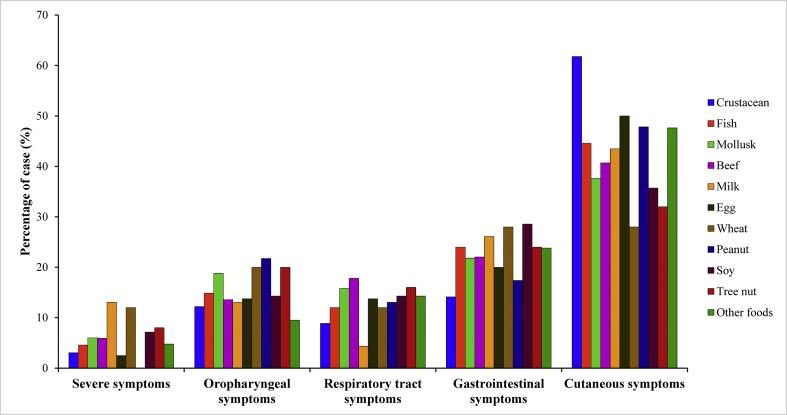
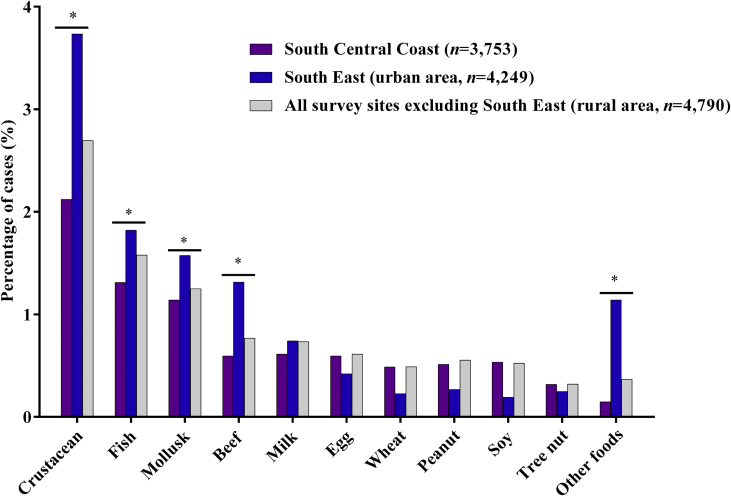
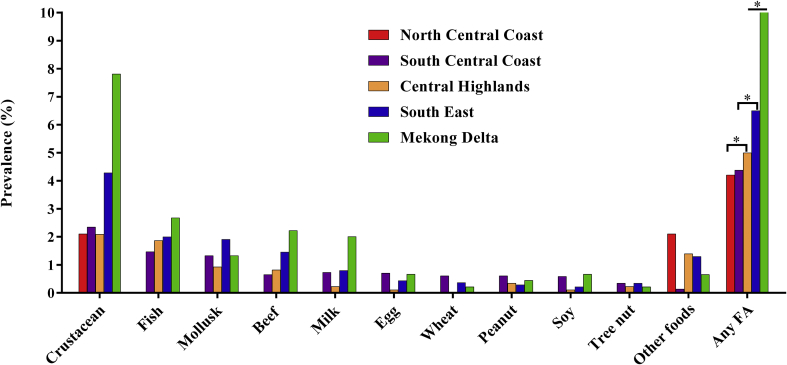
Of the 14,500 surveys distributed, a total of 9,039 responses were returned, resulting in a response rate of 62.4%. Among participants who reported food-induced adverse reactions, 48.0% have repeated reactions. 18.0% of the participants perceived FA symptoms, but less than half of them sought medical services for confirmation (37.9%). Stratifying for true FA symptoms, the prevalence of self-reported FA was 11.8% and of doctor-diagnosed FA, 4.6%. The most common doctor-diagnosed FA was to crustacean (3.0%; 95% CI, 2.6-3.3), followed by fish (1.6%; 95% CI, 1.3-1.8), mollusk (1.3%; 95% CI, 1.0-1.5) and beef (1.0%; 95% CI, 0.8-1.2). The prevalence of doctor-diagnosed FA differed among participants living in urban (6.5%) and rural regions (4.9%) ( < 0.001). Atopic family history was the strongest predictor for FA (odds ratio 8.0; 95% CI, 6.2-10.4).
Seafood allergy among adults is predominant in Vietnam, followed by beef, milk, and egg, while peanut, soy, and tree nut allergy are much less common. Populations in rural regions have considerably less FA; however, the protective environmental factors have yet to be identified.
食物过敏(FA)是一个严重、代价高昂且在全球范围内不断加剧的健康问题。儿童和成人都会发生食物过敏;然而,关于成人人群中食物过敏的患病率及其临床特征的信息匮乏,尤其是在亚洲。我们旨在评估越南成年人食物过敏的患病率以及越南不同地区引发过敏的食物种类分布情况。
对16至50岁的大学生进行了一项全国性的横断面基于人群的调查。我们使用了一份结构化的匿名问卷,该问卷是根据最近发表的食物过敏流行病学研究进行修改并基于欧洲变态反应和临床免疫学会(EAACI)指南制定的,用于收集有关食物过敏患病率、临床表现和相关食物组的数据。进行统计分析以得出自我报告和医生诊断的食物过敏患病率,并检验该人群中关键环境因素与食物过敏发生率之间的关联。
在分发的14500份调查问卷中,共收回9039份回复,回复率为62.4%。在报告有食物引起的不良反应的参与者中,48.0%有反复反应。18.0%的参与者察觉到食物过敏症状,但其中不到一半的人寻求医疗服务进行确诊(37.9%)。对真正的食物过敏症状进行分层分析,自我报告的食物过敏患病率为11.8%,医生诊断的食物过敏患病率为4.6%。医生诊断最常见的食物过敏是对甲壳类动物(3.0%;95%置信区间,2.6 - 3.3),其次是鱼类(1.6%;95%置信区间,1.3 - 1.8)、软体动物(1.3%;95%置信区间,1.0 - 1.5)和牛肉(1.0%;95%置信区间,0.8 - 1.2)。医生诊断的食物过敏患病率在城市(6.5%)和农村地区(4.9%)的参与者中存在差异(P < 0.001)。特应性家族史是食物过敏最强的预测因素(优势比8.0;95%置信区间,6.2 - 10.4)。
在越南,成人中海鲜过敏占主导地位,其次是牛肉、牛奶和鸡蛋过敏,而花生、大豆和坚果过敏则不太常见。农村地区的人群食物过敏情况要少得多;然而,尚未确定具有保护作用的环境因素。