Lee So Hee, Ban Ga Young, Jeong Kyunguk, Shin Yoo Seob, Park Hae Sim, Lee Sooyoung, Ye Young Min
Department of Allergy and Clinical Immunology, Ajou University School of Medicine, Suwon, Korea.
Department of Pediatrics, Ajou University School of Medicine, Suwon, Korea.
Allergy Asthma Immunol Res. 2017 Nov;9(6):534-539. doi: 10.4168/aair.2017.9.6.534.
Increasing in prevalence, food allergy (FA) is becoming an important public health concern. In Korean adults, however, clinical phenotypes and causes of FA have not been studied. We aimed to study common causative allergens and clinical manifestations of FA in Korean adults.
This study was conducted as a retrospective review of medical records for 95 patients (≥19 years old) diagnosed with FA from September 2014 to August 2015 at a single university hospital.
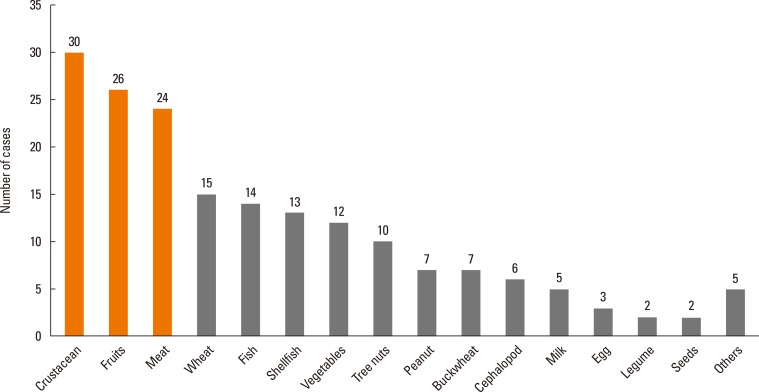
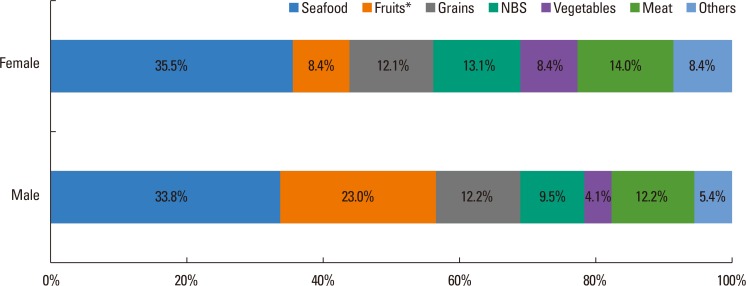
In the 95 patients, 181 FA events were recorded. The mean age of first onset of FA symptoms was 34.7±15.8 years. The most frequent causative food was seafood (34.8%); shrimp and crab allergies ranked highest, regardless of age and sex. Among all FA events, there were 47 (26.0%) cases of anaphylaxis and 26 (14.4%) cases of oral allergy syndrome (OAS). Seafood (51.1%) was the most frequent cause of anaphylaxis, followed by grains (14.9%). Most OAS cases were associated with fruits (95.7%). The frequency of fruit-induced FA was significantly higher in males than in females (23.0% vs 8.4%, P=0.011). While no cases of vegetables-induced FA were noted in younger individuals (19 to 30 years), vegetables accounted for 20.5% of FA symptoms in older subjects (≥51 years, P<0.001). Allergic rhinitis (44.2%) and drug allergy (20.0%) were major comorbidities associated with FA. Overall, 29 FA events had cofactors, of which 10 were combined with exercise.
The major causes of FA in Korean adults were crustacean, fruits, and grains. Interestingly, the clinical manifestations of FA and demographics varied according to type of food allergen.
食物过敏(FA)的患病率不断上升,正成为一个重要的公共卫生问题。然而,在韩国成年人中,FA的临床表型和病因尚未得到研究。我们旨在研究韩国成年人FA的常见致病过敏原和临床表现。
本研究对2014年9月至2015年8月在一家大学医院确诊为FA的95名患者(≥19岁)的病历进行回顾性分析。
在这95名患者中,共记录了181次FA事件。FA症状首次出现的平均年龄为34.7±15.8岁。最常见的致病食物是海鲜(34.8%);无论年龄和性别,虾和蟹过敏最为常见。在所有FA事件中,有47例(26.0%)发生过敏反应,26例(14.4%)发生口腔过敏综合征(OAS)。海鲜(51.1%)是过敏反应最常见的原因,其次是谷物(14.9%)。大多数OAS病例与水果有关(95.7%)。水果诱发的FA在男性中的发生率显著高于女性(23.0%对8.4%,P = 0.011)。在较年轻个体(19至30岁)中未发现蔬菜诱发FA的病例,但在老年受试者(≥51岁)中,蔬菜占FA症状的20.5%(P < 0.001)。过敏性鼻炎(44.2%)和药物过敏(20.0%)是与FA相关的主要合并症。总体而言,29次FA事件有辅助因素,其中10次与运动有关。
韩国成年人FA的主要病因是甲壳类动物、水果和谷物。有趣的是,FA的临床表现和人口统计学特征因食物过敏原类型而异。