Department of Ecology and Evolutionary Biology, Brown University, Providence, RI, United States of America.
Department of Mathematics, Florida State University, Tallahassee, FL, United States of America.
PLoS One. 2020 Mar 12;15(3):e0229837. doi: 10.1371/journal.pone.0229837. eCollection 2020.
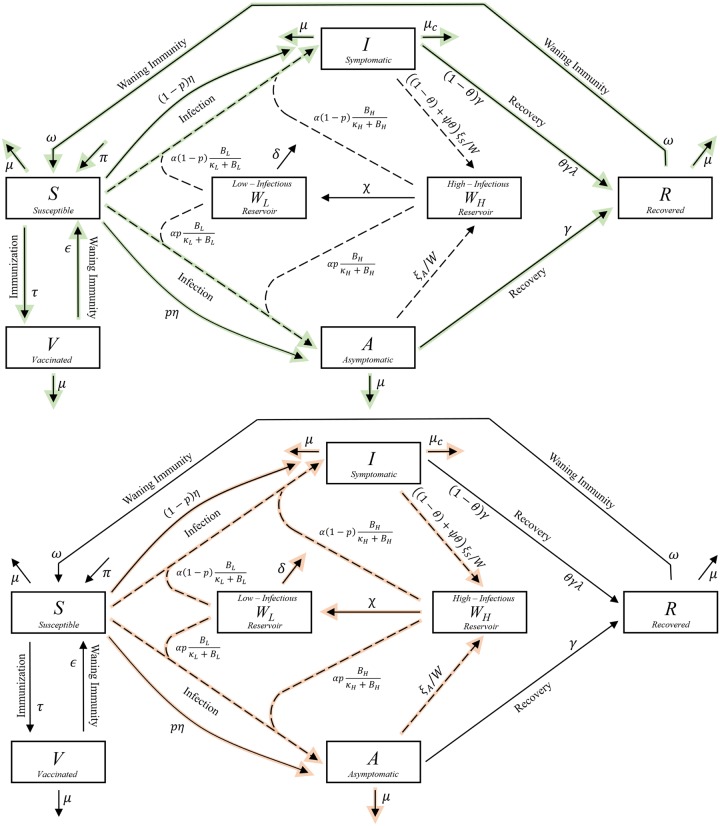
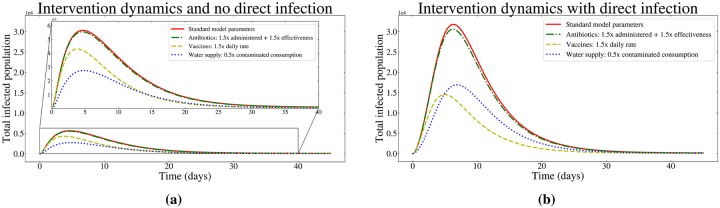
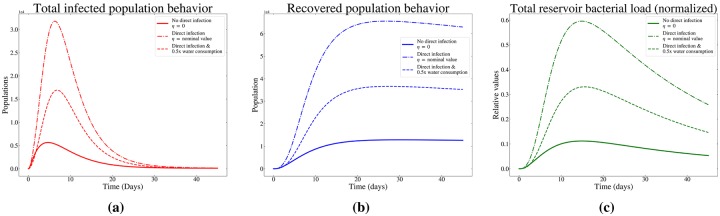
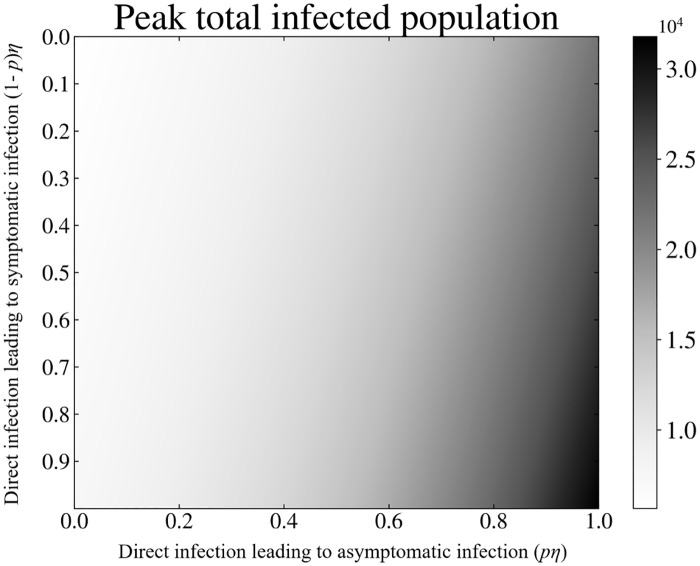
While several basic properties of cholera outbreaks are common to most settings-the pathophysiology of the disease, the waterborne nature of transmission, and others-recent findings suggest that transmission within households may play a larger role in cholera outbreaks than previously appreciated. Important features of cholera outbreaks have long been effectively modeled with mathematical and computational approaches, but little is known about how variation in direct transmission via households may influence epidemic dynamics. In this study, we construct a mathematical model of cholera that incorporates transmission within and between households. We observe that variation in the magnitude of household transmission changes multiple features of disease dynamics, including the severity and duration of outbreaks. Strikingly, we observe that household transmission influences the effectiveness of possible public health interventions (e.g. water treatment, antibiotics, vaccines). We find that vaccine interventions are more effective than water treatment or antibiotic administration when direct household transmission is present. Summarizing, we position these results within the landscape of existing models of cholera, and speculate on its implications for epidemiology and public health.
虽然霍乱爆发的一些基本特征在大多数情况下都是常见的——疾病的病理生理学、疾病的水传播性质等——但最近的研究结果表明,家庭内的传播可能在霍乱爆发中发挥比以前认识到的更大的作用。霍乱爆发的重要特征长期以来一直通过数学和计算方法有效地建模,但对于通过家庭直接传播的变化如何影响流行动力学知之甚少。在这项研究中,我们构建了一个包含家庭内和家庭间传播的霍乱数学模型。我们观察到,家庭传播规模的变化改变了疾病动力学的多个特征,包括疫情的严重程度和持续时间。引人注目的是,我们观察到家庭传播会影响可能的公共卫生干预措施(例如水处理、抗生素、疫苗)的效果。我们发现,当存在直接家庭传播时,疫苗干预措施比水处理或抗生素管理更有效。总之,我们将这些结果置于现有的霍乱模型景观中,并推测其对流行病学和公共卫生的影响。