Department of Ecology and Evolutionary Biology, Yale University, New Haven, CT, 06520, USA.
Public Health Modeling Unit, Yale School of Public Health, New Haven, CT, 06510, USA.
Bull Math Biol. 2024 Jun 14;86(8):88. doi: 10.1007/s11538-024-01313-0.
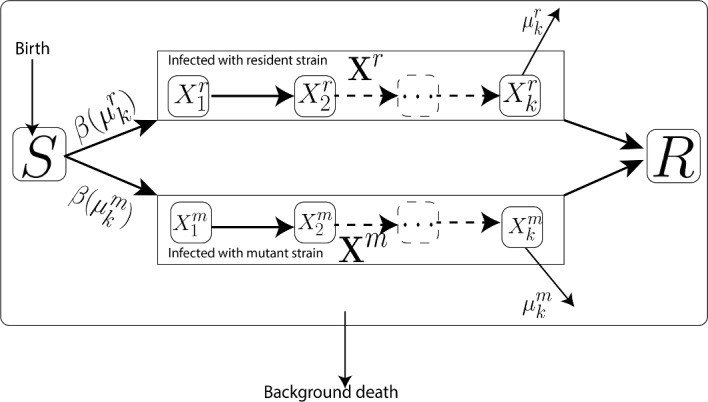
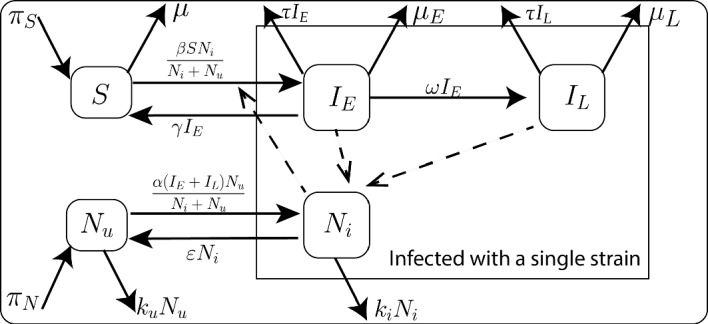
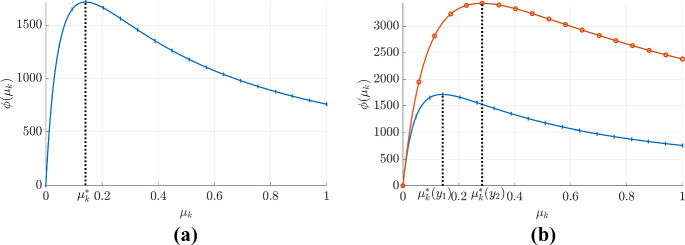
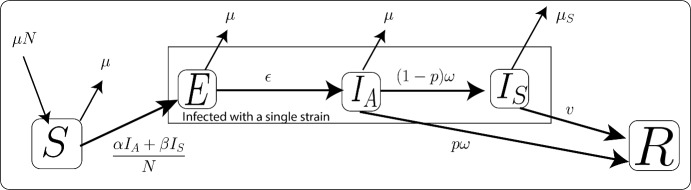
Models are often employed to integrate knowledge about epidemics across scales and simulate disease dynamics. While these approaches have played a central role in studying the mechanics underlying epidemics, we lack ways to reliably predict how the relationship between virulence (the harm to hosts caused by an infection) and transmission will evolve in certain virus-host contexts. In this study, we invoke evolutionary invasion analysis-a method used to identify the evolution of uninvadable strategies in dynamical systems-to examine how the virulence-transmission dichotomy can evolve in models of virus infections defined by different natural histories. We reveal peculiar patterns of virulence evolution between epidemics with different disease natural histories (SARS-CoV-2 and hepatitis C virus). We discuss the findings with regards to the public health implications of predicting virus evolution, and in broader theoretical canon involving virulence evolution in host-parasite systems.
模型通常被用来整合不同尺度的传染病知识,并模拟疾病动态。虽然这些方法在研究传染病的基本机制方面发挥了核心作用,但我们缺乏可靠的方法来预测在特定的病毒-宿主环境中,毒力(感染对宿主造成的伤害)和传播之间的关系将如何演变。在这项研究中,我们援引了进化入侵分析——一种用于识别动态系统中不可入侵策略进化的方法——来研究不同自然史定义的病毒感染模型中,毒力-传播二分法是如何进化的。我们揭示了具有不同疾病自然史的传染病(SARS-CoV-2 和丙型肝炎病毒)之间毒力进化的特殊模式。我们讨论了这些发现对预测病毒进化的公共卫生意义,以及涉及宿主-寄生虫系统中毒力进化的更广泛的理论规范。