Schermer Julie Aitken, Krammer Georg, Goffin Richard D, Biderman Michael D
Management and Organizational Studies, Faculty of Social Science, The University of Western Ontario, London, ON N6A 5C2, Canada.
Institute of Practical Education and Practitioner Research, University College of Teacher Education Styria, 8010 Graz, Austria.
J Intell. 2020 Mar 10;8(1):12. doi: 10.3390/jintelligence8010012.
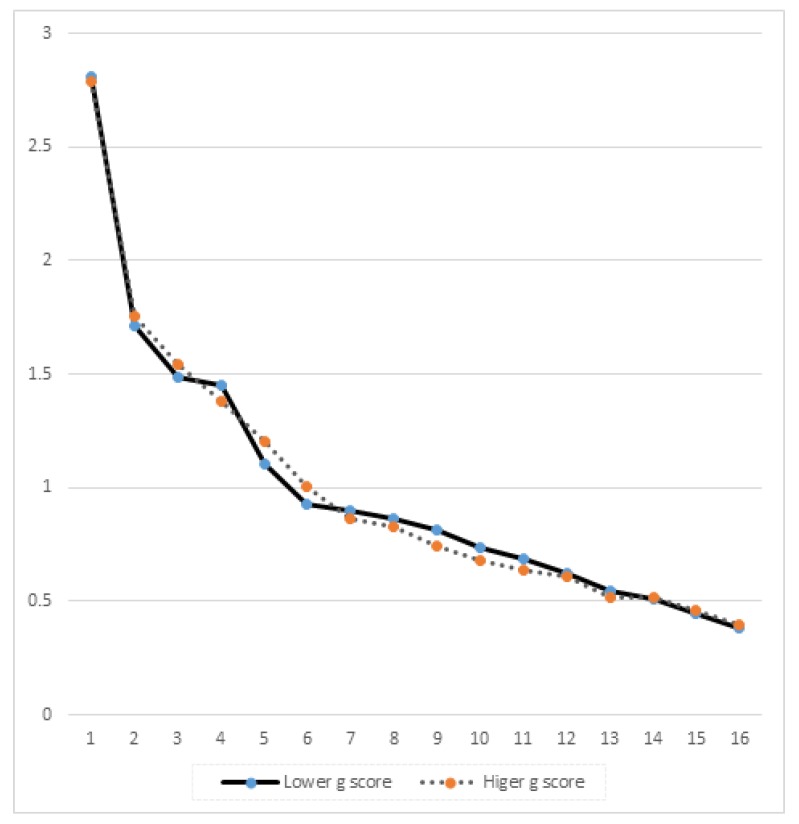
The differentiation of personality by intelligence hypothesis suggests that there will be greater individual differences in personality traits for those individuals who are more intelligent. Conversely, less intelligent individuals will be more similar to each other in their personality traits. The hypothesis was tested with a large sample of managerial job candidates who completed an omnibus personality measure with 16 scales and five intelligence measures (used to generate an intelligence -factor). Based on the -factor composite, the sample was split using the median to conduct factor analyses within each half. A five-factor model was tested for both the lower and higher intelligence halves and were found to have configural invariance but not metric or scalar invariance. In general, the results provide little support for the differentiation hypothesis as there was no clear and consistent pattern of lower inter-scale correlations for the more intelligent individuals.
智力对人格的分化假说表明,对于那些更聪明的个体而言,其人格特质方面的个体差异会更大。相反,不太聪明的个体在人格特质上会彼此更为相似。该假说通过对大量管理岗位求职者样本进行了检验,这些求职者完成了一项包含16个量表的综合人格测量以及五项智力测量(用于生成一个智力因子)。基于该因子综合得分,利用中位数将样本进行划分,以便在每一半样本内进行因子分析。对智力水平较低和较高的两半样本都测试了一个五因素模型,发现它们具有构型不变性,但不具有度量不变性或标量不变性。总体而言,结果几乎没有为分化假说提供支持,因为对于更聪明的个体,并没有清晰且一致的量表间较低相关性模式。