Department of Anesthesiology, Fujian Maternity and Child Health Hospital, Affiliated Hospital of Fujian Medical University, 18 Daoshan Road, Fuzhou, 350001, Fujian Province, China.
BMC Pregnancy Childbirth. 2020 Mar 12;20(1):151. doi: 10.1186/s12884-020-2800-y.
Intravenous remifentanil patient-controlled analgesia (RPCA) is an alternative for epidural analgesia (EA) in labor pain relief. However, it remains unknown whether RPCA is superior to EA in decreasing the risk of intrapartum maternal fever during labor.
According to the Preferred Reporting Items for Systematic Reviews and Meta-Analyses (PRISMA) guidelines, a systematic review and meta-analysis was performed by searching PubMed, EMBASE and the Cochrane Central Register of Controlled Trials from inception to April 2019. All randomized controlled trials (RCTs) investigating the risk of intrapartum maternal fever with RPCA compared with EA alone or EA in combination with spinal analgesia during labor were included.
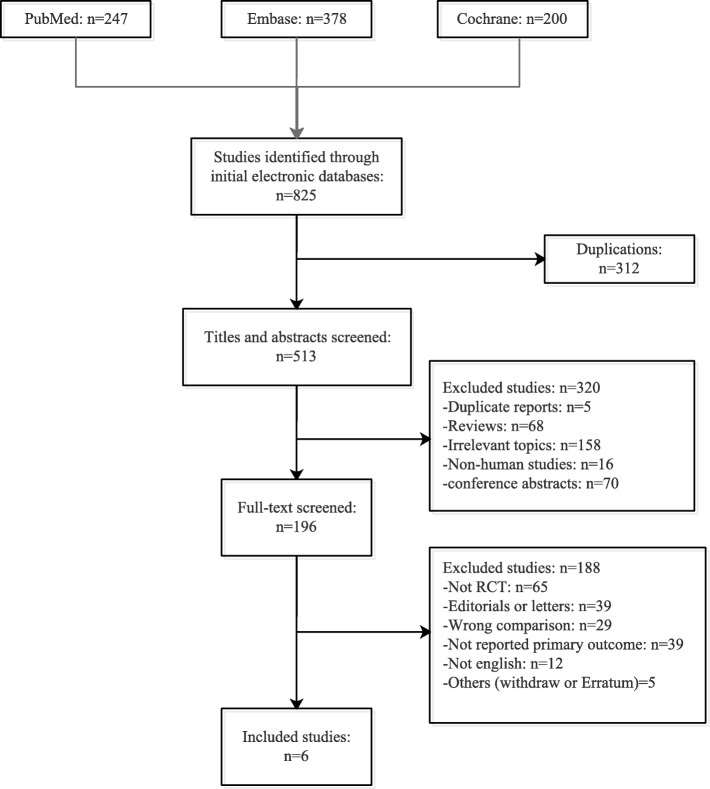
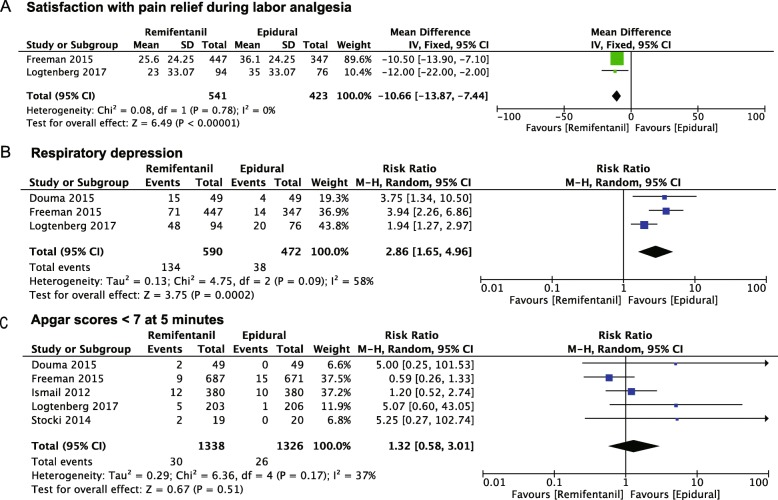
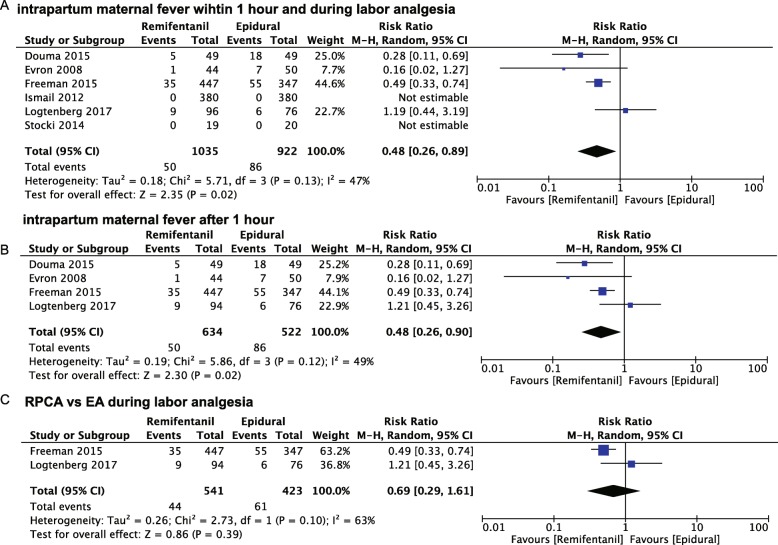
A total of 825 studies were screened, and 6 RCTs including 3341 patients were identified. Compared with EA, RPCA was associated with a significantly lower incidence of intrapartum maternal fever (risk ratio [RR] 0.48, P = 0.02, I = 49%) during labor analgesia. After excluding 2 trials via the heterogeneity analysis, there was no difference in the incidence of intrapartum fever between patients receiving RPCA and those receiving EA. Satisfaction with pain relief during labor was lower in the RPCA group than that in the EA group (- 10.6 [13.87, - 7.44], P < 0.00001, I = 0%). The incidence of respiratory depression was significantly greater in the RPCA group than that in the EA group (risk ratio 2.86 [1.65, 4.96], P = 0.0002, I = 58%). The incidence of Apgar scores < 7 at 5 min in the RPCA group was equivalent to that in the EA group.
There is no solid evidence to illustrate that the incidence of intrapartum maternal fever is lower in patients receiving intravenous RPCA than in patients receiving EA.
静脉注射瑞芬太尼患者自控镇痛(RPCA)是分娩疼痛缓解中硬膜外镇痛(EA)的替代方法。然而,尚不清楚 RPCA 是否比 EA 更能降低分娩期间产妇发热的风险。
根据系统评价和荟萃分析的首选报告项目(PRISMA)指南,通过检索 PubMed、EMBASE 和 Cochrane 对照试验中心数据库,对截至 2019 年 4 月的所有研究进行了系统评价和荟萃分析。所有比较 RPCA 与 EA 单独或 EA 联合脊髓镇痛用于分娩时产妇发热风险的随机对照试验(RCT)均被纳入。
共筛选出 825 项研究,确定了 6 项 RCT,共纳入 3341 例患者。与 EA 相比,RPCA 与分娩镇痛期间产妇发热的发生率显著降低(风险比 [RR] 0.48,P = 0.02,I = 49%)。通过异质性分析排除 2 项试验后,接受 RPCA 与接受 EA 的患者发热发生率无差异。接受 RPCA 的患者对分娩期间疼痛缓解的满意度低于接受 EA 的患者(-10.6 [13.87,-7.44],P < 0.00001,I = 0%)。接受 RPCA 的患者呼吸抑制的发生率明显高于接受 EA 的患者(风险比 2.86 [1.65,4.96],P = 0.0002,I = 58%)。接受 RPCA 的患者 Apgar 评分在 5 分钟时 < 7 的发生率与接受 EA 的患者相当。
目前尚无确凿证据表明接受静脉内 RPCA 的患者分娩期间发热的发生率低于接受 EA 的患者。