Haskins Lyn, Chiliza Jessica, Barker Pierre, Connolly Catherine, Phakathi Sifiso, Feeley Alison, Horwood Christiane
Centre for Rural Health, University of KwaZulu-Natal, 4th Floor, George Campbell Building, Howard College Campus, Durban, South Africa.
Department of Global Health, Boston University School of Public Health, Boston, MA, USA.
BMC Public Health. 2020 Mar 12;20(1):318. doi: 10.1186/s12889-020-8397-2.
Despite policies and guidelines recommending integration of health services in South Africa, provision of maternal and child health services remains fragmented. This study evaluated a rapid, scaleable, quality improvement (QI) intervention to improve integration of maternal and child health and HIV services at a primary health level, in KwaZulu-Natal, South Africa.
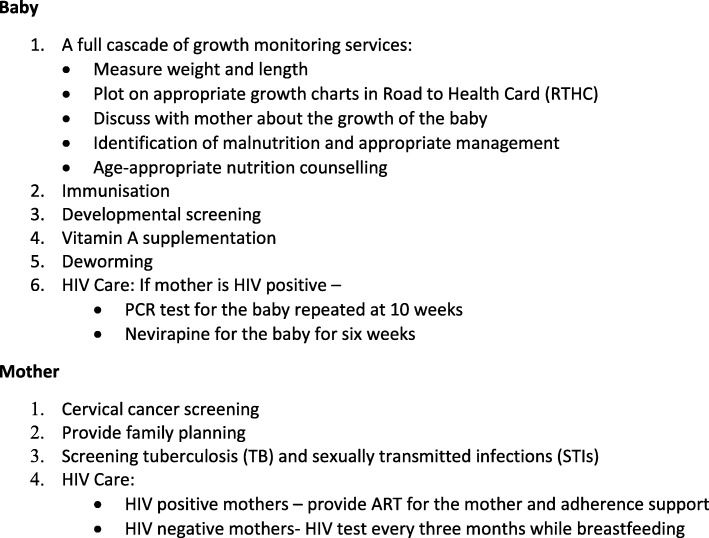
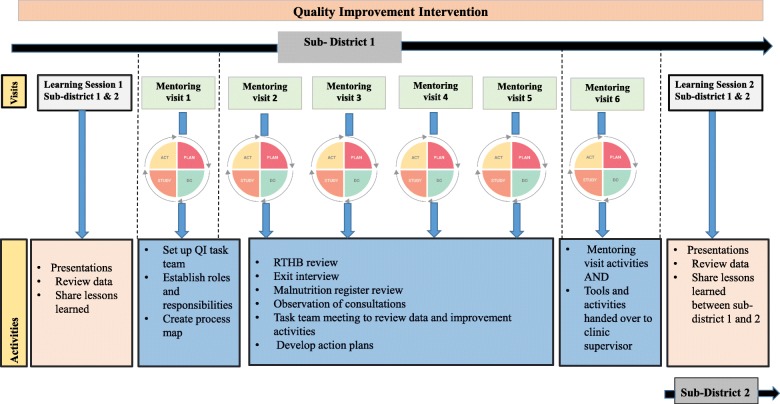
A three-month intervention comprised of six QI mentoring visits, learning sessions with clinic staff to share learnings, and a self-administered checklist aimed to assist health workers monitor and implement an integrated package of health services for mothers and children. The study evaluated 27 clinics in four sub-districts using a stepped-wedge design. Each sub-district received the intervention sequentially in a randomly selected order. Five waves of data collection were conducted in all participating clinics between December 2016-February 2017. A multi-level, mixed effects logistic regression was used to account for random cluster fixed time and group effects using Stata V13.1.
Improvements in some growth monitoring indicators were achieved in intervention clinics compared to control clinics, including measuring the length of the baby (77% vs 63%; p = 0.001) and health workers asking mothers about the child's feeding (74% vs 67%; p = 0.003), but the proportion of mothers who received feeding advice remained unchanged (38% vs 35%; p = 0.48). Significantly more mothers in the intervention group were asked about their baby's health (44% vs 36%; p = 0.001), and completeness of record keeping improved (40% vs 26%; I = < 0.0001). Discussions with the mother about some maternal health services improved: significantly more mothers in the intervention group were asked about HIV (26.5% vs 19.5%; p = 0.009) and family planning (33.5% vs 19.5%; p < 0.001), but this did not result in additional services being provided to mothers at the clinic visit.
This robust evaluation shows significant improvements in coverage of some services, but the QI intervention was unable to achieve the substantial changes required to provide a comprehensive package of services to all mothers and children. We suggest the QI process be adapted to complex under-resourced health systems, building on the strengths of this approach, to provide workable health systems strengthening solutions for scalable implementation.
ClinicalTrials.gov NCT04278612. Date of Registration: February 19, 2020. Retrospectively registered.
尽管南非有政策和指南建议整合卫生服务,但母婴健康服务的提供仍然分散。本研究评估了一种快速、可扩展的质量改进(QI)干预措施,以改善南非夸祖鲁 - 纳塔尔省初级卫生保健层面母婴健康与艾滋病毒服务的整合情况。
为期三个月的干预包括六次QI指导访问、与诊所工作人员的学习交流会议以分享经验教训,以及一份自我管理的清单,旨在帮助卫生工作者监测并实施针对母亲和儿童的综合卫生服务包。该研究采用阶梯式楔形设计对四个分区的27家诊所进行评估。每个分区按随机选择的顺序依次接受干预。2016年12月至2017年2月期间,在所有参与的诊所进行了五轮数据收集。使用Stata V13.1软件进行多层次混合效应逻辑回归分析,以考虑随机聚类固定时间和组效应。
与对照诊所相比,干预诊所的一些生长监测指标有所改善,包括测量婴儿身长(77%对63%;p = 0.001)以及卫生工作者询问母亲孩子的喂养情况(74%对67%;p = 0.003),但接受喂养建议的母亲比例保持不变(38%对35%;p = 0.48)。干预组中询问婴儿健康状况的母亲明显更多(44%对36%;p = 0.001),记录保存的完整性也有所提高(40%对26%;I = <0.0001)。与母亲就一些孕产妇健康服务的讨论有所改善:干预组中询问艾滋病毒情况的母亲明显更多(26.5%对19.5%;p = 0.009)以及计划生育情况的母亲明显更多(33.5%对19.5%;p < 0.001),但这并未导致在诊所就诊时为母亲提供更多服务。
这项有力的评估表明某些服务的覆盖范围有显著改善,但QI干预未能实现为所有母亲和儿童提供全面服务包所需的实质性改变。我们建议根据资源匮乏的复杂卫生系统调整QI流程,基于该方法的优势,提供可行的卫生系统强化解决方案以实现可扩展实施。
ClinicalTrials.gov NCT04278612。注册日期:2020年2月19日。回顾性注册。