Department of Psychiatry, Nagoya University Graduate School of Medicine, Nagoya, Aichi, Japan.
Regional Center for Child and Youth Mental Health and Child Welfare, Norwegian University of Science and Technology, Trondheim, Norway.
BMC Psychiatry. 2020 Mar 12;20(1):121. doi: 10.1186/s12888-020-2477-9.
This paper is a systematic review and meta-analysis of the efficacy of available medications for the treatment of restricted/repetitive behavior (RRBs) in Autism Spectrum Disorder (ASD).
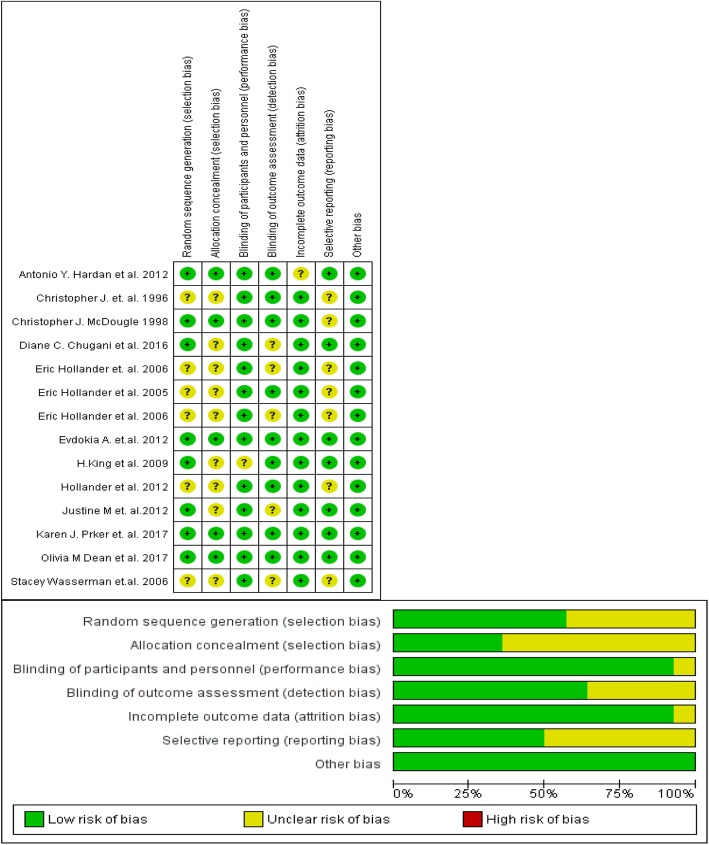
We searched MEDLINE, Embase, PsycINFO, The Cochrane Library (Cochrane Database of Systematic Reviews (CDRS), the Cochrane Central Register of Controlled Trials (CENTRAL), database of Abstracts of Reviews of Effects (DARE)), Scopus, Epistimonikos, Clinicaltrials.gov, and included all randomized controlled trials published after 1993 that were directed at RRBs in patients with ASD of all ages. We extracted the relevant data from the published studies with a predefined data extraction form and assessed the risk of bias. The primary outcomes were change in restricted/repetitive behavior. We performed a meta-analysis using the random effect model and included studies with given mean and standard deviation. This study is registered with PROSPERO number CRD42018092660).
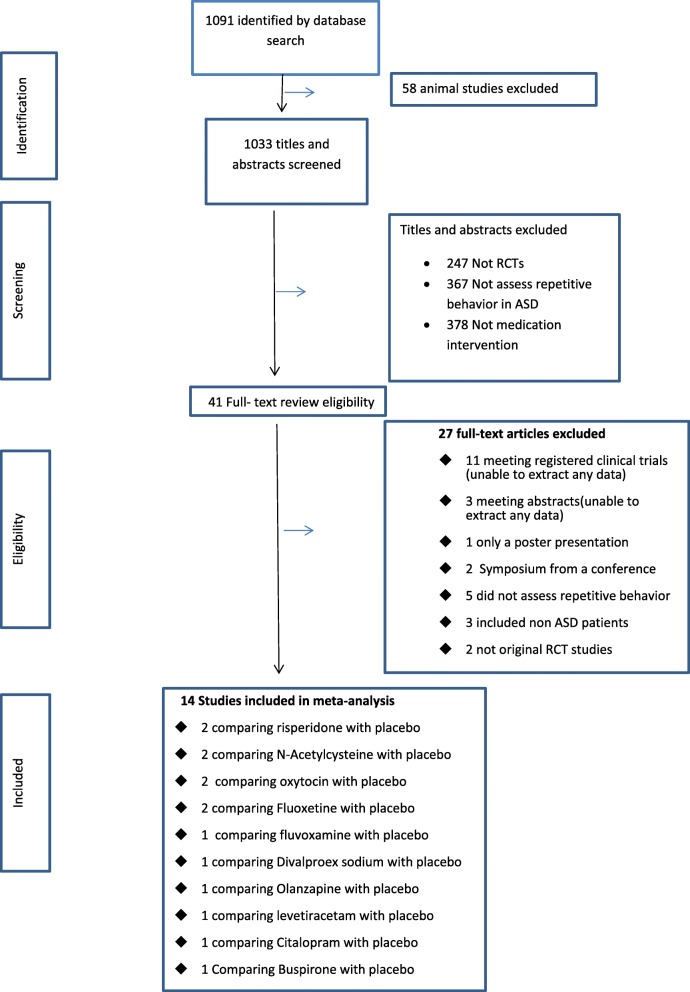
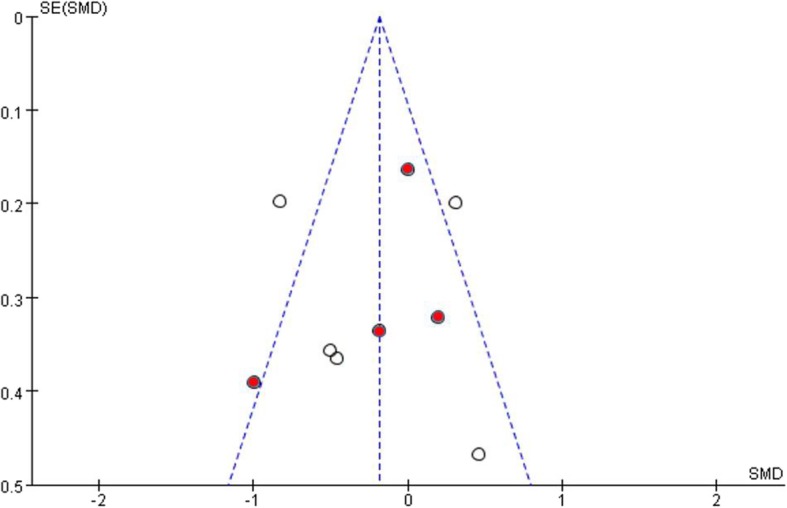
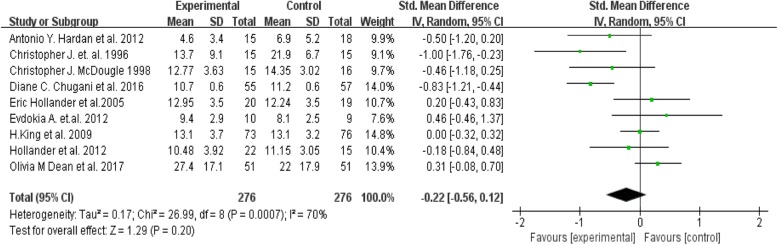
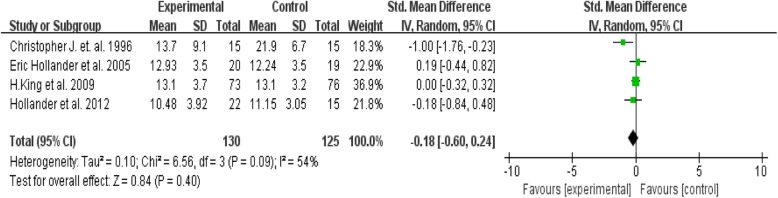
We identified 14 randomized controlled trials that met initial inclusion criteria. After closer inspection, nine trials - involving 552 patients in total - were included in the final analysis. The meta-analysis found no significant difference between medications (including fluvoxamine, risperidone, fluoxetine, citalopram, oxytocin, N-Acetylcysteine, buspirone) and placebo in the treatment of RRBs in ASD (P = 0.20). Similarly, the sub-group meta-analysis also showed no significant difference between Selective Serotonin Reuptake Inhibitor (SSRIs) and placebo in the treatment of RRBs in ASD (P = 0.68). There was no evidence of publication bias.
This meta-analysis finds little support for the routine use of medications to treat restricted/repetitive behaviors in Autism Spectrum Disorder. Further research of large, balanced trials with precise assessment tools and long-term follow-up are needed.
The study protocol is registered in PROSPERO (Reference number: CRD42018092660).
本文是对现有药物治疗自闭症谱系障碍(ASD)中受限/重复行为(RRB)疗效的系统评价和荟萃分析。
我们检索了 MEDLINE、Embase、PsycINFO、The Cochrane Library(Cochrane 系统评价数据库(CDRS)、Cochrane 中心对照试验注册库(CENTRAL)、疗效评价文摘数据库(DARE))、Scopus、Epistimonikos、Clinicaltrials.gov,并纳入了所有 1993 年后发表的针对 ASD 患者所有年龄段 RRB 的随机对照试验。我们使用预先设定的数据提取表从已发表的研究中提取相关数据,并评估了偏倚风险。主要结局为受限/重复行为的变化。我们使用随机效应模型进行荟萃分析,并纳入了具有特定均值和标准差的研究。本研究已在 PROSPERO 注册,注册号为 CRD42018092660。
我们确定了 14 项符合初始纳入标准的随机对照试验。经过仔细检查,共有 9 项试验 - 涉及 552 名患者 - 纳入最终分析。荟萃分析发现,药物治疗(包括氟伏沙明、利培酮、氟西汀、西酞普兰、催产素、N-乙酰半胱氨酸、丁螺环酮)与安慰剂治疗 ASD 中的 RRBs 之间无显著差异(P=0.20)。同样,亚组荟萃分析也显示 SSRI 与安慰剂治疗 ASD 中的 RRBs 之间无显著差异(P=0.68)。没有证据表明存在发表偏倚。
这项荟萃分析几乎没有支持常规使用药物治疗自闭症谱系障碍中的受限/重复行为。需要进一步开展大型、平衡的试验,使用精确的评估工具和长期随访。
研究方案在 PROSPERO 注册(参考编号:CRD42018092660)。