Wiyeh Alison B, Mome Ruth K B, Mahasha Phetole W, Kongnyuy Eugene J, Wiysonge Charles S
Cochrane South Africa, South African Medical Research Council, Cape Town, South Africa.
Department of Epidemiology, University of Washington School of Public Health, Seattle, Washington, USA.
BMC Public Health. 2020 Mar 12;20(1):319. doi: 10.1186/s12889-020-8384-7.
The effectiveness of female condoms for preventing HIV and sexually transmitted infections (STIs) remains inconclusive. We examined the effects of female condoms on the acquisition of HIV and STIs.
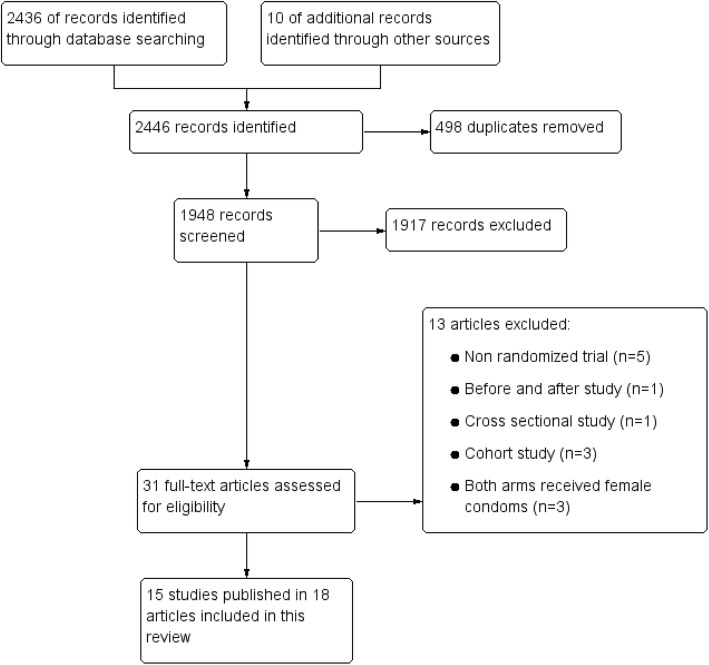
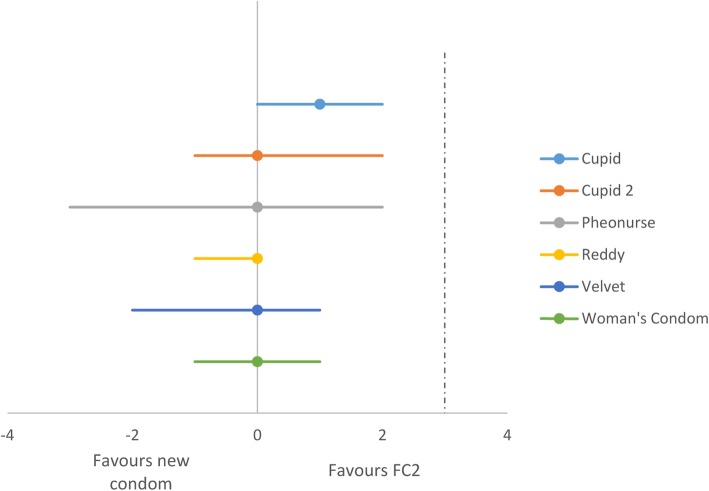
We searched four databases, two trial registries, and reference lists of relevant publications in October 2018 and updated our search in February 2020. We screened search output, evaluated study eligibility, and extracted data in duplicate; resolving differences through discussion. We calculated the effective sample size of cluster randomised trials using an intra-cluster correlation coefficient of 0·03. Data from similar studies were combined in a meta-analysis. We performed a non-inferiority analysis of new condoms relative to marketed ones using a non-inferiority margin of 3%. We assessed the certainty of evidence using GRADE.
We included fifteen studies of 6921 women. We found that polyurethane female condoms (FC1) plus male condoms may be as effective as male condoms only in reducing HIV acquisition (1 trial, n = 149 women, RR 0.07, 95%CI 0.00-1.38; low-certainty evidence). However, the use of FC1 plus male condoms is superior to male condoms alone in reducing the acquisition of gonorrhoea (2 trials, n = 790, RR 0.59, 95%CI 0.41-0.86; high-certainty evidence) and chlamydia (2 trials, n = 790, RR 0.67, 95%CI 0.47-0.94; high-certainty evidence). Adverse events and failure rates of FC1 were very low and decreased during follow up. Although the functionality of newer female condoms (Woman's, Cupid, Pheonurse, Velvet, and Reddy) may be non-inferior to FC2, there were no available studies assessing their efficacy in preventing HIV and STIs.
The use of female plus male condoms is more effective than use of male condoms only in preventing STIs and may be as effective as the male condom only in preventing HIV. There is a need for well conducted studies assessing the effects of newer female condoms on HIV and STIs.
CRD42018090710.
女用避孕套预防艾滋病毒和性传播感染(STIs)的有效性仍无定论。我们研究了女用避孕套对艾滋病毒和性传播感染感染情况的影响。
我们于2018年10月检索了四个数据库、两个试验注册库以及相关出版物的参考文献列表,并于2020年2月更新了检索。我们筛选检索结果,评估研究的合格性,并重复提取数据;通过讨论解决分歧。我们使用0.03的组内相关系数计算整群随机试验的有效样本量。来自相似研究的数据合并进行荟萃分析。我们使用3%的非劣效界值对新型避孕套相对于市售避孕套进行非劣效性分析。我们使用GRADE评估证据的确定性。
我们纳入了15项针对6921名女性的研究。我们发现,聚氨酯女用避孕套(FC1)加男用避孕套在降低艾滋病毒感染方面可能与单用男用避孕套效果相同(1项试验,n = 149名女性,RR 0.07,95%CI 0.00 - 1.38;低确定性证据)。然而,使用FC1加男用避孕套在降低淋病感染(2项试验,n = 790,RR 0.59,95%CI 0.41 - 0.86;高确定性证据)和衣原体感染(2项试验,n = 790,RR 0.67,95%CI 0.47 - 0.94;高确定性证据)方面优于单用男用避孕套。FC1的不良事件和失败率非常低,且在随访期间有所下降。尽管新型女用避孕套(Woman's、Cupid、Pheonurse、Velvet和Reddy)的功能可能不劣于FC2,但尚无评估其预防艾滋病毒和性传播感染疗效的研究。
女用避孕套加男用避孕套在预防性传播感染方面比单用男用避孕套更有效,在预防艾滋病毒方面可能与单用男用避孕套效果相同。需要开展充分的研究来评估新型女用避孕套对艾滋病毒和性传播感染的影响。
PROSPERO注册号:CRD42018090710。