College of Public Health, Medical and Veterinary Sciences, James Cook University, Cairns, QLD, Australia.
Australian Institute of Tropical Health and Medicine, James Cook University, Cairns, QLD, Australia.
Parasit Vectors. 2020 Mar 12;13(1):125. doi: 10.1186/s13071-020-3996-4.
Prevalence of lymphatic filariasis (LF) antigen in American Samoa was 16.5% in 1999. Seven rounds of mass drug administration (MDA) programmes between 2000 and 2006 reduced antigen prevalence to 2.3%. The most efficient methods of surveillance after MDA are not clear, but testing specific at-risk groups such as adults may provide earlier warning of resurgence. The role of migration from LF endemic countries in maintaining transmission also needs investigation. Few studies have investigated knowledge about LF and how that relates to infection risk. This study aims to investigate associations between socio-demographics, population mobility, disease knowledge and LF infection risk.
In 2014, we surveyed 670 adults aged 16-68 years (62% female) at two worksites in American Samoa. Sera were tested for LF antigen and antibodies (Bm14 and Wb123) by rapid test and/or ELISA. Multivariate logistic regression was used to assess association between seromarkers and demographic factors, household socioeconomic status (SES), residence, travel history, and knowledge of LF.
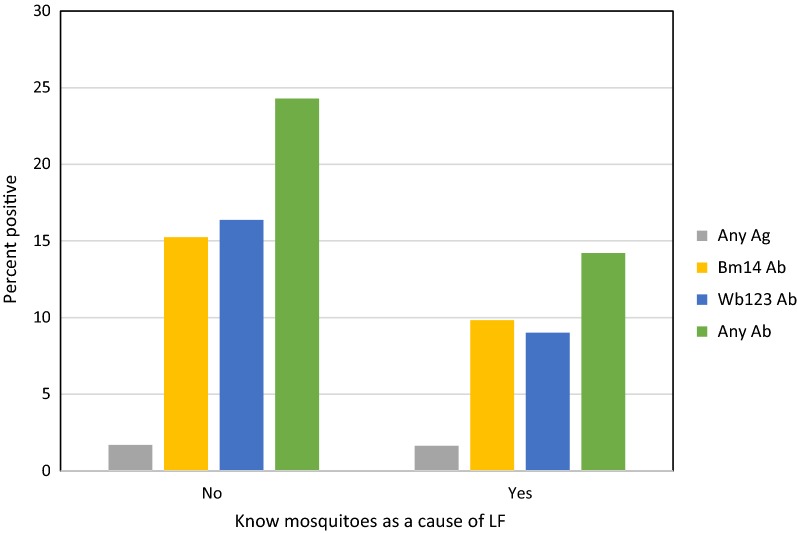
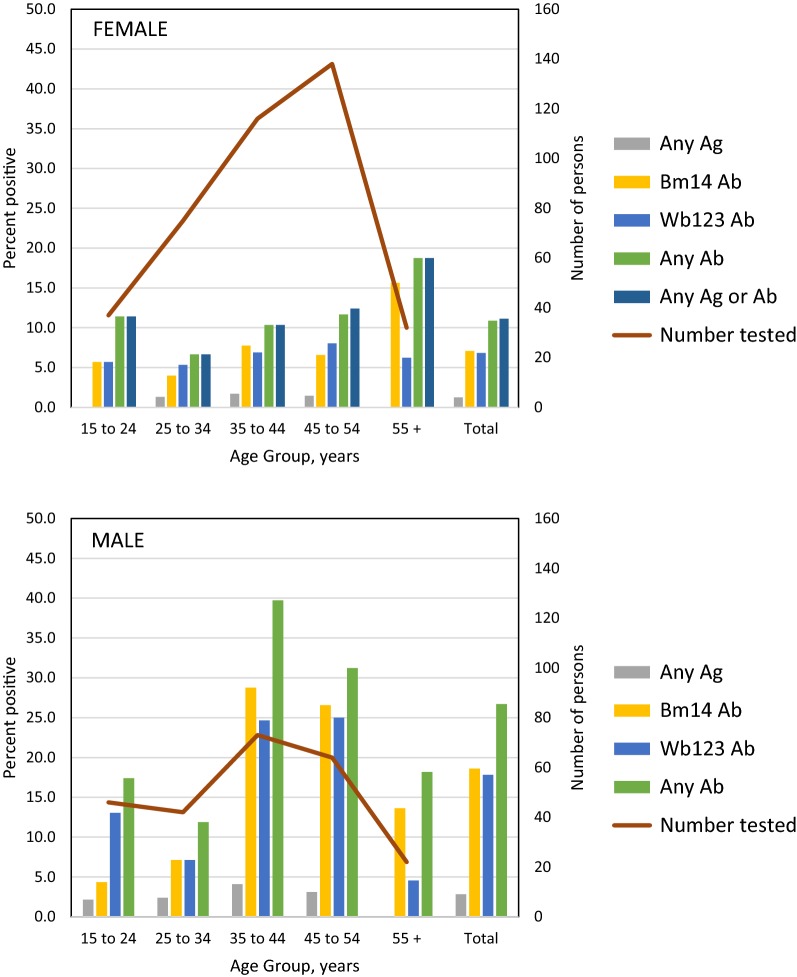
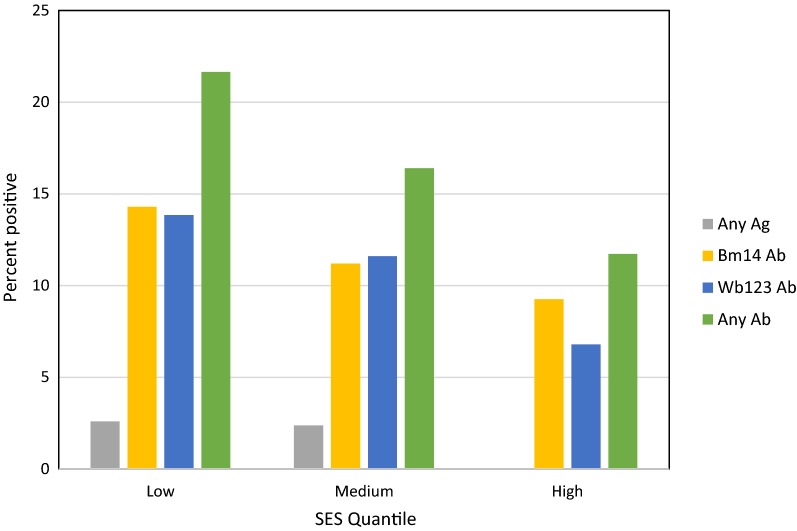
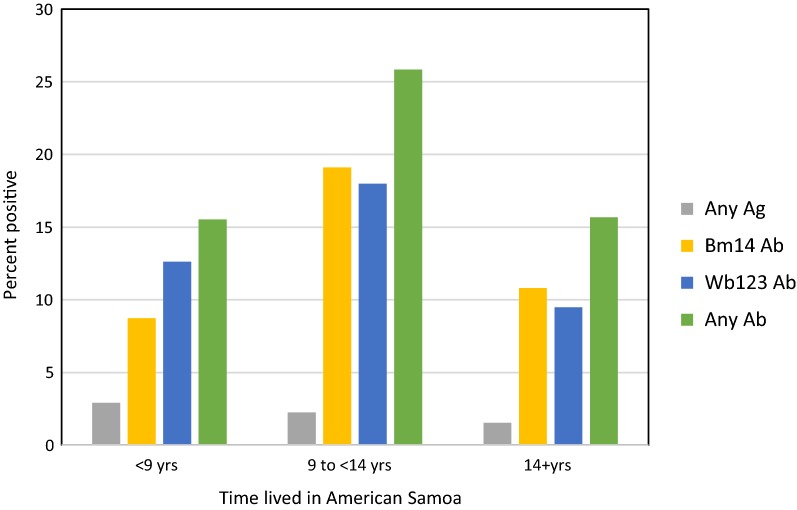
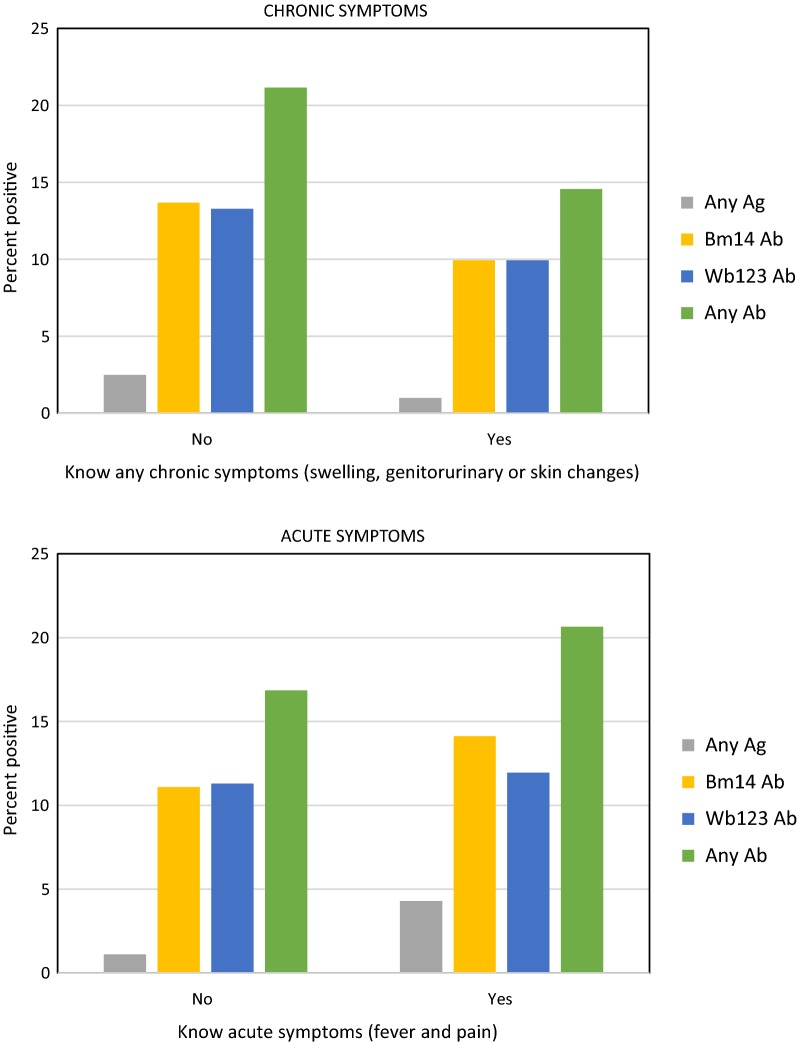
Overall, 1.8% of participants were positive for antigen, 11.8% for Bm14, 11.3% for Wb123 and 17.3% for at least one antibody. Recent travel outside American Samoa was not associated with positivity for any seromarker. Men had higher seroprevalence than women for all outcomes (any antibody: adjusted odds ratio (aOR) = 3.49 (95% CI: 2.21-5.49). Those aged over 35 years (compared to 15-24 years) had higher prevalence of Bm14 antibody (aOR = 3.75, 3.76 and 4.17 for ages 35-44, 45-54 and ≥ 55 years, respectively, P < 0.05). Lower SES was associated with seropositivity (antigen: aOR = 2.89, 95% CI: 1.09-7.69; either antibody: aOR = 1.51, 95% CI: 1.12-2.05). Those who knew that mosquitoes transmitted LF had lower Wb123 antibody prevalence (aOR = 0.55, 95% CI: 0.32-0.95).
Opportunistic sampling of adults at worksites provided an efficient and representative way to assess prevalence and risk factors for LF in American Samoa and in hindsight, foreshadowed the resurgence of transmission. Risk of LF infection, detected by one or more serological markers, was not related to recent travel history, but was strongly associated with male gender, older age, lower SES, and lack of knowledge about mosquito transmission. These results could guide future efforts to increase MDA participation.
1999 年,美属萨摩亚的淋巴丝虫病(LF)抗原流行率为 16.5%。2000 年至 2006 年期间进行了七轮大规模药物治疗(MDA)计划,将抗原流行率降低至 2.3%。MDA 后最有效的监测方法尚不清楚,但对特定高危人群(如成年人)进行检测可能会更早地发现疾病复发的迹象。移民从淋巴丝虫病流行国家进入也需要调查其在维持传播中的作用。很少有研究调查过 LF 相关知识以及其与感染风险的关系。本研究旨在调查社会人口统计学、人口流动、疾病知识与 LF 感染风险之间的关系。
2014 年,我们在美属萨摩亚的两个工作场所调查了 670 名年龄在 16-68 岁之间的成年人(62%为女性)。通过快速检测和/或 ELISA 检测血清中的 LF 抗原和抗体(Bm14 和 Wb123)。采用多变量逻辑回归评估血清标志物与人口统计学因素、家庭社会经济地位(SES)、居住地、旅行史和 LF 知识之间的关联。
总体而言,1.8%的参与者抗原阳性,11.8%的参与者 Bm14 阳性,11.3%的参与者 Wb123 阳性,17.3%的参与者至少有一种抗体阳性。最近没有离开美属萨摩亚的旅行与任何血清标志物的阳性结果无关。与女性相比,男性所有结果的血清阳性率都更高(任何抗体:调整后的优势比(aOR)=3.49(95%置信区间:2.21-5.49))。与 15-24 岁相比,35 岁以上(35-44 岁、45-54 岁和≥55 岁)的人群 Bm14 抗体的阳性率更高(aOR=3.75、3.76 和 4.17,P<0.05)。较低的 SES 与血清阳性有关(抗原:aOR=2.89,95%置信区间:1.09-7.69;任何抗体:aOR=1.51,95%置信区间:1.12-2.05)。那些知道蚊子传播 LF 的人,其 Wb123 抗体的阳性率较低(aOR=0.55,95%置信区间:0.32-0.95)。
在工作场所对成年人进行机会性抽样,为评估美属萨摩亚的 LF 流行率和危险因素提供了一种高效、有代表性的方法,事后看来,这预示着传播的再次出现。LF 感染的风险,通过一种或多种血清标志物检测到,与最近的旅行史无关,但与男性性别、年龄较大、较低的 SES 和缺乏对蚊子传播的认识密切相关。这些结果可以为未来增加 MDA 参与度的努力提供指导。