Houghton Natalia, Bascolo Ernesto, Del Riego Amalia
Pan American Health Organization World Health Organization WashingtonDC United States of America Pan American Health Organization/World Health Organization, Washington, DC, United States of America.
Rev Panam Salud Publica. 2020 Mar 4;44:e11. doi: 10.26633/RPSP.2020.11. eCollection 2020.
To present summary measures of socioeconomic inequalities in access barriers to health services in Colombia, El Salvador, Paraguay, and Peru.
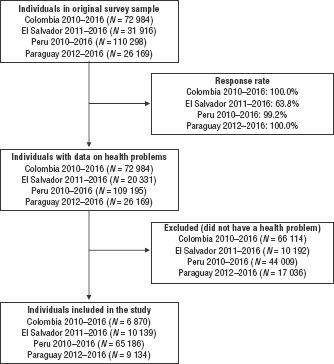
This cross-sectional study used data from nationally - representative household surveys in Colombia, El Salvador, Peru, and Paraguay to analyze income-related inequalities in barriers to seeking health services. Households that reported having a health problem (disease/accident) and not seeking professional health care were considered to be facing access barriers. The measures of inequality were the slope index of inequality and relative index of inequality.
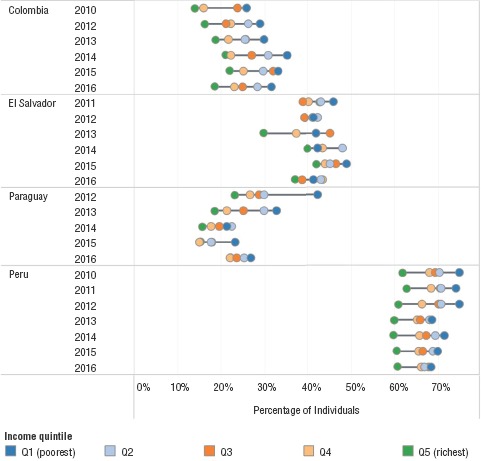
Inequality trends were mixed across the four countries. All showed improvement, but large inequality gaps persisted between the highest and lowest income quintiles, despite health care reforms. Relative inequality gaps were highest in Colombia (60%), followed by Paraguay (30%), Peru (20%), and El Salvador (20%).
The effect of national policy initiatives on equity to accessing health services should be the object of future analysis. There is also a need for research on national and regional monitoring of access barriers and explanatory factors for why people do not seek care, even when having a health problem.
呈现哥伦比亚、萨尔瓦多、巴拉圭和秘鲁在获取卫生服务的障碍方面社会经济不平等的汇总指标。
这项横断面研究使用了哥伦比亚、萨尔瓦多、秘鲁和巴拉圭具有全国代表性的家庭调查数据,以分析在寻求卫生服务的障碍方面与收入相关的不平等。报告有健康问题(疾病/事故)但未寻求专业医疗保健的家庭被视为面临获取障碍。不平等的衡量指标是不平等斜率指数和不平等相对指数。
四个国家的不平等趋势各不相同。所有国家都有所改善,但尽管进行了医疗改革,最高和最低收入五分位数之间仍然存在巨大的不平等差距。相对不平等差距在哥伦比亚最高(60%),其次是巴拉圭(30%)、秘鲁(20%)和萨尔瓦多(20%)。
国家政策举措对卫生服务公平获取的影响应成为未来分析的对象。还需要开展研究,对获取障碍以及人们即使有健康问题却不寻求治疗的解释因素进行国家和区域监测。