Department of Medical Physics and Biomedical Engineering, UCL, London, UK.
School of Biomedical Engineering and Imaging Science, KCL, London, UK.
Int J Comput Assist Radiol Surg. 2020 Apr;15(4):651-659. doi: 10.1007/s11548-020-02127-w. Epub 2020 Mar 12.
Early squamous cell neoplasia (ESCN) in the oesophagus is a highly treatable condition. Lesions confined to the mucosal layer can be curatively treated endoscopically. We build a computer-assisted detection system that can classify still images or video frames as normal or abnormal with high diagnostic accuracy.
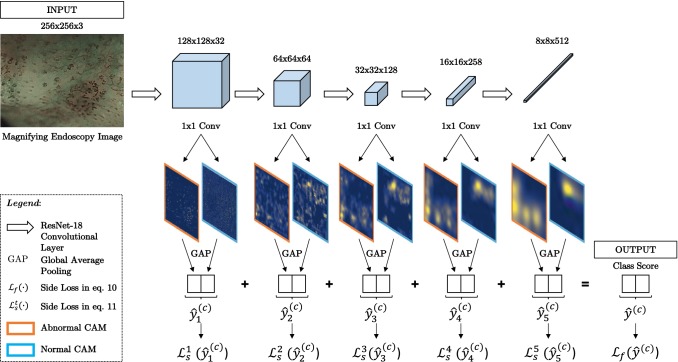
We present a new benchmark dataset containing 68K binary labelled frames extracted from 114 patient videos whose imaged areas have been resected and correlated to histopathology. Our novel convolutional network architecture solves the binary classification task and explains what features of the input domain drive the decision-making process of the network.
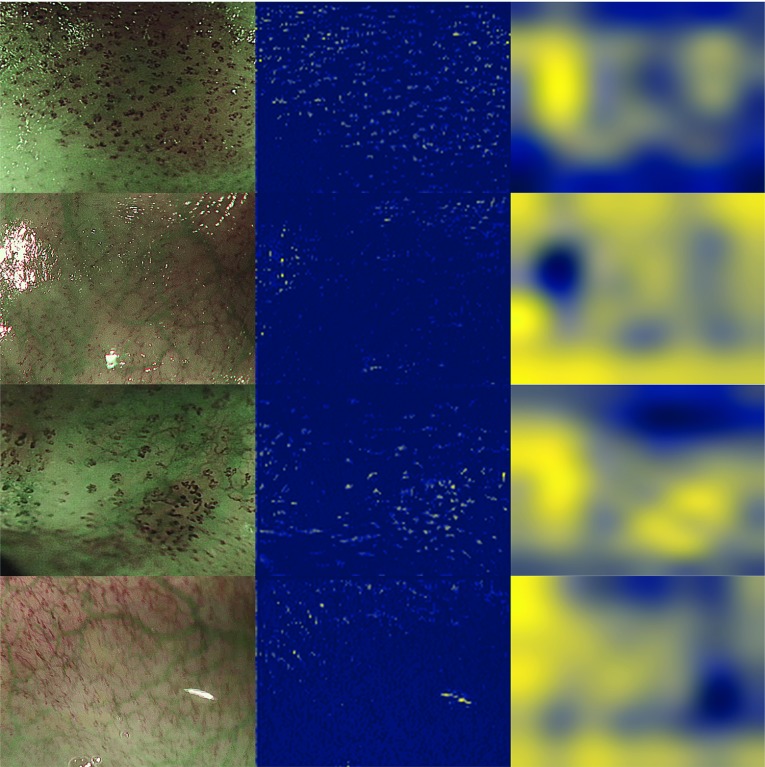
The proposed method achieved an average accuracy of 91.7% compared to the 94.7% achieved by a group of 12 senior clinicians. Our novel network architecture produces deeply supervised activation heatmaps that suggest the network is looking at intrapapillary capillary loop patterns when predicting abnormality.
We believe that this dataset and baseline method may serve as a reference for future benchmarks on both video frame classification and explainability in the context of ESCN detection. A future work path of high clinical relevance is the extension of the classification to ESCN types.
食管早期鳞状细胞癌(ESCN)是一种高度可治疗的疾病。局限于黏膜层的病变可以通过内镜进行治愈性治疗。我们构建了一个计算机辅助检测系统,该系统可以以较高的诊断准确性对静态图像或视频帧进行正常或异常分类。
我们提出了一个新的基准数据集,其中包含从 114 个患者视频中提取的 68K 个二进制标记帧,这些视频的成像区域已被切除并与组织病理学相关联。我们的新型卷积网络架构解决了二进制分类任务,并解释了输入域的哪些特征驱动网络的决策过程。
与 12 位高级临床医生所达到的 94.7%相比,所提出的方法的平均准确率达到了 91.7%。我们的新型网络架构生成了深度监督激活热图,这表明网络在预测异常时正在观察乳头内毛细血管环模式。
我们相信,该数据集和基准方法可以作为未来 ESCN 检测中视频帧分类和可解释性的基准的参考。一个具有高度临床相关性的未来工作方向是将分类扩展到 ESCN 类型。