
深度学习用于内镜图像中食管癌的诊断:一项系统评价和荟萃分析
Deep Learning for the Diagnosis of Esophageal Cancer in Endoscopic Images: A Systematic Review and Meta-Analysis.
作者信息
Islam Md Mohaimenul, Poly Tahmina Nasrin, Walther Bruno Andreas, Yeh Chih-Yang, Seyed-Abdul Shabbir, Li Yu-Chuan Jack, Lin Ming-Chin
机构信息
Graduate Institute of Biomedical Informatics, College of Medical Science and Technology, Taipei Medical University, Taipei 110, Taiwan.
International Center for Health Information Technology (ICHIT), Taipei Medical University, Taipei 110, Taiwan.
出版信息
Cancers (Basel). 2022 Dec 5;14(23):5996. doi: 10.3390/cancers14235996.
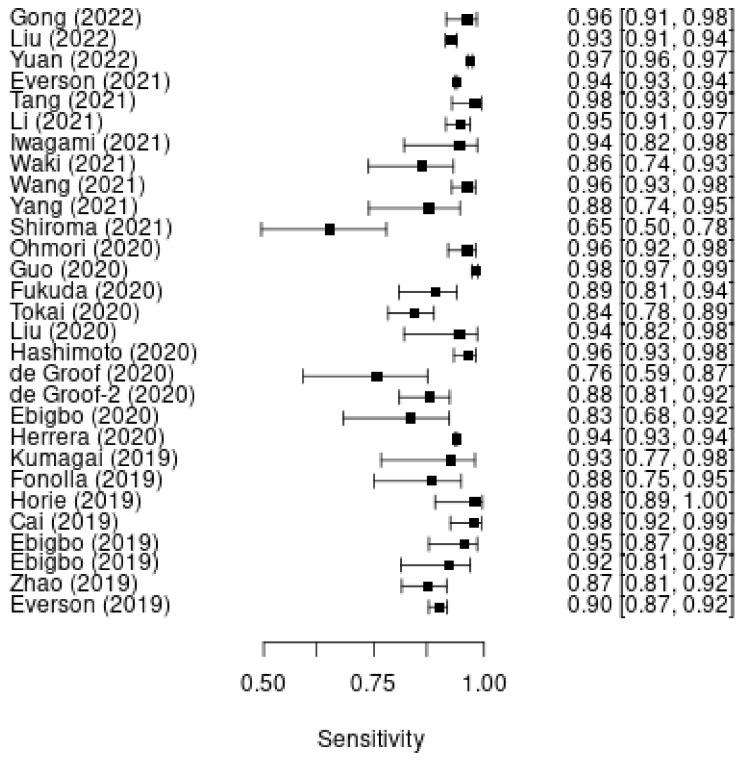
Esophageal cancer, one of the most common cancers with a poor prognosis, is the sixth leading cause of cancer-related mortality worldwide. Early and accurate diagnosis of esophageal cancer, thus, plays a vital role in choosing the appropriate treatment plan for patients and increasing their survival rate. However, an accurate diagnosis of esophageal cancer requires substantial expertise and experience. Nowadays, the deep learning (DL) model for the diagnosis of esophageal cancer has shown promising performance. Therefore, we conducted an updated meta-analysis to determine the diagnostic accuracy of the DL model for the diagnosis of esophageal cancer. A search of PubMed, EMBASE, Scopus, and Web of Science, between 1 January 2012 and 1 August 2022, was conducted to identify potential studies evaluating the diagnostic performance of the DL model for esophageal cancer using endoscopic images. The study was performed in accordance with PRISMA guidelines. Two reviewers independently assessed potential studies for inclusion and extracted data from retrieved studies. Methodological quality was assessed by using the QUADAS-2 guidelines. The pooled accuracy, sensitivity, specificity, positive and negative predictive value, and the area under the receiver operating curve (AUROC) were calculated using a random effect model. A total of 28 potential studies involving a total of 703,006 images were included. The pooled accuracy, sensitivity, specificity, and positive and negative predictive value of DL for the diagnosis of esophageal cancer were 92.90%, 93.80%, 91.73%, 93.62%, and 91.97%, respectively. The pooled AUROC of DL for the diagnosis of esophageal cancer was 0.96. Furthermore, there was no publication bias among the studies. The findings of our study show that the DL model has great potential to accurately and quickly diagnose esophageal cancer. However, most studies developed their model using endoscopic data from the Asian population. Therefore, we recommend further validation through studies of other populations as well.
食管癌是预后较差的常见癌症之一,是全球癌症相关死亡的第六大主要原因。因此,食管癌的早期准确诊断对于为患者选择合适的治疗方案并提高其生存率起着至关重要的作用。然而,准确诊断食管癌需要丰富的专业知识和经验。如今,用于食管癌诊断的深度学习(DL)模型已显示出有前景的性能。因此,我们进行了一项更新的荟萃分析,以确定DL模型对食管癌诊断的准确性。检索了2012年1月1日至2022年8月1日期间的PubMed、EMBASE、Scopus和Web of Science,以确定评估使用内镜图像的DL模型对食管癌诊断性能的潜在研究。该研究按照PRISMA指南进行。两名 reviewers 独立评估潜在研究是否纳入,并从检索到的研究中提取数据。使用QUADAS - 2指南评估方法学质量。使用随机效应模型计算合并准确性、敏感性、特异性、阳性和阴性预测值以及受试者工作特征曲线下面积(AUROC)。总共纳入了28项潜在研究,涉及总共703,006张图像。DL对食管癌诊断的合并准确性、敏感性、特异性、阳性和阴性预测值分别为92.90%、93.80%、91.73%、93.62%和91.97%。DL对食管癌诊断的合并AUROC为0.96。此外,研究之间没有发表偏倚。我们的研究结果表明,DL模型在准确快速诊断食管癌方面具有巨大潜力。然而,大多数研究使用来自亚洲人群的内镜数据开发其模型。因此,我们也建议通过对其他人群的研究进行进一步验证。



 Zotero 插件