Finnish Institute for Health and Welfare, Helsinki, Finland.
Towson University, MD, USA.
J Appl Gerontol. 2021 Sep;40(9):1110-1115. doi: 10.1177/0733464820911542. Epub 2020 Mar 13.
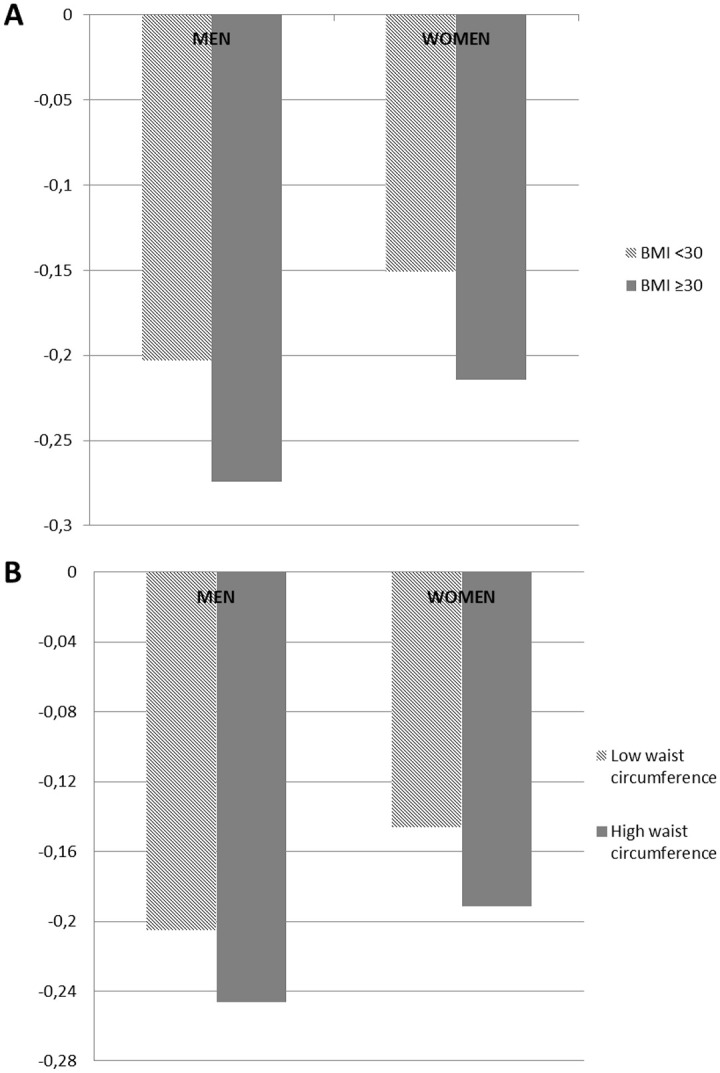
Obesity is linked to poorer physical functioning in older adults, but impact of excess adiposity on loss of functional capacity in late midlife is unclear. This study examined associations between adiposity markers and 11-year change in maximal walking speed, a sensitive indicator of physical functioning, among adults aged 55 to 69 years. Maximal walking speed over 6.1 m was assessed in 2000 and 2011 among Finnish men ( = 409) and women ( = 498) from the prospective Health 2000 Survey. Body mass index (BMI) and waist circumference were assessed in 2000. Generalized estimating equation models estimated changes in maximal walking speed by BMI and waist circumference, stratified by sex. BMI greater than 30 kg/m was associated with accelerated decline in maximal walking speed particularly in women. Associations with waist circumference were nonsignificant. Late midlife obesity may speed up the decline in functional capacity as measured by maximal walking speed, especially in women.
肥胖与老年人身体机能较差有关,但过多的体脂对中年后期功能能力丧失的影响尚不清楚。本研究调查了体脂标志物与最大步行速度 11 年变化之间的关系,最大步行速度是身体机能的一个敏感指标,研究对象为年龄在 55 至 69 岁的成年人。在 2000 年和 2011 年,来自前瞻性健康 2000 调查的芬兰男性(n=409)和女性(n=498)评估了 6.1 米以上的最大步行速度。2000 年评估了体重指数(BMI)和腰围。性别分层的广义估计方程模型估计了 BMI 和腰围对最大步行速度变化的影响。BMI 大于 30 kg/m2 与最大步行速度的加速下降特别在女性中相关。与腰围的关联无统计学意义。中年后期肥胖可能会加速最大步行速度等功能能力的下降,尤其是在女性中。