Baysari Melissa Therese, Zheng Wu Yi, Van Dort Bethany, Reid-Anderson Hannah, Gronski Mihaela, Kenny Eliza
Faculty of Health Sciences, The University of Sydney, Sydney, Australia.
Centre for Health Systems & Safety Research, Australian Institute of Health Innovation, Macquarie University, Sydney, Australia.
J Med Internet Res. 2020 Mar 13;22(3):e14855. doi: 10.2196/14855.
When users of electronic medical records (EMRs) are presented with large numbers of irrelevant computerized alerts, they experience alert fatigue, begin to ignore alert information, and override alerts without processing or heeding alert recommendations. Anecdotally, doctors at our study site were dissatisfied with the medication-related alerts being generated, both in terms of volume being experienced and clinical relevance.
This study aimed to involve end users in the redesign of medication-related alerts in a hospital EMR, 4 years post implementation.
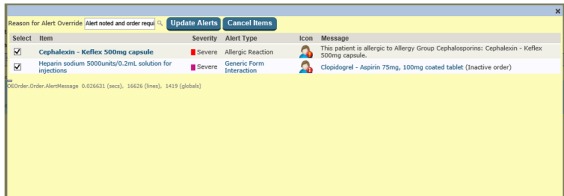
This work was undertaken at a private not-for-profit teaching hospital in Sydney, Australia. Since EMR implementation in 2015, the organization elected to implement all medication-related alert types available in the system for prescribers: allergy and intolerance alerts, therapeutic duplication alerts, pregnancy alerts, and drug-drug interaction alerts. The EMR included no medication administration alerts for nurses. To obtain feedback on current alerts and suggestions for redesign, a Web-based survey was distributed to all doctors and nurses at the site via hospital mailing lists.
Despite a general dissatisfaction with alerts, very few end users completed the survey. In total, only 3.37% (36/1066) of doctors and 14.5% (60/411) of nurses took part. Approximately 90% (30/33) of doctors who responded held the view that too many alerts were triggered in the EMR. Doctors suggested that most alerts be removed and that alerts be more specific and less sensitive. In contrast, 97% (58/60) of the nurse respondents indicated that they would like to receive medication administration alerts in the EMR. Most nurses indicated that they would like to receive all the alert types available at all severity levels.
Attempting to engage with end users several years post implementation was challenging. Involving users so late in the implementation process may lead to clinicians viewing the provision of feedback to be futile. Seeking user feedback on usefulness, volume, and design of alerts is extremely valuable; however, we suggest this is undertaken early, preferably before system implementation.
当电子病历(EMR)用户面对大量无关的计算机化警报时,他们会经历警报疲劳,开始忽略警报信息,并在未处理或未留意警报建议的情况下忽略警报。据传闻,我们研究地点的医生对所生成的与药物相关的警报不满意,无论是在经历的数量还是临床相关性方面。
本研究旨在让终端用户参与医院电子病历中与药物相关警报的重新设计,该电子病历已实施4年。
这项工作在澳大利亚悉尼的一家私立非营利性教学医院进行。自2015年实施电子病历以来,该机构选择为开处方者实施系统中所有可用的与药物相关的警报类型:过敏和不耐受警报、治疗重复警报、妊娠警报和药物相互作用警报。电子病历中没有为护士设置用药警报。为了获得关于当前警报的反馈以及重新设计的建议,通过医院邮件列表向该地点的所有医生和护士分发了一项基于网络的调查。
尽管对警报普遍不满意,但很少有终端用户完成调查。总共只有3.37%(36/1066)的医生和14.5%(60/411)的护士参与。约90%(30/33)做出回应的医生认为电子病历中触发的警报太多。医生建议删除大多数警报,并且警报应更具体、敏感性更低。相比之下,97%(58/60)的护士受访者表示他们希望在电子病历中收到用药警报。大多数护士表示他们希望收到所有严重程度级别的所有警报类型。
实施几年后试图让终端用户参与具有挑战性。在实施过程这么晚的时候让用户参与可能会导致临床医生认为提供反馈是徒劳的。就警报的有用性、数量和设计征求用户反馈非常有价值;然而,我们建议尽早进行,最好在系统实施之前。