Hashemikamangar Sedighe Sadat, Hoseinpour Farnoosh, Kiomarsi Nazanin, Dehaki Mehrzad Gholampour, Kharazifard Mohammad Javad
Department of Operative Dentistry, Dental School, Tehran University of Medical Sciences, Tehran, Iran.
Operative Department, Tehran University of Medical Science, Tehran, Iran.
Eur J Dent. 2020 Feb;14(1):85-91. doi: 10.1055/s-0040-1705071. Epub 2020 Mar 13.
This study aimed to assess the effect of an optical whitening toothpaste on color stability of microhybrid, nanofilled, and microfilled composite resins and resin-modified glass ionomer (RMGI) cement in comparison of two other toothpastes.
In this experimental study, disc-shaped composite samples were fabricated. The samples were then polished using silicon carbide papers. Twenty-seven samples of each material were fabricated and subjected to colorimetry using a spectrophotometer. Each group of material was then divided into three subgroups for the application of conventional whitening and whitening containing blue covarine toothpastes. One operator brushed the samples with an electric soft toothbrush with circular motion twice a day, each time for 30 seconds. Colorimetry was performed at 0, 1, 7, 30, and 90 days.
Two-way analysis of variance (ANOVA), one-way ANOVA, and Tukey's honestly significant difference (HSD) test were used for statistical analysis.
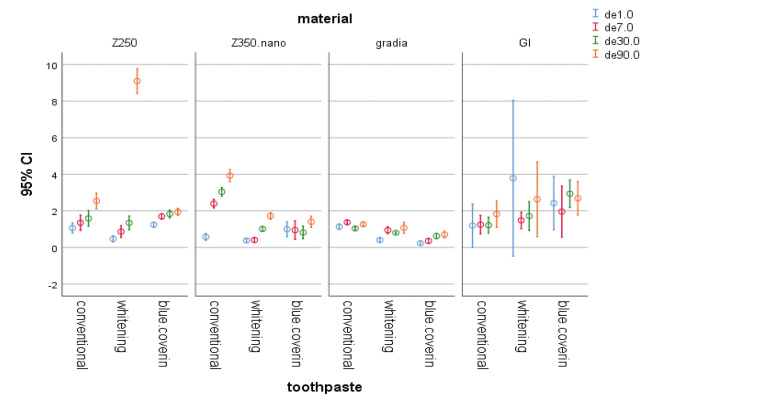
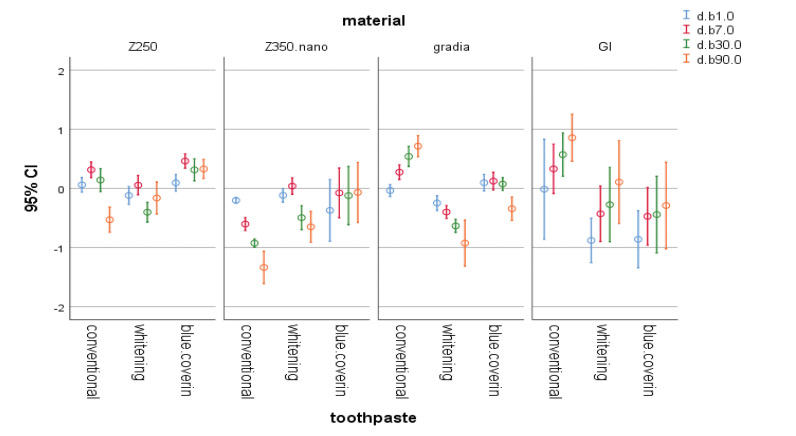
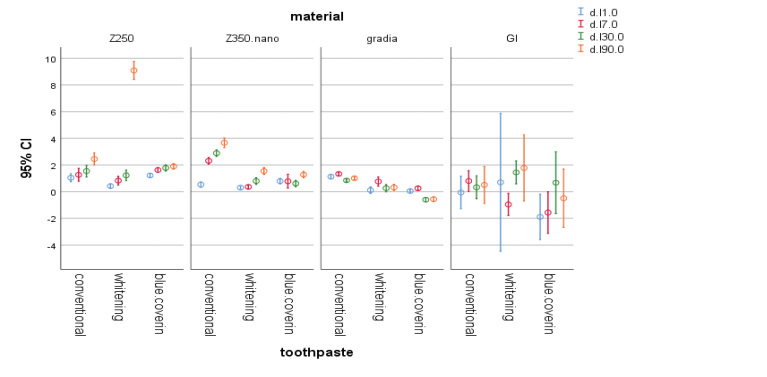
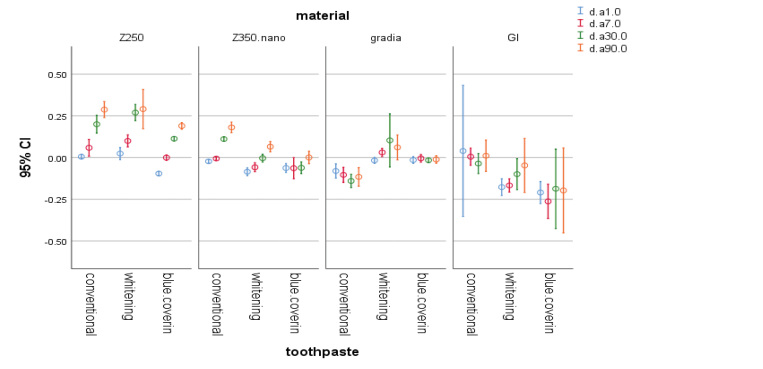
The interaction effect of type of restorative material and time on ∆E was not significant at baseline or 1 day ( > 0.05). The effect of type of toothpaste on ∆E was not significant at baseline or 1 day ( = 0.78) but the effect of type of material was significant ( < 0.05). The toothpastes had significantly different effects on ∆E of Z250 at all time points ( < 0.05) except for ∆E0-30 ( = 0.106). The toothpastes had significantly different effects on ∆E of Z350 and Gradia at all time points ( < 0.05). The same was true for RMGI except for ∆E0-7 ( = 0.43) and ∆E0-90 ( = 0.52). The majority of color changes caused by toothpastes were not clinically perceivable (∆E < 3.3), except for ∆E0-90 by the whitening toothpaste (∆E = 9), ∆E0-90 by the conventional toothpaste for Z350 (∆E = 3.9), and ∆E0-1 by the whitening toothpaste for RMGI (∆E = 3.7).
The color change of all composite samples was not clinically perceivable (<3.3) at all time points, which shows that the tested toothpastes do not cause a significant change in color of composite materials.
本研究旨在评估一款美白牙膏与其他两款牙膏相比,对微混合复合树脂、纳米填充复合树脂、微填充复合树脂以及树脂改性玻璃离子(RMGI)水门汀颜色稳定性的影响。
在本实验研究中,制作了圆盘状复合树脂样本。然后使用碳化硅砂纸对样本进行打磨。每种材料制作27个样本,并使用分光光度计进行比色。然后将每组材料分为三个亚组,分别使用传统美白牙膏和含蓝色共聚物的美白牙膏。一名操作人员使用电动软毛牙刷以圆周运动方式每天对样本刷牙两次,每次30秒。在第0、1、7、30和90天进行比色。
采用双向方差分析(ANOVA)、单向方差分析和Tukey真实显著差异(HSD)检验进行统计分析。
修复材料类型和时间对∆E的交互作用在基线或第1天不显著(>0.05)。牙膏类型对∆E在基线或第1天不显著(=0.78),但材料类型的影响显著(<0.05)。除了∆E0 - 30(=0.106)外,在所有时间点牙膏对Z250的∆E有显著不同影响(<0.05)。在所有时间点牙膏对Z350和Gradia的∆E有显著不同影响(<0.05)。RMGI除了∆E0 - 7(=0.43)和∆E0 - 90(=0.52)外情况相同。除了美白牙膏的∆E0 - 90(∆E = 9)、Z350的传统牙膏的∆E0 - 90(∆E = 3.9)以及RMGI的美白牙膏的∆E0 - 1(∆E = 3.7)外,牙膏引起的大多数颜色变化在临床上无法察觉(∆E < 3.3)。
所有复合树脂样本在所有时间点的颜色变化在临床上均无法察觉(<3.3),这表明所测试的牙膏不会导致复合材料颜色发生显著变化。