Steinbeis-Innovationszentrum Zellkulturtechnik, c/o University of Applied Sciences Mannheim, Paul-Wittsack-Str.10, D-68163 Mannheim, Germany.
Sensors (Basel). 2020 Mar 11;20(6):1570. doi: 10.3390/s20061570.
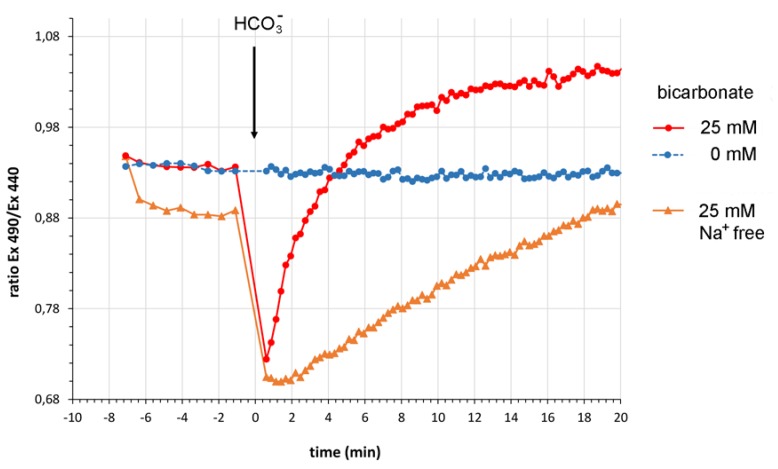
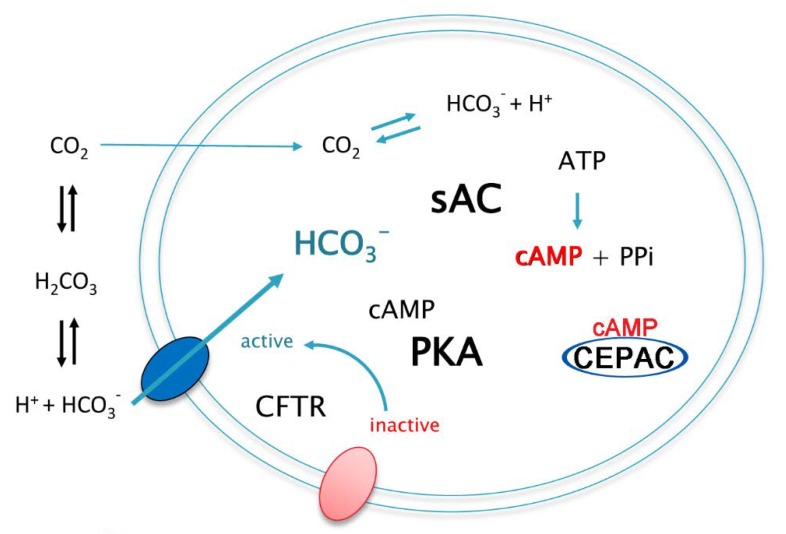
Bicarbonate plays a central role in human physiology from cellular respiration to pH homeostasis. However, so far, the measurement of bicarbonate concentration changes in living cells has only been possible by measuring intracellular pH changes. In this article, we report the development of a genetically encoded pH-independent fluorescence-based single-use sensory cellular test system for monitoring intracellular bicarbonate concentration changes in living cells. We describe the usefulness of the developed biosensor in characterizing the bicarbonate transport activities of anionophores-small molecules capable of facilitating the membrane permeation of this anion. We also demonstrate the ability of the bicarbonate sensory cellular test system to measure intracellular bicarbonate concentration changes in response to activation and specific inhibition of wild-type human CFTR protein when co-expressed with the bicarbonate sensing and reporting units in living cells. A valuable benefit of the bicarbonate sensory cellular test system could be the screening of novel anionophore library compounds for bicarbonate transport activity with efficiencies close to the natural anion channel CFTR, which is not functional in the respiratory epithelia of cystic fibrosis patients.
碳酸氢盐在人体生理学中起着核心作用,从细胞呼吸到 pH 值平衡。然而,到目前为止,只有通过测量细胞内 pH 值的变化,才能测量活细胞中碳酸氢盐浓度的变化。在本文中,我们报告了一种遗传编码的 pH 独立荧光单用途传感细胞测试系统的开发,用于监测活细胞内碳酸氢盐浓度的变化。我们描述了所开发的生物传感器在表征阴离子载体(能够促进这种阴离子的膜渗透的小分子)的碳酸氢盐转运活性方面的有用性。我们还证明了碳酸氢盐传感细胞测试系统能够测量活细胞中内源性人 CFTR 蛋白被激活和特异性抑制时细胞内碳酸氢盐浓度的变化,当将碳酸氢盐感应和报告单元共表达时。碳酸氢盐传感细胞测试系统的一个有价值的好处可能是筛选新型阴离子载体文库化合物,以评估其碳酸氢盐转运活性,其效率接近天然阴离子通道 CFTR,CFTR 在囊性纤维化患者的呼吸道上皮中没有功能。