Department of Sports Medicine, Norwegian School of Sports Sciences, Sognsveien 220, 0806, Oslo, Norway.
Department of Public Health, Sports and Nutrition, University of Agder, Kristiansand, Norway.
Int J Behav Nutr Phys Act. 2020 Mar 14;17(1):39. doi: 10.1186/s12966-020-00945-4.
Observational studies linking physical activity with mortality are susceptible to reverse causation bias from undiagnosed and prevalent diseases. Researchers often attempt to deal with reverse causation bias by excluding deaths occurring within the first 1 or 2 years from the analysis, but it is unclear if excluding deaths within this time-frame is sufficient to remove bias.
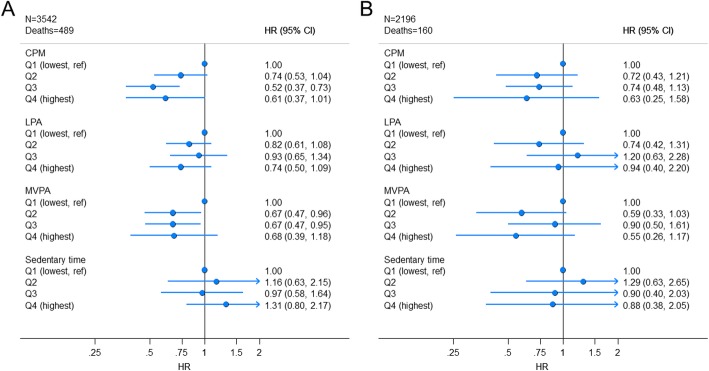
We examined associations between total and intensity-specific physical activity and sedentary time with all-cause mortality in a prospective cohort of 3542 individuals from the 2003-2006 NHANES cycles. In order to yield measures of association hypothesized as minimally influenced by reverse causation bias the primary analysis excluded individuals with < 5 years of follow-up. Accelerometer-measured physical activity was linked with recently updated vital status from the National Death Index with a median follow-up of 10.8 years.
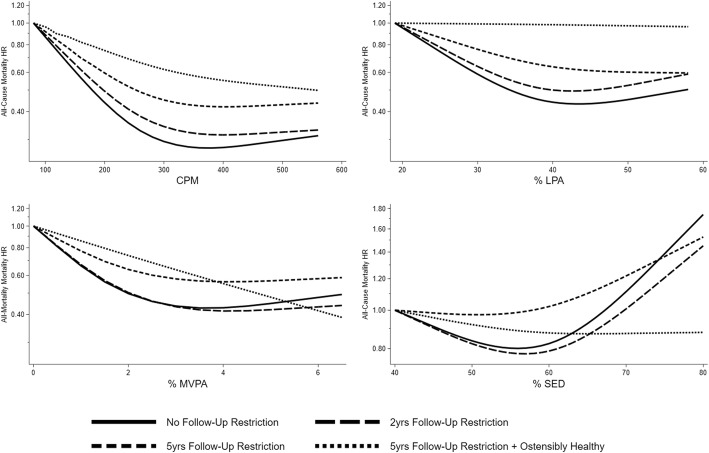
Hazard ratios (95% confidence intervals) were 0.74 (0.53, 1.04), 0.52 (0.37, 0.73), and 0.61 (0.38, 1.01) for ascending quartiles of total physical activity against the least active reference. Hazard ratios for ascending moderate-to-vigorous physical activity quartiles against the reference were 0.67 (0.47, 1.96), 0.67 (0.47, 0.95), and 0.68 (0.39, 1.18). Associations for light intensity physical activity and sedentary time were smaller in magnitude and all confidence intervals included unity. Total activity and moderate-to-vigorous physical activity hazard ratios from analyses only excluding deaths within the first 2 years were inflated by 13 and 26% relative to analysis restricted to ≥5 years of follow-up.
The pattern of associations suggested total physical activity and moderate-to-vigorous physical activity were associated with lower mortality after more than 10 years of follow-up and excluding the first 5 years of observation time to minimize the impact of reverse causation bias. Excluding deaths within the first 2 years appeared insufficient to minimize the impact of reserve causation bias.
将体力活动与死亡率联系起来的观察性研究容易受到未确诊和普遍存在的疾病的反向因果关系偏差的影响。研究人员通常试图通过排除分析中前 1 或 2 年内发生的死亡来处理反向因果关系偏差,但尚不清楚在此时间范围内排除死亡是否足以消除偏差。
我们在 2003-2006 年 NHANES 周期中对来自 3542 名个体的前瞻性队列进行了总体力活动和强度特异性体力活动与全因死亡率之间的关联研究。为了得出被假设为受反向因果关系偏差影响最小的关联度量,主要分析排除了随访时间<5 年的个体。使用加速度计测量的体力活动与国家死亡指数中最近更新的生存状况相关联,中位随访时间为 10.8 年。
与最不活跃的参考相比,总体力活动递增四分位数的风险比(95%置信区间)分别为 0.74(0.53,1.04)、0.52(0.37,0.73)和 0.61(0.38,1.01)。与参考相比,递增的中等至剧烈体力活动四分位数的风险比分别为 0.67(0.47,1.96)、0.67(0.47,0.95)和 0.68(0.39,1.18)。低强度体力活动和久坐时间的关联程度较小,所有置信区间均包含 1。与仅排除前 2 年内死亡的分析相比,总活动和中高强度体力活动的风险比分别增加了 13%和 26%,而限制在≥5 年随访的分析则增加了 13%和 26%。
在超过 10 年的随访后,总体力活动和中高强度体力活动与死亡率较低相关,且在观察时间的前 5 年内排除了观察时间,以最大限度地减少反向因果关系偏差的影响,这一关联模式表明。排除前 2 年内的死亡似乎不足以最大限度地减少储备因果关系偏差的影响。