Departments of Anesthesiology & Pain Management and Neurology & Neurotherapeutics, University of Texas Southwestern Medical Center, Dallas, TX, USA.
Division of Neurology, Department of Pediatrics, Children's Hospital of Philadelphia, Philadelphia, PA, USA.
Pediatr Res. 2020 Dec;88(6):925-933. doi: 10.1038/s41390-020-0841-6. Epub 2020 Mar 14.
Extra-corporeal membrane oxygenation (ECMO) is a life-saving intervention for severe respiratory and cardiac diseases. However, 50% of survivors have abnormal neurologic exams. Current ECMO management is guided by systemic metrics, which may poorly predict cerebral perfusion. Continuous optical monitoring of cerebral hemodynamics during ECMO holds potential to detect risk factors of brain injury such as impaired cerebrovascular autoregulation (CA).
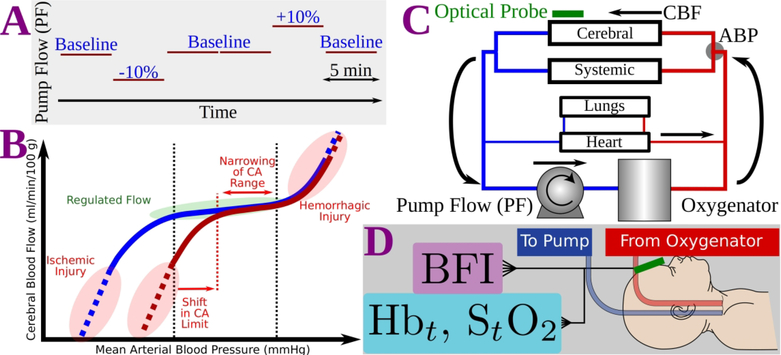
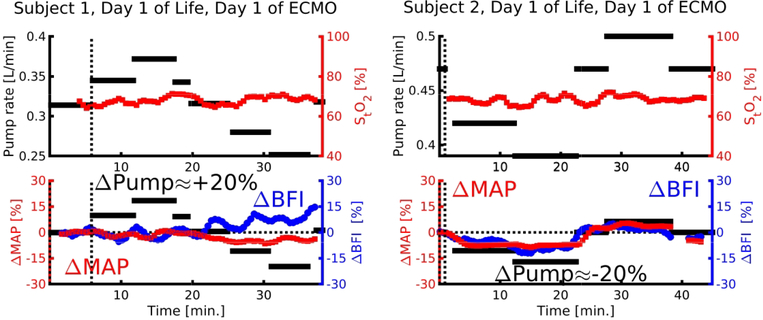
We conducted daily measurements of microvascular cerebral blood flow (CBF), oxygen saturation, and total hemoglobin concentration using diffuse correlation spectroscopy (DCS) and frequency-domain diffuse optical spectroscopy in nine neonates. We characterize CA utilizing the correlation coefficient (DCSx) between CBF and mean arterial blood pressure (MAP) during ECMO pump flow changes.
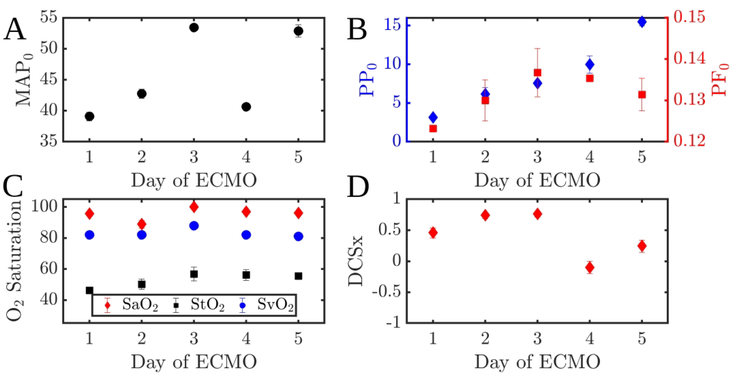
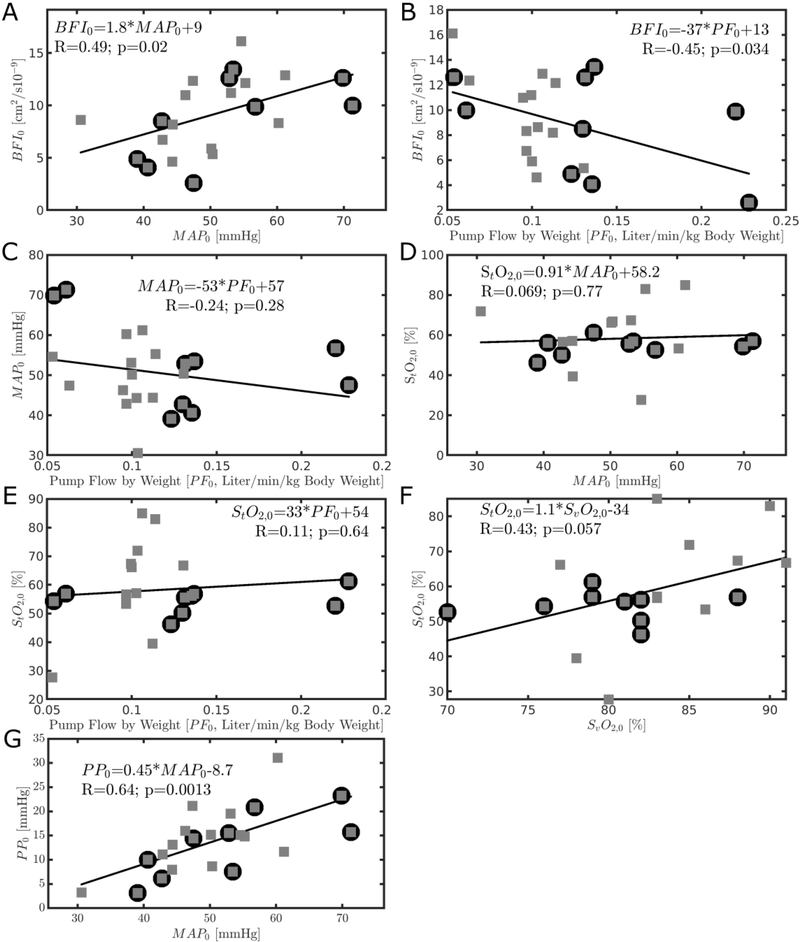
Average MAP and pump flow levels were weakly correlated with CBF and were not correlated with cerebral oxygen saturation. CA integrity varied between individuals and with time. Systemic measurements of MAP, pulse pressure, and left cardiac dysfunction were not predictive of impaired CA.
Our pilot results suggest that systemic measures alone cannot distinguish impaired CA from intact CA during ECMO. Furthermore, optical neuromonitoring could help determine patient-specific ECMO pump flows for optimal CA integrity, thereby reducing risk of secondary brain injury.
Cerebral blood flow and oxygenation are not well predicted by systemic proxies such as ECMO pump flow or blood pressure. Continuous, quantitative, bedside monitoring of cerebral blood flow and oxygenation with optical tools enables new insight into the adequacy of cerebral perfusion during ECMO. A demonstration of hybrid diffuse optical and correlation spectroscopies to continuously measure cerebral blood oxygen saturation and flow in patients on ECMO, enabling assessment of cerebral autoregulation. An observation of poor correlation of cerebral blood flow and oxygenation with systemic mean arterial pressure and ECMO pump flow, suggesting that clinical decision making guided by target values for these surrogates may not be neuroprotective. ~50% of ECMO survivors have long-term neurological deficiencies; continuous monitoring of brain health throughout therapy may reduce these tragically common sequelae through brain-focused adjustment of ECMO parameters.
体外膜肺氧合(ECMO)是治疗严重呼吸和心脏疾病的救命干预措施。然而,50%的幸存者存在异常的神经检查结果。目前的 ECMO 管理是通过系统指标来指导的,这些指标可能无法很好地预测脑灌注。在 ECMO 期间连续光学监测脑血流动力学具有检测脑损伤危险因素(如脑血管自动调节受损)的潜力。
我们对 9 名新生儿进行了使用漫射相关光谱(DCS)和频域漫射光学光谱的每日微血流(CBF)、氧饱和度和总血红蛋白浓度测量。我们利用 ECMO 泵流量变化期间 CBF 和平均动脉血压(MAP)之间的相关系数(DCSx)来描述 CA。
平均 MAP 和泵流量水平与 CBF 弱相关,与脑氧饱和度不相关。CA 的完整性在个体之间和随时间变化。MAP、脉压和左心功能障碍的系统测量不能预测 CA 受损。
我们的初步结果表明,仅使用系统测量无法区分 ECMO 期间 CA 受损与完整 CA。此外,光学神经监测有助于确定特定患者的 ECMO 泵流量,以实现最佳 CA 完整性,从而降低继发性脑损伤的风险。
脑血流和氧合不能通过 ECMO 泵流量或血压等系统替代物很好地预测。使用光学工具连续、定量地床边监测脑血流和氧合,可以深入了解 ECMO 期间脑灌注的充分性。演示了混合漫射光学和相关光谱学,以连续测量 ECMO 患者的脑血氧饱和度和血流,从而评估脑自动调节。观察到脑血流和氧合与系统平均动脉压和 ECMO 泵流量相关性差,这表明根据这些替代物的目标值进行临床决策可能无法起到神经保护作用。约 50%的 ECMO 幸存者存在长期神经功能缺陷;在整个治疗过程中对大脑健康进行连续监测,可能通过针对 ECMO 参数的大脑焦点调整来减少这些非常常见的后遗症。