Roy Bhaskar, Dunbar Michael, Agrawal Juhee, Allen Lauren, Dwivedi Yogesh
Department of Psychiatry and Behavioral Neurobiology, University of Alabama at Birmingham, Birmingham, Alabama.
Int J Neuropsychopharmacol. 2020 Apr 21;23(3):165-177. doi: 10.1093/ijnp/pyz071.
Recent studies suggest that microRNAs (miRNAs) can participate in depression pathogenesis by altering a host of genes that are critical in corticolimbic functioning. The present study focuses on examining whether alterations in the miRNA network in the amygdala are associated with susceptibility or resiliency to develop depression-like behavior in rats.
Amygdala-specific altered miRNA transcriptomics were determined in a rat depression model following next-generation sequencing method. Target prediction analyses (cis- and trans) and qPCR-based assays were performed to decipher the functional role of altered miRNAs. miRNA-specific target interaction was determined using in vitro transfection assay in neuroblastoma cell line. miRNA-specific findings from the rat in vivo model were further replicated in postmortem amygdala of major depressive disorder (MDD) subjects.
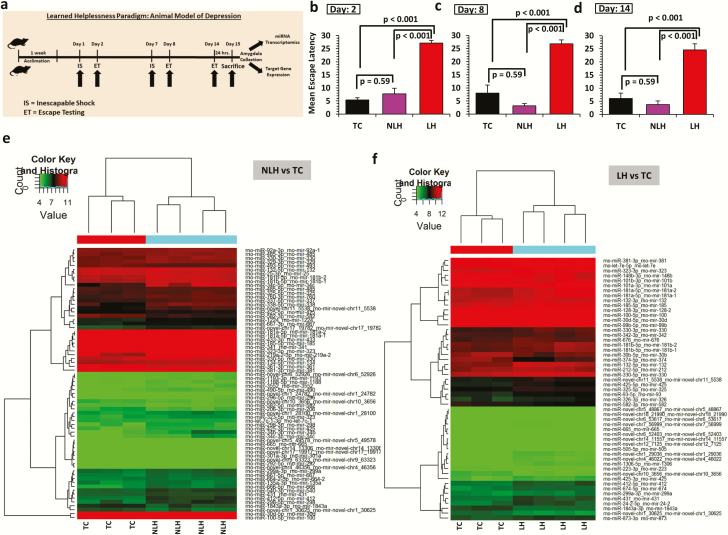
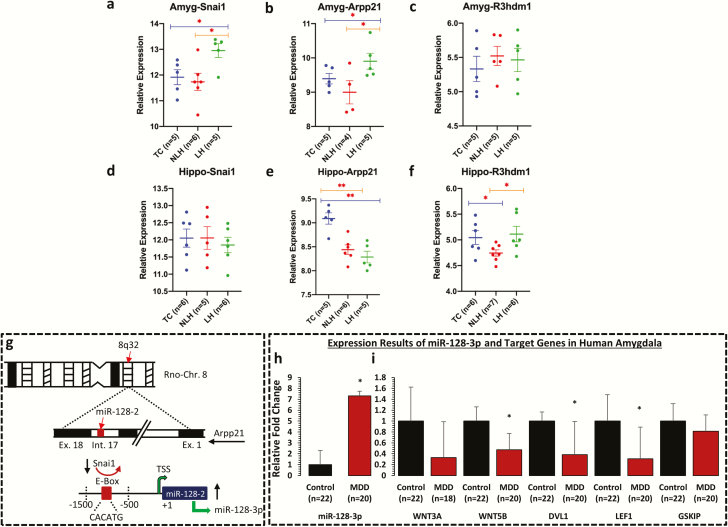
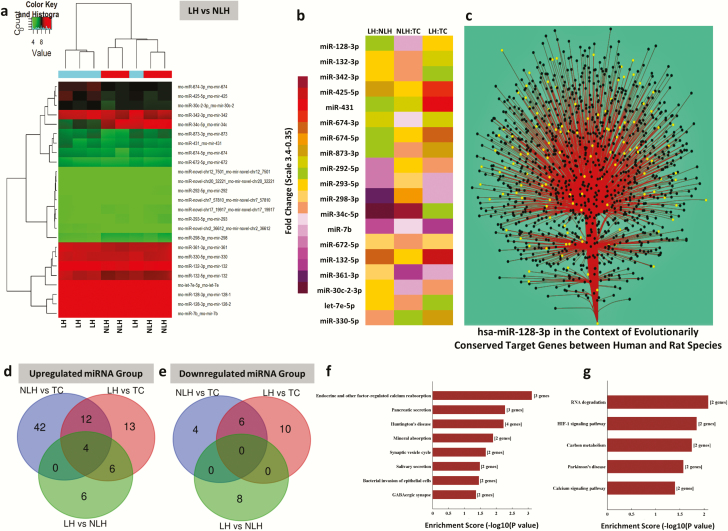
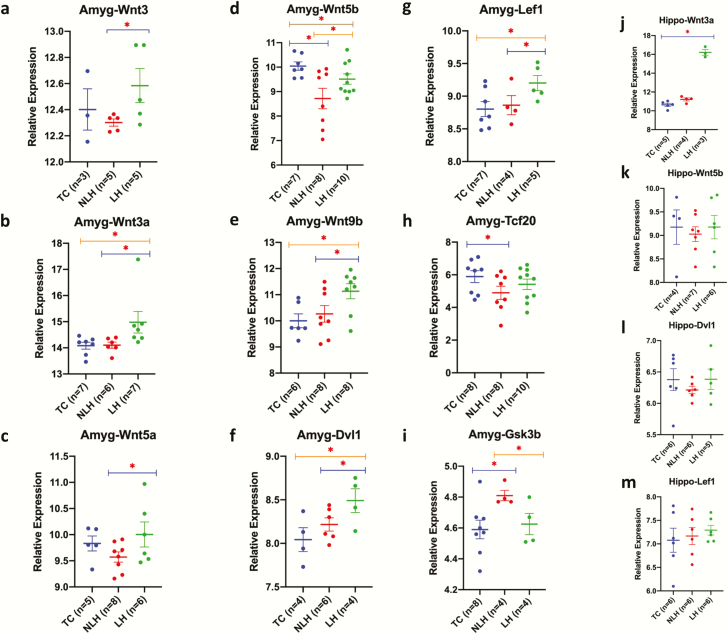
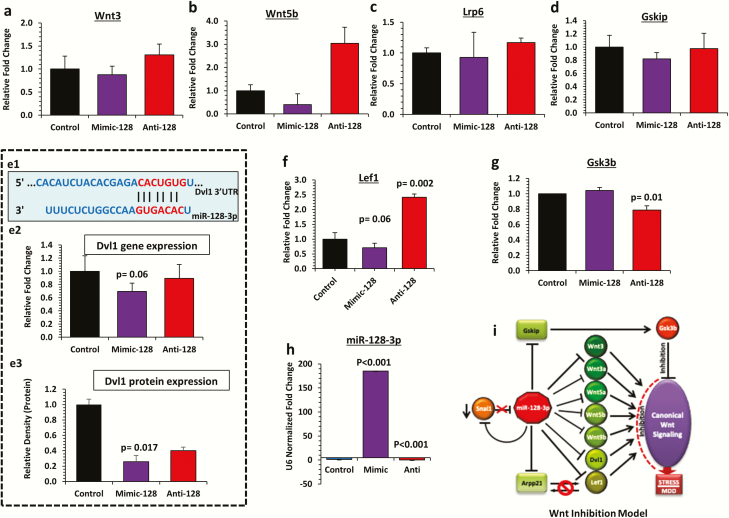
Changes in miRNome identified 17 significantly upregulated and 8 significantly downregulated miRNAs in amygdala of learned helpless (LH) compared with nonlearned helpless rats. Prediction analysis showed that the majority of the upregulated miRNAs had target genes enriched for the Wnt signaling pathway. Among altered miRNAs, upregulated miR-128-3p was identified as a top hit based on statistical significance and magnitude of change in LH rats. Target validation showed significant downregulation of Wnt signaling genes in amygdala of LH rats. A discernable increase in expression of amygdalar miR-128-3p along with significant downregulation of key target genes from Wnt signaling (WNT5B, DVL, and LEF1) was noted in MDD subjects. Overexpression of miR-128-3p in a cellular model lead to a marked decrease in the expression of Dvl1 and Lef1 genes, confirming them as validated targets of miR-128-3p. Additional evidence suggested that the amygdala-specific diminished expression of transcriptional repressor Snai1 could be potentially linked to induced miR-128-2 expression in LH rats. Furthermore, an amygdala-specific posttranscriptional switching mechanism could be active between miR-128-3p and RNA binding protein Arpp21 to gain control over their target genes such as Lef1.
Our study suggests that in amygdala a specific set of miRNAs may play an important role in depression susceptibility, which could potentially be mediated through Wnt signaling.
近期研究表明,微小RNA(miRNA)可通过改变众多对皮质边缘系统功能至关重要的基因来参与抑郁症的发病机制。本研究着重探讨杏仁核中miRNA网络的改变是否与大鼠出现抑郁样行为的易感性或恢复力相关。
采用下一代测序方法,在大鼠抑郁模型中确定杏仁核特异性改变的miRNA转录组学。进行靶标预测分析(顺式和反式)以及基于qPCR的检测,以阐明改变的miRNA的功能作用。使用神经母细胞瘤细胞系的体外转染试验确定miRNA特异性靶标相互作用。在重度抑郁症(MDD)患者的尸检杏仁核中进一步重复大鼠体内模型的miRNA特异性研究结果。
与未习得性无助大鼠相比,习得性无助(LH)大鼠杏仁核中的miRNome变化显示,有17种miRNA显著上调,8种miRNA显著下调。预测分析表明,大多数上调的miRNA的靶基因在Wnt信号通路中富集。在改变的miRNA中,基于LH大鼠的统计学显著性和变化幅度,上调的miR-128-3p被确定为最显著的一种。靶标验证显示,LH大鼠杏仁核中Wnt信号基因显著下调。在MDD患者中,杏仁核miR-128-3p的表达明显增加,同时Wnt信号的关键靶基因(WNT5B、DVL和LEF1)显著下调。在细胞模型中过表达miR-128-3p导致Dvl1和Lef1基因的表达显著降低,证实它们是miR-128-3p的有效靶标。额外的证据表明,LH大鼠中杏仁核特异性转录抑制因子Snai1表达的减少可能与诱导的miR-128-2表达潜在相关。此外,在miR-128-3p和RNA结合蛋白Arpp21之间可能存在一种杏仁核特异性的转录后转换机制,以控制它们的靶基因如Lef1。
我们的研究表明,在杏仁核中,一组特定的miRNA可能在抑郁症易感性中起重要作用,这可能通过Wnt信号通路介导。