Heilbrunn Department of Population and Family Health, Mailman School of Public Health, Columbia University, New York, NY, USA.
Regional Institute for Population Studies, University of Ghana, Accra, Ghana.
Glob Health Action. 2020 Dec 31;13(1):1732664. doi: 10.1080/16549716.2020.1732664.
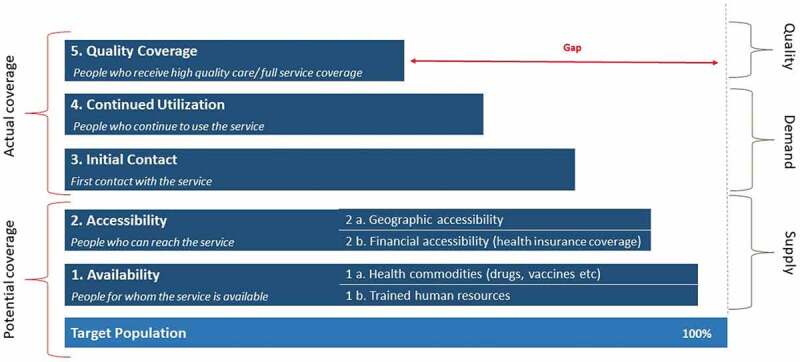
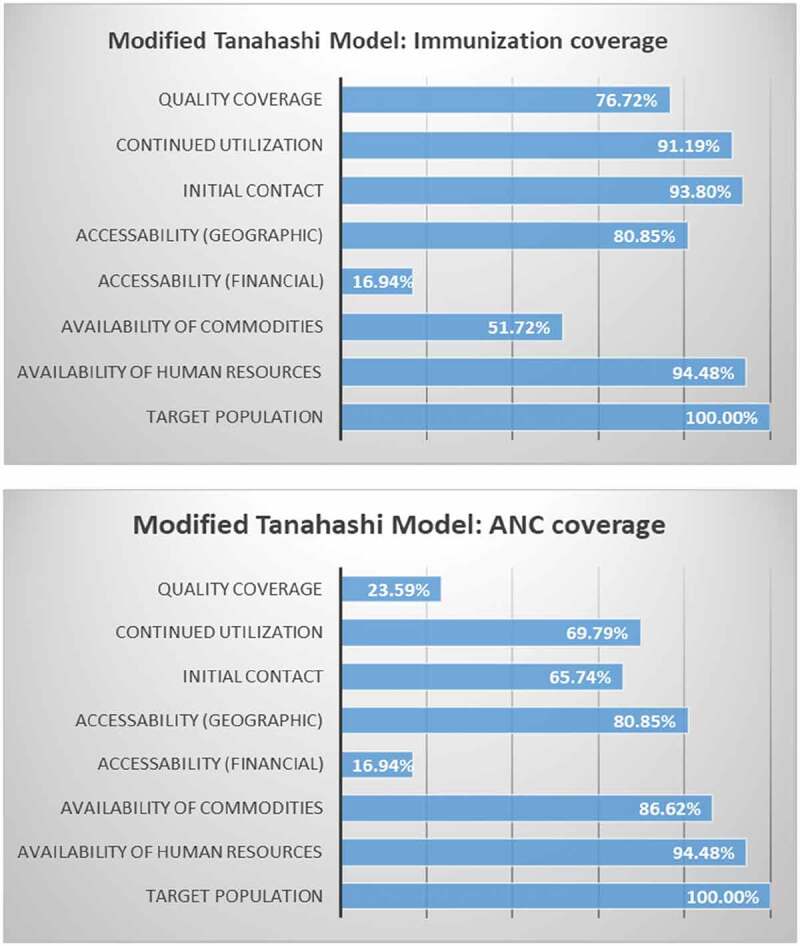
: The United Nations 2030 Sustainable Development Goals have reaffirmed the international community's commitment to maternal, newborn, and child health, with further investments in achieving quality essential service coverage and financial protection for all.: Using a modified version of the 1978 Tanahashi model as an analytical framework for measuring and assessing health service coverage, this paper aims to examine the system of care at the community level in Ghana's Volta Region to highlight the continued reforms needed to achieve Universal Health Coverage.: The Tanahashi model evaluates health system coverage through five key measures that reflect different stages along the service provision continuum: availability of services; accessibility; initial contact with the health system; continued utilization; and quality coverage. Data from cross-sectional household and health facility surveys were used in this study. Immunization and antenatal care services were selected as tracer interventions to serve as proxies to assess systems bottlenecks.: Financial access and quality coverage were identified as the biggest bottlenecks for both tracer indicators. Financial accessibility, measured by enrollment in Ghana's National Health Insurance Scheme was poor with 16.94% presenting valid membership cards. Childhood immunization was high but dropped modestly from 93.8% at initial contact to 76.7% quality coverage. For antenatal care, estimates ranged from 65.9% at initial visit to 25.1% quality coverage.: Results highlight the difficulty in achieving high levels of quality service coverage and the large variations that exist within services provided at the primary care level. While vertical investments have been prioritized to benefit specific health services, a comprehensive systems approach to primary health care needs to be further strengthened to reach Ghana's Universal Health Coverage objectives.
联合国 2030 年可持续发展目标重申了国际社会对母婴和儿童健康的承诺,进一步投资于实现所有人都能获得优质基本服务和财务保障的目标。本文使用经改良的 1978 年田原模式作为分析框架,旨在评估加纳沃尔特地区社区一级的护理系统,以突出实现全民健康覆盖所需的持续改革。田原模式通过五个关键指标来评估卫生系统覆盖范围,这些指标反映了服务提供连续体的不同阶段:服务的提供情况、可及性、与卫生系统的初次接触、持续利用以及优质覆盖。本研究使用了横断面家庭和卫生机构调查的数据。选择免疫和产前护理服务作为示踪干预措施,作为评估系统瓶颈的代理指标。财务可及性和优质覆盖被确定为这两个示踪指标的最大瓶颈。财务可及性的衡量指标是加纳国家健康保险计划的参保率,只有 16.94%的人持有有效的会员卡,参保率很低。儿童免疫接种率很高,但从初次接触时的 93.8%略有下降到 76.7%的优质覆盖。产前护理方面,估计从初次就诊的 65.9%到优质覆盖的 25.1%不等。研究结果突出了实现高质量服务覆盖的困难,以及初级保健服务中存在的巨大差异。虽然垂直投资已被优先用于特定的卫生服务,但需要进一步加强全面的初级卫生保健系统方法,以实现加纳的全民健康覆盖目标。