Department of Disease Control, London School of Hygiene and Tropical Medicine, London, UK.
Department of Global Health and Development, London School of Hygiene and Tropical Medicine, London, UK.
J Glob Health. 2022 Jan 15;12:04001. doi: 10.7189/jogh.12.04001. eCollection 2022.
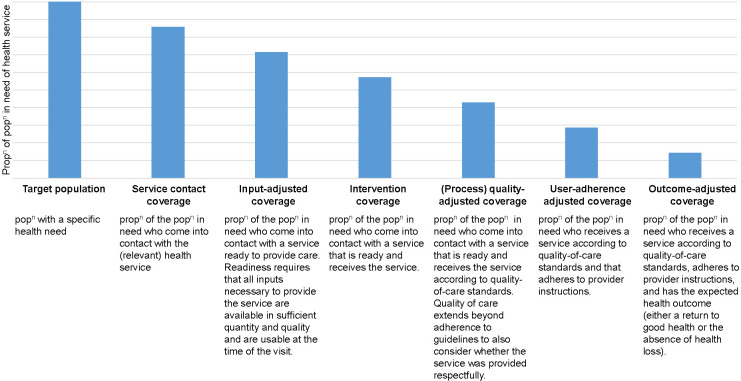
Effective coverage measures aim to estimate the proportion of a population in need of a service that received a positive health outcome. In 2020, the Effective Coverage Think Tank Group recommended using a 'coverage cascade' for maternal, newborn, child and adolescent health and nutrition (MNCAHN), which organises components of effective coverage in a stepwise fashion, with each step accounting for different aspects of quality of care (QoC), applied at the population level. The cascade outlines six steps that increase the likelihood that the population in need experience the intended health benefit: 1) the population in need (target population) who contact a health service; 2) that has the inputs available to deliver the service; 3) who receive the health service; 4) according to quality standards; 5) and adhere to prescribed medication(s) or health workers instructions; and 6) experience the expected health outcome. We examined how effective coverage of life-saving interventions from childbirth to children aged nine has been defined and assessed which steps of the cascade are captured by existing measures.
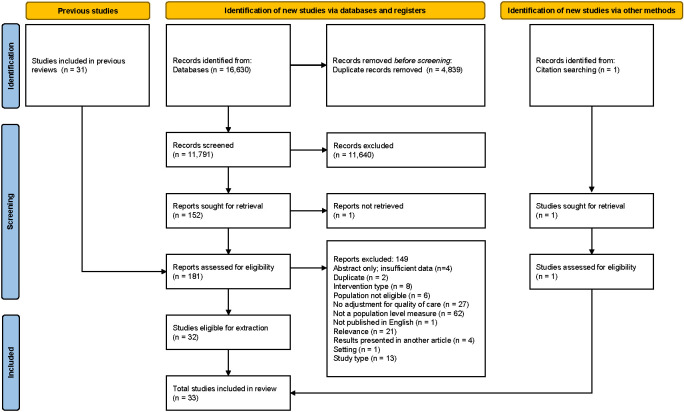
We undertook a rapid systematic review. Seven scientific literature databases were searched covering the period from May 1, 2017 to July, 8 2021. Reference lists from reviews published in 2018 and 2019 were examined to identify studies published prior to May 2017. Eligible studies reported population-level contact coverage measures adjusted for at least one dimension of QoC.
Based on these two search approaches this review includes literature published from 2010 to 2021. From 16 662 records reviewed, 33 studies were included, reporting 64 effective coverage measures. The most frequently examined measures were for childbirth and immediate newborn care (n = 24). No studies examined measures among children aged five to nine years. Definitions of effective coverage varied across studies. Key sources of variability included (i) whether a single effective coverage measure was reported for a package of interventions or separate measures were calculated for each intervention; (ii) the number and type of coverage cascade steps applied to adjust for QoC; and (iii) the individual items included in the effective coverage definition and the methods used to generate a composite quality measure.
In the MNCAHN literature there is substantial heterogeneity in both definitions and construction of effective coverage, limiting the comparability of measures over time and place. Current measurement approaches are not closely aligned with the proposed cascade. For widespread adoption, there is a need for greater standardisation of indicator definitions and transparency in reporting, so governments can use these measures to improve investments in MNACHN and implement life-saving health policies and programs.
有效覆盖衡量标准旨在估算需要服务的人群中获得积极健康结果的比例。2020 年,有效覆盖智库小组建议使用孕产妇、新生儿、儿童和青少年健康与营养(MNCAHN)的“覆盖级联”,该级联以逐步的方式组织有效覆盖的组成部分,每个步骤都考虑到护理质量(QoC)的不同方面,适用于人群层面。级联概述了六个步骤,可提高目标人群获得预期健康益处的可能性:1)需要服务的人群(目标人群)接触卫生服务;2)有提供服务的投入;3)获得卫生服务;4)符合质量标准;5)并遵守规定的药物(或卫生工作者的指示);6)体验预期的健康结果。我们研究了从分娩到 9 岁儿童的救命干预措施的有效覆盖范围是如何定义的,并评估了现有措施涵盖了级联的哪些步骤。
我们进行了快速系统审查。七个科学文献数据库对 2017 年 5 月 1 日至 2021 年 7 月 8 日期间的文献进行了搜索。对 2018 年和 2019 年发表的综述的参考文献进行了检查,以确定 2017 年 5 月之前发表的研究。合格的研究报告了经过至少一个 QoC 维度调整的人群接触覆盖措施。
根据这两种搜索方法,本综述包括 2010 年至 2021 年发表的文献。从审查的 16662 条记录中,纳入了 33 项研究,报告了 64 项有效覆盖措施。最常检查的措施是分娩和新生儿即时护理(n=24)。没有研究检查五岁至九岁儿童的措施。有效覆盖的定义在不同的研究中存在差异。可变性的主要来源包括:i)是否为一揽子干预措施报告了单一的有效覆盖措施,还是为每个干预措施单独计算了措施;ii)应用于调整 QoC 的覆盖级联步骤的数量和类型;以及 iii)有效覆盖定义中包含的个别项目以及生成综合质量措施的方法。
在 MNCAHN 文献中,有效覆盖的定义和构建存在很大的异质性,限制了措施在时间和地点上的可比性。目前的衡量方法与建议的级联并不完全一致。为了广泛采用,需要更加标准化指标定义,并提高报告的透明度,以便各国政府能够利用这些措施来改善 MNACHN 的投资,并实施拯救生命的卫生政策和方案。