Peluso Michael J, Thanh Cassandra, Prator Cecilia A, Hogan Louise E, Arechiga Victor M, Stephenson Sophie, Norris Philip J, Di Germanio Clara, Fuchs Dietmar, Zetterberg Henrik, Deeks Steven G, Gisslén Magnus, Price Richard W, Henrich Timothy J
Division of HIV, Infectious Diseases, and Global Medicine, Zuckerberg San Francisco General Hospital, University of California San Francisco, San Francisco, USA.
Division of Experimental Medicine, University of California San Francisco, San Francisco, USA.
J Virus Erad. 2020 Feb 20;6(1):19-26. doi: 10.1016/S2055-6640(20)30006-6.
The aim of this study was to assess soluble CD30 (sCD30), a protein that colocalises with HIV-1 RNA and DNA in lymphoid cells and tissues, in cerebrospinal fluid (CSF) as a marker of HIV-1 infection in the central nervous system (CNS).
This was a cross-sectional study using archived samples from two clinical cohorts. Soluble CD30 concentrations were measured in paired CSF and plasma from untreated viraemic individuals (=52), individuals on suppressive antiretroviral therapy (ART) (=33), HIV-1 controllers (=10), participants with CSF HIV-1 'escape' (=11) and controls without HIV-1 infection (=16). Nonparametric tests were used to compare levels across groups and evaluate correlations with HIV-1 RNA, CSF neurofilament light chain protein (NFL) and neopterin.
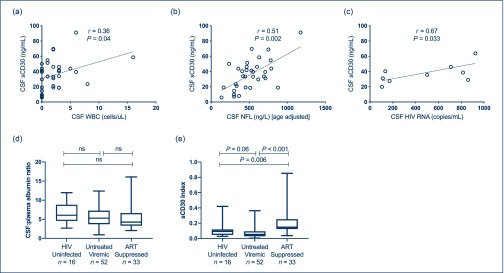
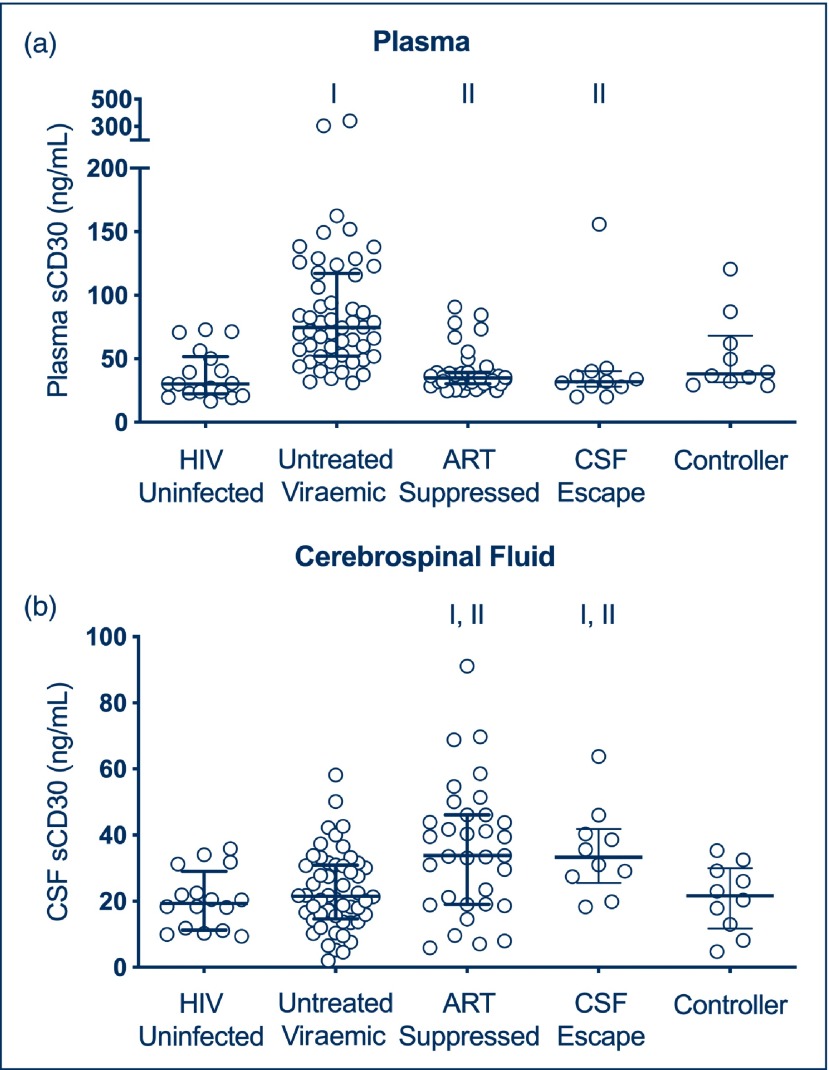
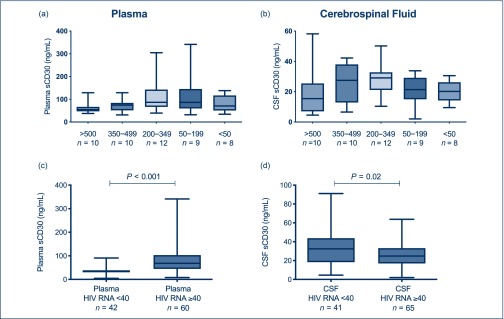
Compared with controls (median 30 ng/mL, interquartile range [IRQ] 23-50), plasma sCD30 levels were elevated in viraemic participants (75 ng/mL, 52-116; <0.001), but not in those on suppressive ART (38 ng/mL, 32-62). In contrast, CSF sCD30 levels were elevated in ART-suppressed individuals (34 ng/mL, 19-46; =0.001) and in those with CSF 'escape' (33 ng/mL, 27-40; =0.004) compared with controls (18 ng/mL, 11-23), but not in untreated viraemic individuals. No association was observed between CSF sCD30 and plasma HIV-1 RNA, concurrent or nadir CD4+ T cell count, duration of infection or plasma sCD30. CSF sCD30 correlated with CSF NFL (=0.34, =0.001).
In contrast to plasma, sCD30 levels are elevated in the CSF of individuals with HIV-1 infection who are on suppressive ART. Elevated levels of sCD30 in the CSF may be an indicator of persistent CNS HIV-1 infection, although the mechanism underlying this elevation warrants further investigation.
本研究旨在评估可溶性CD30(sCD30),一种在淋巴细胞和组织中与HIV-1 RNA和DNA共定位的蛋白质,作为中枢神经系统(CNS)中HIV-1感染的标志物在脑脊液(CSF)中的情况。
这是一项横断面研究,使用来自两个临床队列的存档样本。在未治疗的病毒血症个体(n = 52)、接受抑制性抗逆转录病毒治疗(ART)的个体(n = 33)、HIV-1控制者(n = 10)、脑脊液HIV-1“逃逸”的参与者(n = 11)和无HIV-1感染的对照者(n = 16)的配对脑脊液和血浆中测量可溶性CD30浓度。使用非参数检验比较各组水平,并评估与HIV-1 RNA、脑脊液神经丝轻链蛋白(NFL)和新蝶呤的相关性。
与对照组(中位数30 ng/mL,四分位间距[IRQ] 23 - 50)相比,病毒血症参与者的血浆sCD30水平升高(75 ng/mL,52 - 116;P < 0.001),但接受抑制性ART的参与者中未升高(38 ng/mL,32 - 62)。相比之下,与对照组(18 ng/mL,11 - 23)相比,接受ART抑制的个体(34 ng/mL,19 - 46;P = 0.001)和脑脊液“逃逸”的个体(33 ng/mL,27 - 40;P = 0.004)的脑脊液sCD30水平升高,但未治疗的病毒血症个体中未升高。未观察到脑脊液sCD30与血浆HIV-1 RNA、同期或最低点CD4 + T细胞计数、感染持续时间或血浆sCD30之间的关联。脑脊液sCD30与脑脊液NFL相关(r = 0.34,P = 0.001)。
与血浆相反,接受抑制性ART的HIV-1感染个体的脑脊液中sCD30水平升高。脑脊液中sCD30水平升高可能是中枢神经系统持续HIV-1感染的一个指标,尽管这种升高的潜在机制值得进一步研究。