Department of Pharmacology and Experimental Neuroscience, University of Nebraska Medical Center, Omaha, NE, United States.
Department of Microbiology and Immunology, University of Miami School of Medicine, Miami, FL, United States.
Front Immunol. 2020 Oct 9;11:583934. doi: 10.3389/fimmu.2020.583934. eCollection 2020.
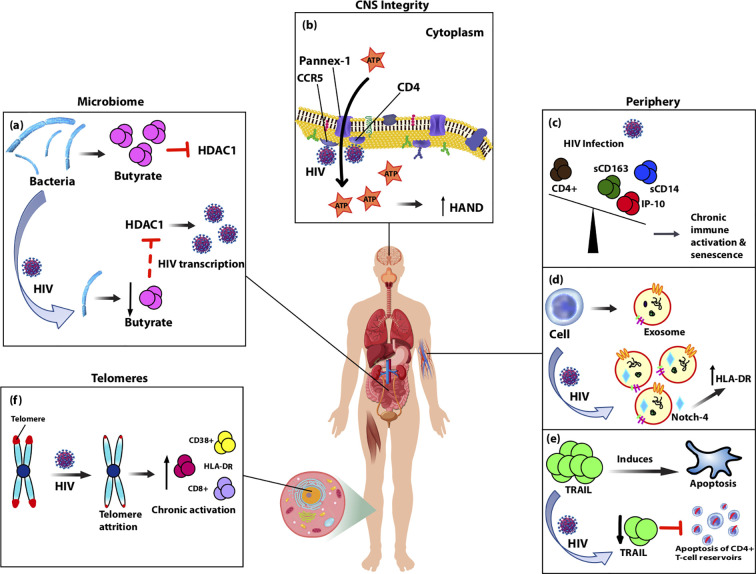
With advancement, prompt use, and increasing accessibility of antiretroviral therapy, people with HIV are living longer and have comparable lifespans to those negative for HIV. However, people living with HIV experience tradeoffs with quality of life often developing age-associated co-morbid conditions such as cancers, cardiovascular diseases, or neurodegeneration due to chronic immune activation and inflammation. This creates a discrepancy in chronological and physiological age, with HIV-infected individuals appearing older than they are, and in some contexts ART-associated toxicity exacerbates this gap. The complexity of the accelerated aging process in the context of HIV-infection highlights the need for greater understanding of biomarkers involved. In this review, we discuss markers identified in different anatomical sites of the body including periphery, brain, and gut, as well as markers related to DNA that may serve as reliable predictors of accelerated aging in HIV infected individuals as it relates to inflammatory state and immune activation.
随着抗逆转录病毒疗法的进步、及时应用和可及性的提高,HIV 感染者的寿命延长,与 HIV 阴性者的寿命相当。然而,HIV 感染者的生活质量存在权衡,由于慢性免疫激活和炎症,他们经常会出现与年龄相关的合并症,如癌症、心血管疾病或神经退行性疾病。这就造成了生理年龄和实际年龄的差异,HIV 感染者看起来比实际年龄更老,在某些情况下,抗逆转录病毒药物治疗相关的毒性会加剧这种差距。HIV 感染加速衰老过程的复杂性突出了需要更好地了解相关生物标志物。在这篇综述中,我们讨论了在身体的不同解剖部位(包括外周、大脑和肠道)中确定的标志物,以及与 DNA 相关的标志物,这些标志物可能作为 HIV 感染者加速衰老的可靠预测指标,与炎症状态和免疫激活有关。