INSERM, U1082 IRTOMIT, 86021 Poitiers, France.
Université de Limoges, Faculté de Médecine, EA 6309 "Maintenance Myélinique et Neuropathies Périphériques", 87025 Limoges, France.
Biomolecules. 2020 Mar 12;10(3):439. doi: 10.3390/biom10030439.
Ischemia-reperfusion injury is encountered in numerous processes such as cardiovascular diseases or kidney transplantation; however, the latter involves cold ischemia, different from the warm ischemia found in vascular surgery by arterial clamping. The nature and the intensity of the processes induced by ischemia types are different, hence the therapeutic strategy should be adapted. Herein, we investigated the protective role of tannic acid, a natural polyphenol in a rat model reproducing both renal warm ischemia and kidney allotransplantation. The follow-up was done after 1 week.
To characterize the effect of tannic acid, an in vitro model of endothelial cells subjected to hypoxia-reoxygenation was used.
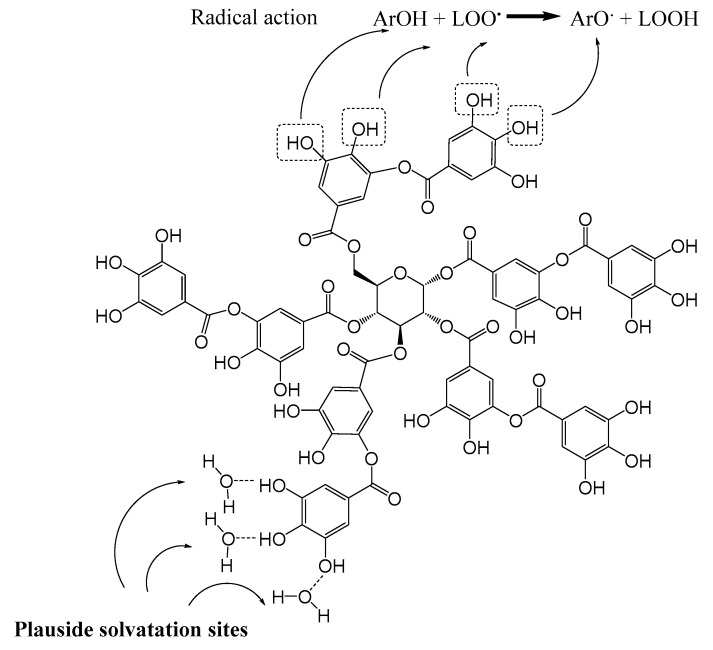
Tannic acid statistically improved recovery after warm ischemia but not after cold ischemia. In kidneys biopsies, 3h after warm ischemia-reperfusion, oxidative stress development was limited by tannic acid and the production of reactive oxygen species was inhibited, potentially through Nuclear Factor erythroid-2-Related factor 2 (NRF2) activation. In vitro, tannic acid and its derivatives limited cytotoxicity and the generation of reactive oxygen species. Molecular dynamics simulations showed that tannic acid efficiently interacts with biological membranes, allowing efficient lipid oxidation inhibition. Tannic acid also promoted endothelial cell migration and proliferation during hypoxia.
Tannic acid was able to improve renal recovery after renal warm ischemia with an antioxidant effect putatively extended by the production of its derivatives in the body and promoted cell regeneration during hypoxia. This suggests that the mechanisms induced by warm and cold ischemia are different and require specific therapeutic strategies.
缺血再灌注损伤发生于多种过程,如心血管疾病或肾移植;然而,后者涉及冷缺血,与血管手术中动脉夹闭导致的温缺血不同。不同类型的缺血所诱导的过程的性质和强度不同,因此治疗策略应适应这些不同。在此,我们研究了单宁酸在一种模拟肾温缺血和同种异体肾移植的大鼠模型中的保护作用。随访时间为 1 周。
为了研究单宁酸的作用,我们使用了一种体外缺氧-复氧内皮细胞模型。
单宁酸在统计学上改善了温缺血后的恢复,但对冷缺血无改善。在肾脏活检中,温缺血再灌注 3 小时后,氧化应激的发展受到单宁酸的限制,活性氧的产生受到抑制,这可能是通过核因子红细胞 2 相关因子 2(NRF2)的激活。在体外,单宁酸及其衍生物可限制细胞毒性和活性氧的产生。分子动力学模拟表明,单宁酸可有效地与生物膜相互作用,从而有效地抑制脂质氧化。单宁酸还促进了缺氧时内皮细胞的迁移和增殖。
单宁酸能够改善肾温缺血后的肾功能恢复,其抗氧化作用可能通过其在体内产生的衍生物来延长,并促进缺氧时细胞的再生。这表明温缺血和冷缺血的机制不同,需要特定的治疗策略。