Bianco Federico, Pasini Elena, Nutini Marcello, Murgia Xabier, Stoeckl Carolin, Schlun Martin, Hetzer Uwe, Bonelli Sauro, Lombardini Marta, Milesi Ilaria, Pertile Marisa, Minocchieri Stefan, Salomone Fabrizio, Bucholski Albert
Department of Preclinical Pharmacology, R&D, Chiesi Farmaceutici S.p.A., 43122 Parma, Italy.
Scientific Consultancy, 48640 Bilbao, Spain.
Pharmaceutics. 2020 Mar 12;12(3):257. doi: 10.3390/pharmaceutics12030257.
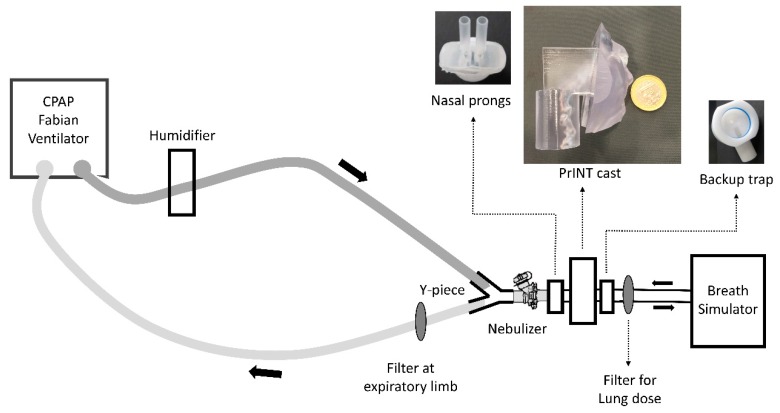
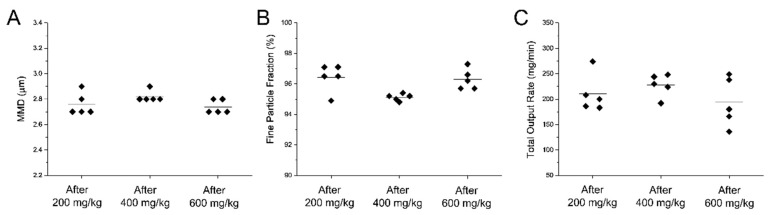
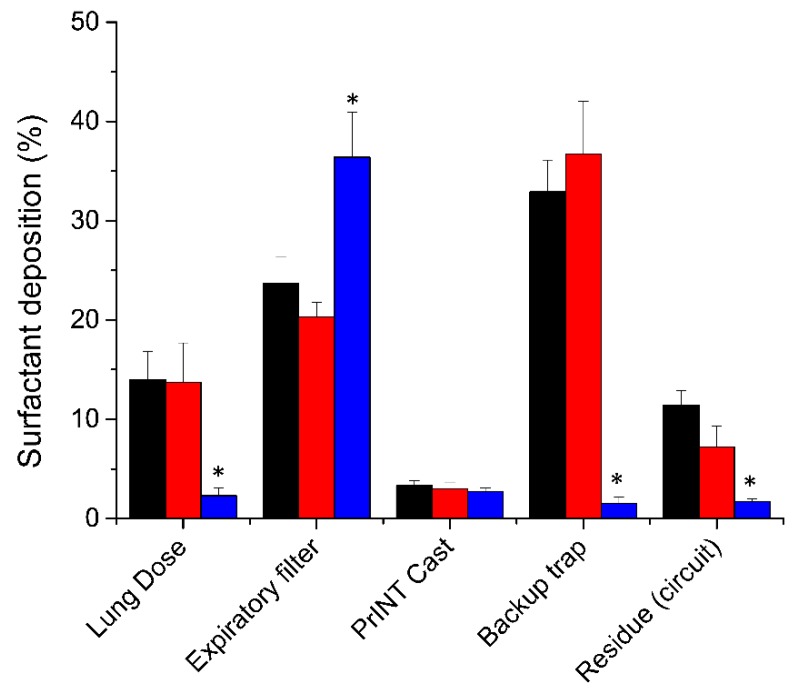
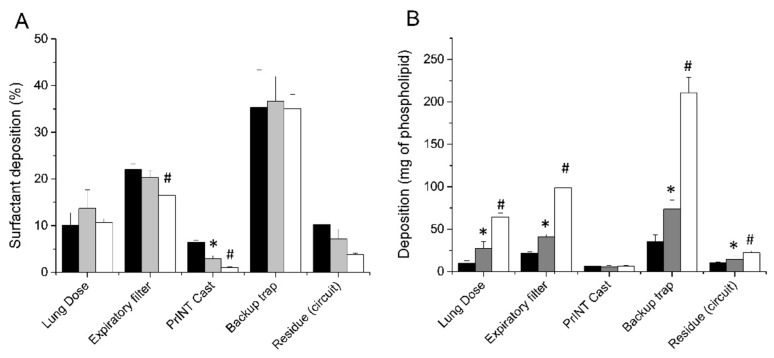
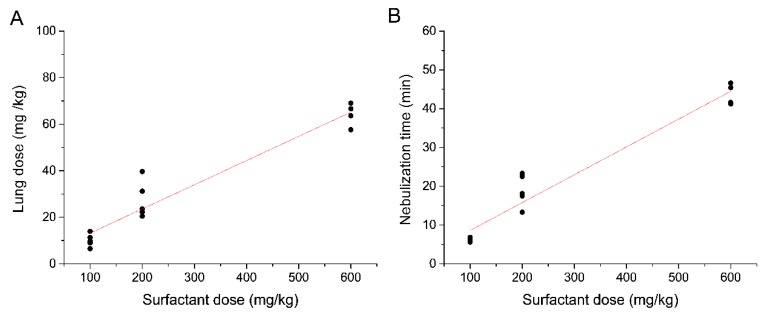
Non-invasive delivery of nebulized surfactant has been a long-pursued goal in neonatology. Our aim was to evaluate the performance of an investigational vibrating-membrane nebulizer in a realistic non-invasive neonatal ventilation circuit with different configurations. Surfactant (aerosols were generated with a nebulizer in a set-up composed of a continuous positive airway pressure (CPAP) generator with a humidifier, a cast of the upper airway of a preterm infant (PrINT), and a breath simulator with a neonatal breathing pattern. The lung dose (LD), defined as the amount of surfactant collected in a filter placed at the distal end of the PrINT cast, was determined after placing the nebulizer at different locations of the circuit and using either infant nasal mask or nasal prongs as CPAP interfaces. The LD after delivering a range of nominal surfactant doses (100-600 mg/kg) was also investigated. Surfactant aerosol particle size distribution was determined by laser diffraction. Irrespective of the CPAP interface used, about 14% of the nominal dose (200 mg/kg) reached the LD filter. However, placing the nebulizer between the Y-piece and the CPAP interface significantly increased the LD compared with placing it 7 cm before the Y-piece, in the inspiratory limb. (14% ± 2.8 vs. 2.3% ± 0.8, nominal dose of 200 mg/kg). The customized eFlow Neos showed a constant aerosol generation rate and a mass median diameter of 2.7 μm after delivering high surfactant doses (600 mg/kg). The customized eFlow Neos nebulizer showed a constant performance even after nebulizing high doses of undiluted surfactant. Placing the nebulizer between the Y-piece and the CPAP interface achieves the highest LD under non-invasive ventilation conditions.
雾化表面活性剂的无创给药一直是新生儿学领域长期追求的目标。我们的目的是在具有不同配置的实际无创新生儿通气回路中评估一种研究用振动膜雾化器的性能。使用雾化器在由带有加湿器的持续气道正压通气(CPAP)发生器、早产儿上呼吸道模型(PrINT)和具有新生儿呼吸模式的呼吸模拟器组成的装置中产生表面活性剂气溶胶。肺剂量(LD)定义为放置在PrINT模型远端的过滤器中收集的表面活性剂的量,在将雾化器放置在回路的不同位置并使用婴儿鼻面罩或鼻导管作为CPAP接口后进行测定。还研究了在输送一系列标称表面活性剂剂量(100 - 600 mg/kg)后的肺剂量。通过激光衍射测定表面活性剂气溶胶粒径分布。无论使用何种CPAP接口,约14%的标称剂量(200 mg/kg)到达肺剂量过滤器。然而,与将雾化器放置在吸气支中Y形接头前方7 cm处相比,将雾化器放置在Y形接头和CPAP接口之间可显著增加肺剂量。(14% ± 2.8对2.3% ± 0.8,标称剂量200 mg/kg)。定制的eFlow Neos在输送高表面活性剂剂量(600 mg/kg)后显示出恒定的气溶胶生成速率和质量中值直径为2.7μm。即使在雾化高剂量未稀释的表面活性剂后,定制的eFlow Neos雾化器仍显示出恒定的性能。在无创通气条件下,将雾化器放置在Y形接头和CPAP接口之间可实现最高的肺剂量。