Kim Donghyun, Lee Sangbong, Lee Jihwan
Korea Marine Equipment Research Institute, Busan 49111, Korea.
Lab021, Busan 48508, Korea.
Sensors (Basel). 2020 Mar 12;20(6):1588. doi: 10.3390/s20061588.
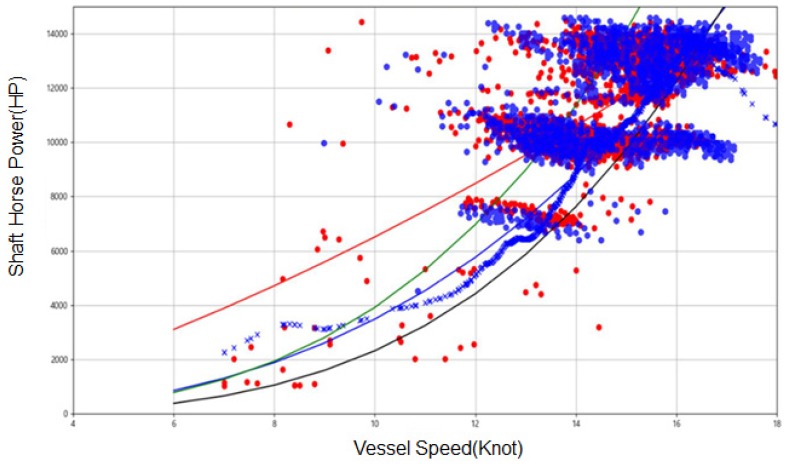
The fluctuation of the oil price and the growing requirement to reduce greenhouse gas emissions have forced ship builders and shipping companies to improve the energy efficiency of the vessels. The accurate prediction of the required propulsion power at various operating condition is essential to evaluate the energy-saving potential of a vessel. Currently, a new ship is expected to use the ISO15016 method in estimating added resistance induced by external environmental factors in power prediction. However, since ISO15016 usually assumes static water conditions, it may result in low accuracy when it is applied to various operating conditions. Moreover, it is time consuming to apply the ISO15016 method because it is computationally expensive and requires many input data. To overcome this limitation, we propose a data-driven approach to predict the propulsion power of a vessel. In this study, support vector regression (SVR) is used to learn from big data obtained from onboard measurement and the National Oceanic and Atmospheric Administration (NOAA) database. As a result, we show that our data-driven approach shows superior performance compared to the ISO15016 method if the big data of the solid line are secured.
油价的波动以及减少温室气体排放的需求不断增加,迫使船舶制造商和航运公司提高船舶的能源效率。准确预测船舶在各种运行条件下所需的推进功率对于评估船舶的节能潜力至关重要。目前,新船在功率预测中估计外部环境因素引起的附加阻力时,预计会采用ISO15016方法。然而,由于ISO15016通常假设为静水条件,当应用于各种运行条件时,其准确性可能较低。此外,应用ISO15016方法耗时,因为其计算成本高且需要许多输入数据。为克服这一局限性,我们提出一种数据驱动的方法来预测船舶的推进功率。在本研究中,支持向量回归(SVR)用于从船上测量获得的大数据以及美国国家海洋和大气管理局(NOAA)数据库中进行学习。结果表明,如果能获得实线的大数据,我们的数据驱动方法比ISO15016方法表现更优。