Department of Medicine and Clinical Science, Graduate School of Medical Sciences, Kyushu University, Fukuoka, Japan.
Diabetes Center and Clinical Research Center, Hakujyuji Hospital, Fukuoka, Japan.
J Diabetes Investig. 2020 Sep;11(5):1258-1264. doi: 10.1111/jdi.13253. Epub 2020 Apr 26.
AIMS/INTRODUCTION: The incidence of severe hypoglycemia and its risk factors including an insulin-sensitizing adipokine, adiponectin, were prospectively investigated in Japanese patients with type 1 or insulin-treated type 2 diabetes.
A total of 207 participants with type 1 diabetes (mean age 55 years) and 1,396 with insulin-treated type 2 diabetes (mean age 65 years) from the local diabetes registry were followed for 5 years (follow-up rate 99%). Severe hypoglycemia was defined as events requiring the assistance of others for recovery from hypoglycemia.
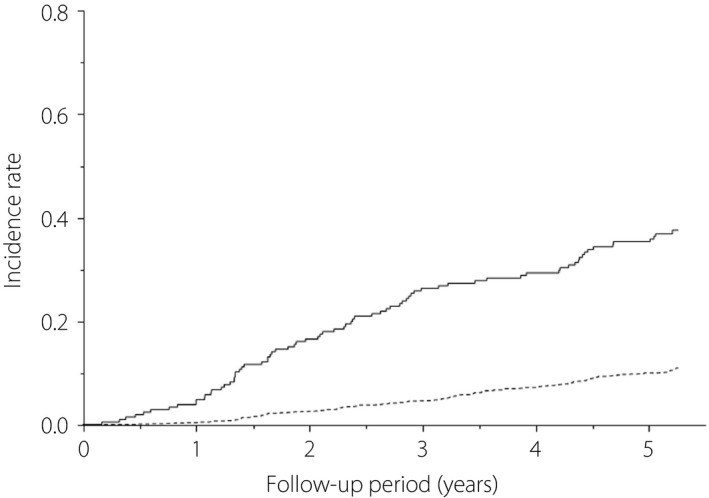
The incidence of severe hypoglycemia was 9.2 per 100 person-years in those with type 1 diabetes, and 2.3 per 100 person-years in those with insulin-treated type 2 diabetes, respectively. For type 1 diabetes, the risk was significant in those with a history of severe hypoglycemia within the previous year, slow eating and higher serum adiponectin (the highest vs the lowest in quartile hazard ratio 2.36, 95% confidence interval 1.22-4.69). For insulin-treated type 2 diabetes, the risk included age ≥65 years, history of severe hypoglycemia within the previous year, alcohol consumption ≥60 g/day, larger insulin dose and higher serum adiponectin (the highest vs the lowest in quartile, hazard ratio 2.95, 95% confidence interval 1.22-4.69). For all participants, the incidence of severe hypoglycemia increased along with serum adiponectin (age- and sex-adjusted hazard ratio 1.65 per 1 standard deviation increase of log serum adiponectin, 95% confidence interval 1.45-1.87).
The incidence of severe hypoglycemia was prospectively determined, and the association between severe hypoglycemia and higher serum adiponectin was observed in Japanese patients with type 1 and insulin-treated type 2 diabetes.
目的/引言:本研究前瞻性调查了日本 1 型或胰岛素治疗 2 型糖尿病患者中严重低血糖的发生率及其危险因素,包括胰岛素增敏性脂肪因子脂联素。
本研究共纳入了来自当地糖尿病登记处的 207 例 1 型糖尿病患者(平均年龄 55 岁)和 1396 例胰岛素治疗 2 型糖尿病患者(平均年龄 65 岁),随访时间为 5 年(随访率为 99%)。严重低血糖定义为需要他人协助才能从低血糖中恢复的事件。
1 型糖尿病患者的严重低血糖发生率为每 100 人年 9.2 例,胰岛素治疗 2 型糖尿病患者的发生率为每 100 人年 2.3 例。对于 1 型糖尿病,在前一年有严重低血糖病史、进食缓慢和较高血清脂联素的患者风险显著增加(四分位距最高与最低的风险比为 2.36,95%置信区间为 1.22-4.69)。对于胰岛素治疗的 2 型糖尿病,风险因素包括年龄≥65 岁、前一年有严重低血糖病史、每日饮酒≥60g、胰岛素剂量较大和较高血清脂联素(四分位距最高与最低的风险比为 2.95,95%置信区间为 1.22-4.69)。对于所有参与者,严重低血糖的发生率随着血清脂联素的增加而增加(年龄和性别调整后的风险比为每增加 1 个标准差的对数血清脂联素增加 1.65,95%置信区间为 1.45-1.87)。
本研究前瞻性确定了严重低血糖的发生率,并观察到日本 1 型和胰岛素治疗 2 型糖尿病患者中严重低血糖与较高血清脂联素之间的关联。