
延边黄牛气候适应性的全基因组扫描与选择印记
Whole Genome Scan and Selection Signatures for Climate Adaption in Yanbian Cattle.
作者信息
Shen Jiafei, Hanif Quratulain, Cao Yang, Yu Yongsheng, Lei Chuzhao, Zhang Guoliang, Zhao Yumin
机构信息
Key Laboratory of Beef Cattle Genetics and Breeding in Ministry of Agriculture and Rural Agriculture, Branch of Animal Husbandry, Jilin Academy of Agricultural Sciences, Changchun, China.
College of Animal Science and Technology, Northwest A&F University, Yangling, China.
出版信息
Front Genet. 2020 Feb 25;11:94. doi: 10.3389/fgene.2020.00094. eCollection 2020.
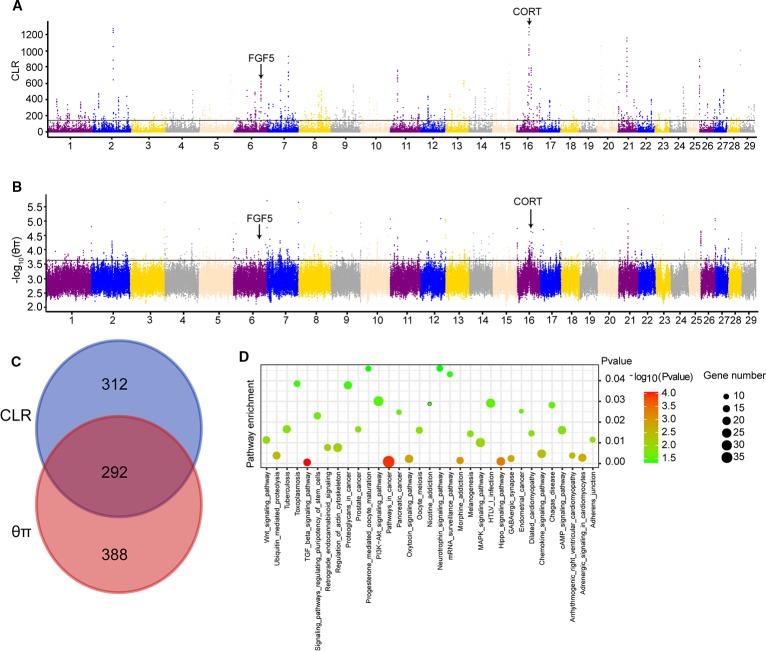
Yanbian cattle is inhabitant of North of China, exhibiting many phenotypic features, such as long, dense body hair, and abundant intramuscular fat, designed to combat the extreme cold climate adaption. In the current study, we studied the cold tolerance of nine Yanbian cattle by whole genome resequencing and compared with African tropical cattle, N'Dama, as a control group. Yanbian cattle was aligned to the Bos taurus reference genome (ARS-UCD1.2) yielding an average of 10.8 fold coverage. The positive selective sweep analysis for the cold adaption in Yanbian cattle were analyzed using composite likelihood ratio (CLR) and nucleotide diversity (θπ), resulting in 292 overlapped genes. The strongest selective signal was found on BTA16 with potential mutation in CORT gene, a regulatory gene of primary hormone in the hypothalamic-pituitary-adrenal (HPA) axis, is reported to be associated with the cold stress, representedfour missense mutations (c.269C > T, p.Lys90Ile; c.251A > G, p.Glu84Gly; c.112C > T, p.Pro38Ser; c.86G > A, p.Pro29His). Meanwhile another gene on BTA6, showed significantly higher selective sweep signals for a cold adapted trait for hair follicle and length development, (fibroblast growth factor 5) with a missense mutation (c.191C > T, p.Ser64Phe). Moreover, cold adapted Yanbian cattle was statistically compared with the hot adapted N'Dama cattle, a taurine cattle reported to show superior heat tolerance than zebu cattle, making them better adapted to the hot regions of Africa. XP-CLR, Fst, and θπ ratio were used to compare both breeds, yielding 487, 924, and 346 genes respectively. Among the 12 overlapped genes, () (c.638A > G, p.Lys 213Arg) involved in fat digestion and absorption plays an important role in membrane transport of long-chain fatty acid and its expression could increase in cold exposure. Henceforth, our study provides a novel genetic insights into the cold climate adaptation of Yanbian cattle and identified three candidate genes (, , ), which can add to an understanding of the cold climate adaptation of Yanbian cattle.
延边牛是中国北方的牛种,具有许多表型特征,如浓密的长毛和丰富的肌内脂肪,以适应极端寒冷的气候。在本研究中,我们通过全基因组重测序研究了九头延边牛的耐寒性,并与非洲热带牛品种恩达马牛作为对照组进行比较。延边牛与牛参考基因组(ARS-UCD1.2)比对,平均覆盖度为10.8倍。利用复合似然比(CLR)和核苷酸多样性(θπ)对延边牛的冷适应进行正选择扫描分析,得到292个重叠基因。在BTA16上发现了最强的选择信号,CORT基因存在潜在突变,CORT基因是下丘脑-垂体-肾上腺(HPA)轴主要激素的调节基因,据报道与冷应激有关,有四个错义突变(c.269C>T,p.Lys90Ile;c.251A>G,p.Glu84Gly;c.112C>T,p.Pro38Ser;c.86G>A,p.Pro29His)。同时,BTA6上的另一个基因,在毛囊和长度发育的冷适应性状上显示出显著更高的选择扫描信号,即成纤维细胞生长因子5(fibroblast growth factor 5),有一个错义突变(c.191C>T,p.Ser64Phe)。此外,对适应寒冷的延边牛与适应炎热的恩达马牛进行统计学比较,恩达马牛是一种据报道比瘤牛具有更强耐热性的牛品种,使其更能适应非洲的炎热地区。使用XP-CLR、Fst和θπ比值对两个品种进行比较,分别得到487、924和346个基因。在12个重叠基因中,参与脂肪消化和吸收的(c.638A>G,p.Lys 213Arg)在长链脂肪酸的膜转运中起重要作用,其表达在冷暴露时会增加。今后,我们的研究为延边牛对寒冷气候的适应提供了新的遗传见解,并鉴定出三个候选基因(、、),这有助于加深对延边牛寒冷气候适应的理解。

 Zotero 插件