
痛风石性痛风患者膝关节活动范围受限经药物治疗后改善:18个月随访
Limited Knee-Joint Range of Motion in Patients With Tophaceous Gout Improved With Medical Treatment: A 18-Months Follow Up.
作者信息
Lu Chuan-Chin, Wei James Cheng-Chung, Chang Cheng-Ang, Chen Chih-Ming, Tsai Sen-Wei, Yeh Chih-Jung
机构信息
Department of Rheumatology, Physical Medicine and Rehabilitation, Taichung Tzu Chi Hospital, Buddhist Tzu Chi Medical Foundation, Taichung, Taiwan.
Department of Physical Therapy, Hung Kuang University, Taichung, Taiwan.
出版信息
Front Med (Lausanne). 2020 Feb 28;7:74. doi: 10.3389/fmed.2020.00074. eCollection 2020.
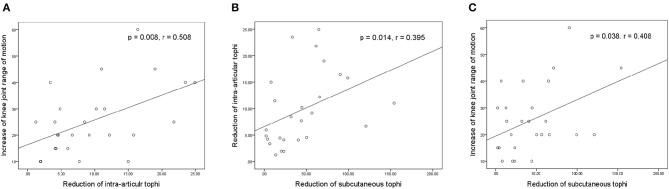
Tophi may occur within the knee joint causing limited knee-joint range of motion (knee motion). We investigated the relationships between knee motion, total intra-articular tophi size (tIA-tophi), and total subcutaneous tophi size (tSC-tophi) and determined knee motion improvement after continual urate-lowering therapy (ULT). A total of 26 patients with tophaceous gout and limited knee motion were enrolled. Inclusion criteria were age ≤ 60 years and preserved knee joint space on a plain radiograph. tSC-tophi were measured using a Vernier caliper and tIA-tophi were measured using magnetic resonance imaging software. All patients were re-evaluated after 12-24 months of continual ULT. Upon initial visit, knee motion was related to tIA-tophi and tSC-tophi. After an average of 18.2 months of ULT, the reduction in tSC-tophi was correlated with the reduction in tIA-tophi ( = 0.014, = 0.395) and improvement in knee motion ( = 0.038, = 0.408). Knee motion can be eventually improved even in cases of poor initial knee motion ( = 0.000, = -0.911) or large initial tIA-tophi ( = 0.014, = 0.476). Tophi can occur in any location within the knee joint. In multiple lineal regression, knee motion was predicted to improve 8.39° for every 10cm of tIA-tophi reduction. Limited knee motion in patients with intra-articular tophi improved with medical treatment, regardless of initial severity. Furthermore, tSC-tophi can be used as an indicator of limited knee motion and their improvement as a predictor of knee motion improvement.
痛风石可能出现在膝关节内,导致膝关节活动范围受限(膝关节活动)。我们研究了膝关节活动、关节内痛风石总体大小(tIA - 痛风石)和皮下痛风石总体大小(tSC - 痛风石)之间的关系,并确定了持续降尿酸治疗(ULT)后膝关节活动的改善情况。总共纳入了26例有痛风石性痛风且膝关节活动受限的患者。纳入标准为年龄≤60岁且X线平片显示膝关节间隙保留。使用游标卡尺测量tSC - 痛风石,使用磁共振成像软件测量tIA - 痛风石。所有患者在持续ULT治疗12 - 24个月后进行重新评估。初诊时,膝关节活动与tIA - 痛风石和tSC - 痛风石有关。在平均18.2个月的ULT治疗后,tSC - 痛风石的减少与tIA - 痛风石的减少相关( = 0.014, = 0.395),也与膝关节活动的改善相关( = 0.038, = 0.408)。即使初始膝关节活动较差( = 0.000, = -0.911)或初始tIA - 痛风石较大( = 0.014, = 0.476),膝关节活动最终也能得到改善。痛风石可出现在膝关节内的任何位置。在多元线性回归中,预测每减少10cm的tIA - 痛风石,膝关节活动将改善8.39°。关节内有痛风石的患者,无论初始严重程度如何,其受限的膝关节活动通过药物治疗均可改善。此外,tSC - 痛风石可作为膝关节活动受限的指标,其改善情况可作为膝关节活动改善的预测指标。


 Zotero 插件