Gray Victor, Allardice Jesse R, Zhang Zhilong, Dowland Simon, Xiao James, Petty Anthony J, Anthony John E, Greenham Neil C, Rao Akshay
Cavendish Laboratory, University of Cambridge, J. J. Thomson Avenue, Cambridge CB3 0HE, United Kingdom.
Department of Chemistry-Ångström Laboratory, Uppsala University, Box 523, 751 20 Uppsala, Sweden.
ACS Nano. 2020 Apr 28;14(4):4224-4234. doi: 10.1021/acsnano.9b09339. Epub 2020 Mar 18.
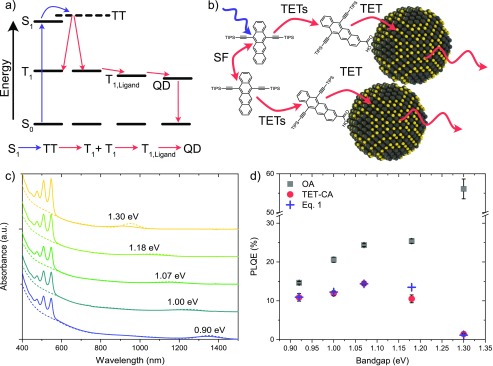
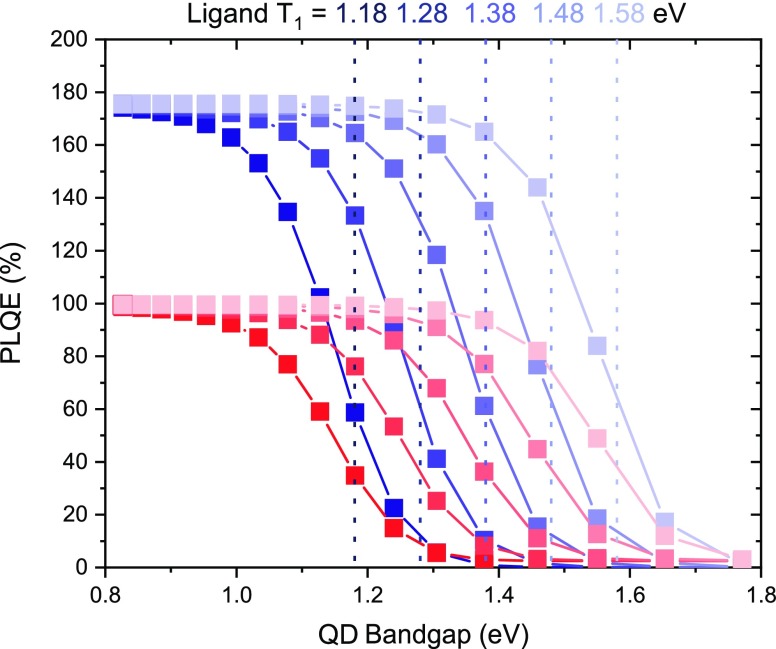
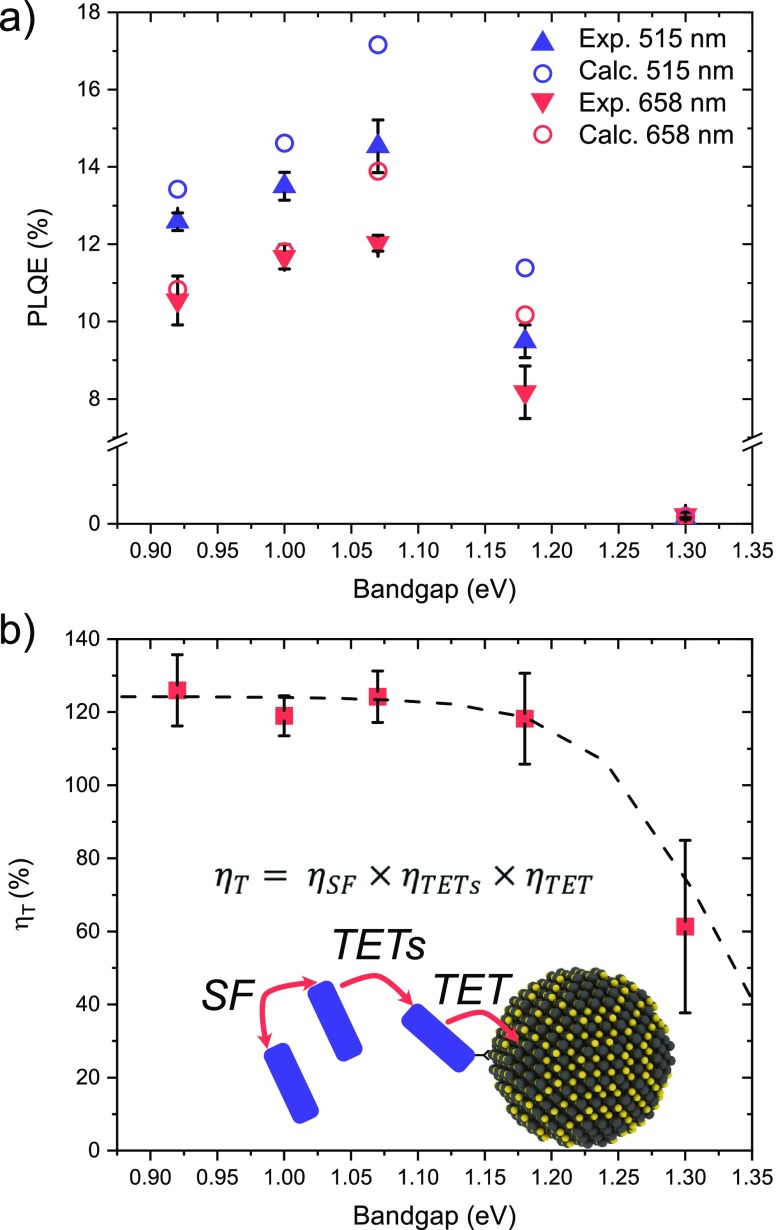
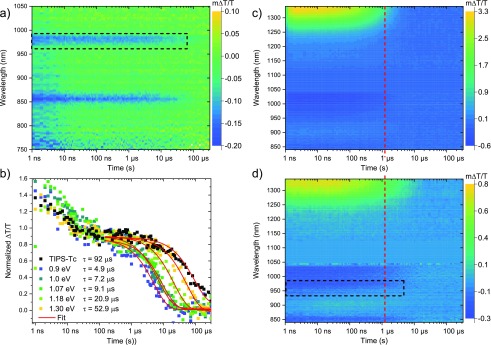
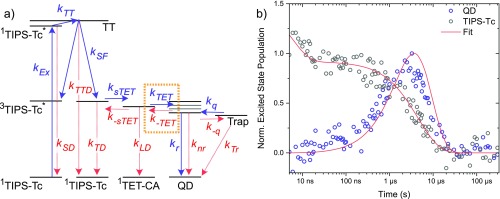
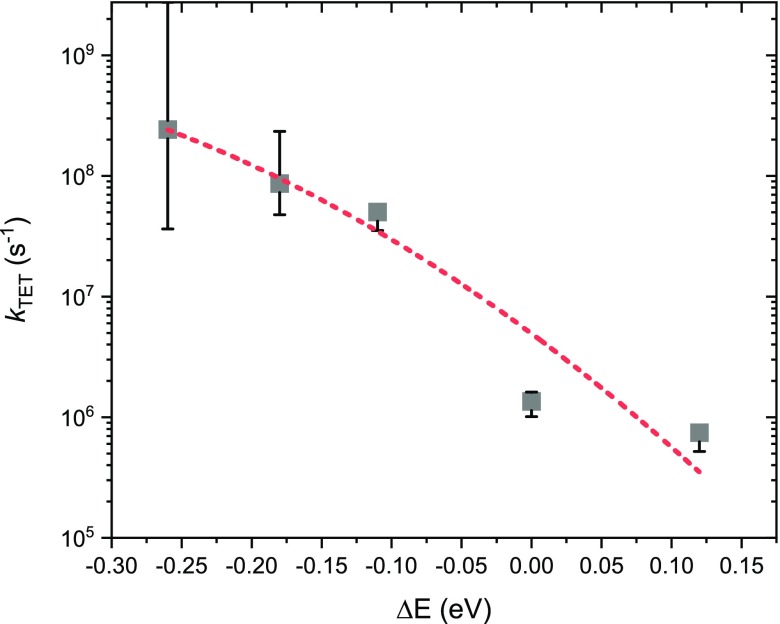
Hybrid inorganic-organic materials such as quantum dots (QDs) coupled with organic semiconductors have a wide range of optoelectronic applications, taking advantage of the respective materials' strengths. A key area of investigation in such systems is the transfer of triplet exciton states to and from QDs, which has potential applications in the luminescent harvesting of triplet excitons generated by singlet fission, in photocatalysis and photochemical upconversion. While the transfer of energy from QDs to the triplet state of organic semiconductors has been intensely studied in recent years, the mechanism and materials parameters controlling the reverse process, triplet transfer to QDs, have not been well investigated. Here, through a combination of steady-state and time-resolved optical spectroscopy we study the mechanism and energetic dependence of triplet energy transfer from an organic ligand (TIPS-tetracene carboxylic acid) to PbS QDs. Over an energetic range spanning from exothermic (-0.3 eV) to endothermic (+0.1 eV) triplet energy transfer we find that the triplet energy transfer to the QD occurs through a single step process with a clear energy dependence that is consistent with an electron exchange mechanism as described by Marcus-Hush theory. In contrast, the reverse process, energy transfer from the QD to the triplet state of the ligand, does not show any energy dependence in the studied energy range; interestingly, a delayed formation of the triplet state occurs relative to the quantum dots' decay. Based on the energetic dependence of triplet energy transfer we also suggest design criteria for future materials systems where triplet excitons from organic semiconductors are harvested QDs, for instance in light emitting structures or the harvesting of triplet excitons generated singlet fission.
诸如量子点(QD)与有机半导体耦合的无机-有机杂化材料,利用了各自材料的优势,具有广泛的光电应用。此类系统中一个关键的研究领域是三重态激子态在量子点之间的转移,这在单重态裂变产生的三重态激子的发光收集、光催化和光化学上转换方面具有潜在应用。虽然近年来从量子点到有机半导体三重态的能量转移已得到深入研究,但控制反向过程(即三重态转移到量子点)的机制和材料参数尚未得到充分研究。在此,通过稳态和时间分辨光谱学相结合的方法,我们研究了从有机配体(TIPS-四苯并四羧酸)到PbS量子点的三重态能量转移的机制和能量依赖性。在从放热(-0.3 eV)到吸热(+0.1 eV)的三重态能量转移的能量范围内,我们发现三重态向量子点的能量转移通过单步过程发生,具有明显的能量依赖性,这与Marcus-Hush理论描述的电子交换机制一致。相比之下,反向过程,即从量子点到配体三重态的能量转移,在所研究的能量范围内未显示出任何能量依赖性;有趣的是,相对于量子点的衰变,三重态的形成存在延迟。基于三重态能量转移的能量依赖性,我们还为未来的材料系统提出了设计标准,例如在发光结构中或在单重态裂变产生的三重态激子的收集过程中,从有机半导体收集三重态激子到量子点。