Greater Bay Area Cancer Registry, San Francisco, California.
Department of Epidemiology and Biostatistics, University of California at San Francisco, San Francisco, California.
Cancer. 2020 Jun 15;126(12):2849-2858. doi: 10.1002/cncr.32845. Epub 2020 Mar 17.
Among Latinas with breast cancer, residence in an ethnic enclave may be associated with survival. However, findings from prior studies are inconsistent.
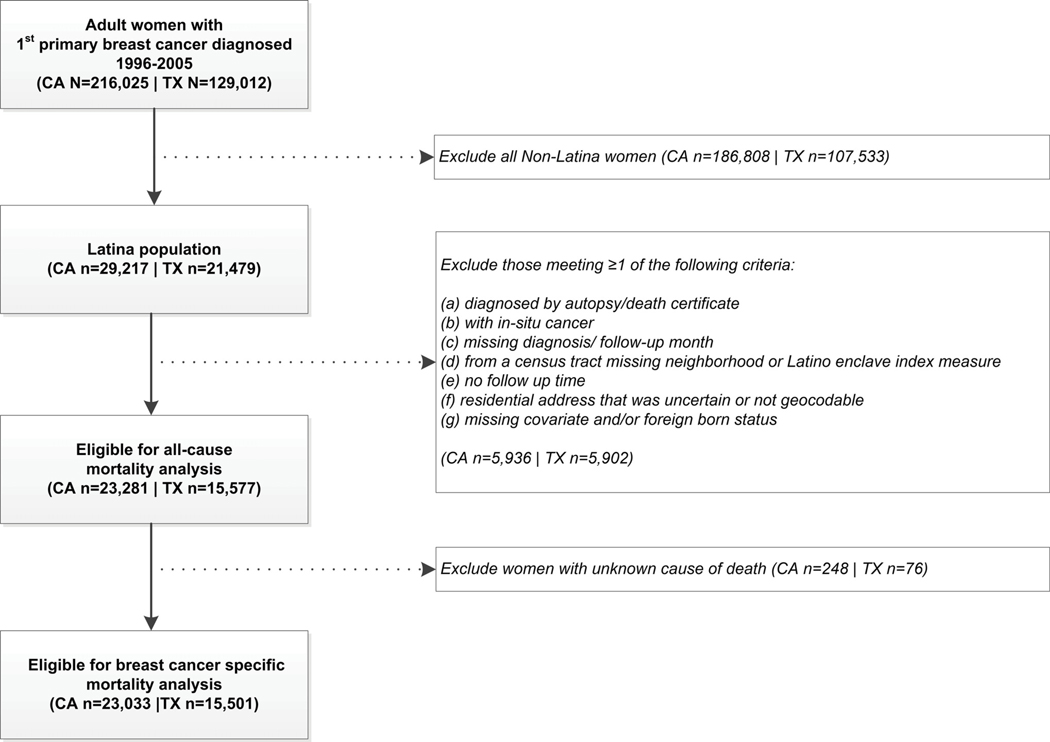
The authors conducted parallel analyses of California and Texas cancer registry data for adult (aged ≥18 years) Latinas who were diagnosed with invasive breast cancer from 1996 to 2005, with follow-up through 2014. Existing indices applied to tract-level 2000 US Census data were used to measure Latinx enclaves and neighborhood socioeconomic status (nSES). Multivariable Cox proportional hazard models were fit for all-cause and breast cancer-specific survival adjusted for year of diagnosis, patient age, nativity (with multiple imputation), tumor stage, histology, grade, size, and clustering by census tract.
Among 38,858 Latinas, the majority (61.3% in California and 70.5% in Texas) lived in enclaves. In fully adjusted models for both states, foreign-born women were found to be more likely to die of breast cancer and all causes when compared with US-born women. Living in enclaves and in neighborhoods with higher SES were found to be independently associated with improved survival from both causes. When combined into a 4-level variable, those in low nSES nonenclaves had worse survival for both causes compared with those living in low nSES enclaves and, in the all-cause but not breast cancer-specific models, those in high nSES neighborhoods, regardless of enclave status, had improved survival from all causes.
Applying the same methods across 2 states eliminated previously published inconsistent associations between enclave residence and breast cancer survival. Future studies should identify specific protective effects of enclave residence to inform interventions.
在患有乳腺癌的拉丁裔女性中,居住在族裔飞地可能与生存有关。然而,先前的研究结果并不一致。
作者对加利福尼亚州和得克萨斯州癌症登记处的数据进行了平行分析,这些数据来自 1996 年至 2005 年间被诊断患有浸润性乳腺癌的成年(年龄≥18 岁)拉丁裔女性,随访至 2014 年。使用适用于 2000 年美国人口普查数据的现有指标来衡量拉丁裔飞地和邻里社会经济地位(nSES)。多变量 Cox 比例风险模型用于调整诊断年份、患者年龄、原籍国(多重插补)、肿瘤分期、组织学、分级、大小以及按普查区聚类等因素后,对全因和乳腺癌特异性生存进行拟合。
在 38858 名拉丁裔女性中,大多数(加利福尼亚州为 61.3%,得克萨斯州为 70.5%)居住在飞地。在两个州的完全调整模型中,与美国出生的女性相比,外国出生的女性死于乳腺癌和所有原因的可能性更高。研究发现,居住在飞地和社会经济地位较高的社区与两种原因的生存改善独立相关。当将这些因素组合成一个 4 级变量时,与生活在低 nSES 飞地的人相比,低 nSES 非飞地的人两种原因的生存都更差,而在全因但非乳腺癌特异性模型中,无论飞地状况如何,高 nSES 社区的人全因生存都有所改善。
在两个州应用相同的方法消除了先前发表的飞地居住与乳腺癌生存之间不一致的关联。未来的研究应该确定飞地居住的具体保护作用,以为干预措施提供信息。