Division of Applied Life Science (BK 21), College of Natural Sciences, Gyeongsang National University, Jinju 52828, Korea.
Maastricht University Medical Center (MUMC+), School for Mental Health and Neuroscience|Alzheimer Center Limburg, 6229ER Maastricht, The Netherlands.
Cells. 2020 Mar 9;9(3):667. doi: 10.3390/cells9030667.
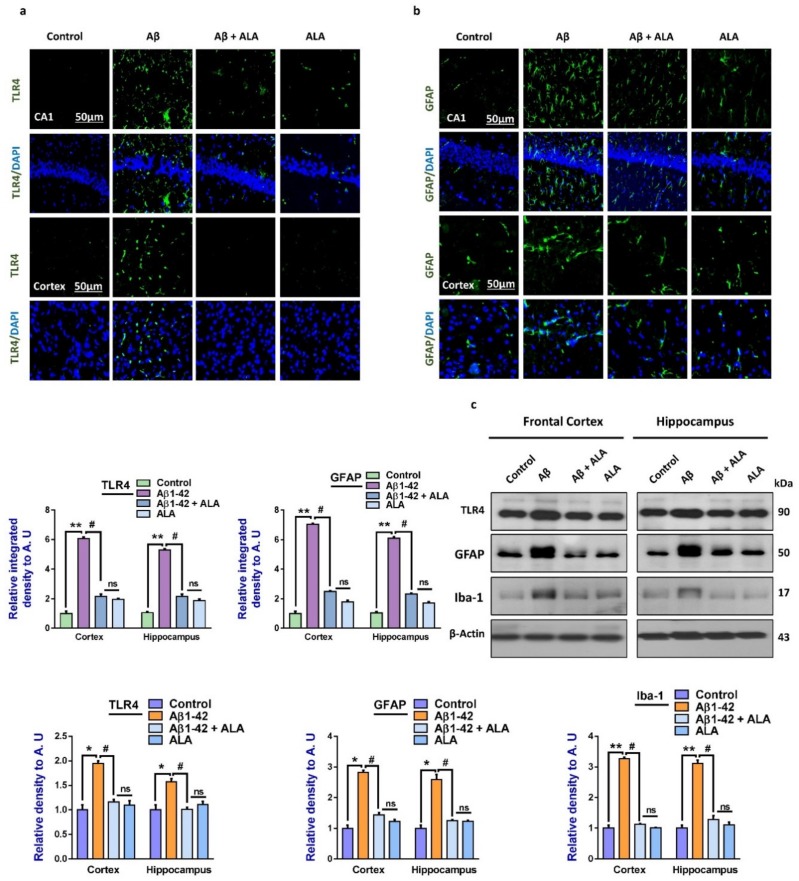
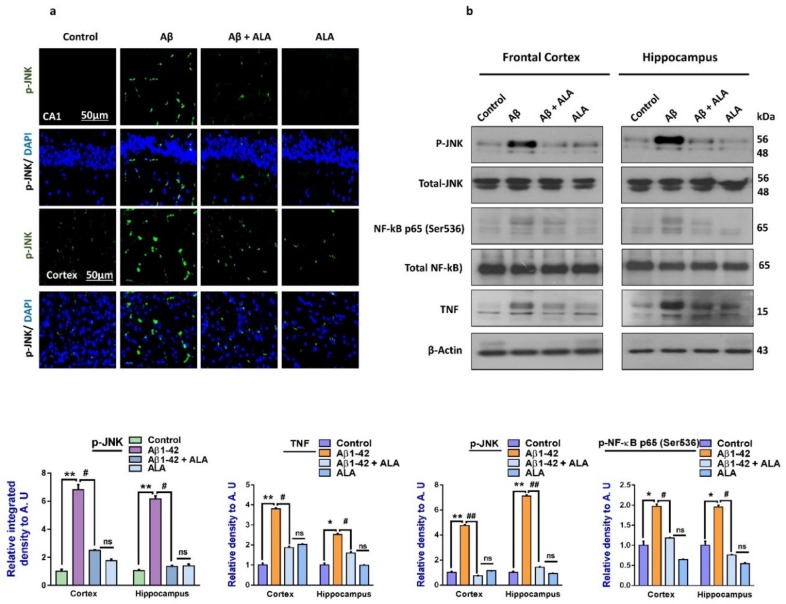
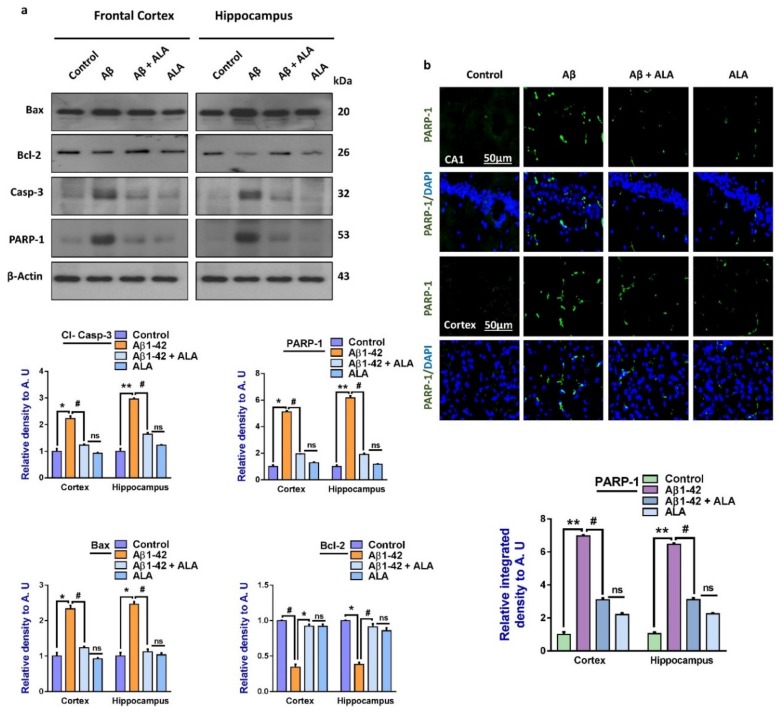
In this work, we evaluated the effects of alpha linoleic acid (ALA), an omega-3 polyunsaturated fatty acid, on amyloid-beta-induced glial-cell-mediated neuroinflammation, amyloidogenesis, and cognitive dysfunction in mice. After an infusion of Aβ (Aβ, 5 μL/5 min/mouse, intracerebroventricular injection (i.c.v), and respective treatments of ALA (60 mg/kg per oral for six weeks), neuroinflammation, apoptotic markers, and synaptic markers were evaluated by Western blot and immunofluorescence analyses. According to our findings, the infusion of Aβ activated Toll-like receptor 4 (TLR4), glial fibrillary acidic protein (GFAP), and ionized calcium adaptor molecule 1 (Iba-1) in the frontal cortices and hippocampi of the Aβ-injected mice to a greater extent than the Aβ + ALA-cotreated mice. Similarly, there was an elevated expression of phospho-c-Jun-N-terminal kinase (p-JNK), phospho-nuclear factor-kB p65 (p-NF-kB p65 (Ser536)), and tissue necrosis factor (TNF) in the Aβ infused mouse brains; interestingly, these markers were significantly reduced in the Aβ + ALA-cotreated group. The elevated expression of pro-apoptotic markers was observed during apoptotic cell death in the Aβ-treated mouse brains, whereas these markers were markedly reduced in the Aβ + ALA-cotreated group. Moreover, Aβ infusion significantly increased amyloidogenesis, as assessed by the enhanced expression of the amyloid precursor proteins (APP) beta-amyloid cleaving enzyme-1 (BACE-1) and amyloid-beta (Aβ) in the mouse brains, whereas these proteins were markedly reduced in the Aβ + ALA-cotreated group. We also checked the effects of ALA against Aβ-triggered synaptic dysfunction and memory dysfunction, showing that ALA significantly improved memory and synaptic functions in Aβ-treated mouse brains. These results indicated that ALA could be an applicable intervention in neuroinflammation, apoptotic cell loss, amyloidogenesis, and memory dysfunction via the inhibition of TLR4 and its downstream targets in Aβ + ALA-cotreated mouse brains.
在这项工作中,我们评估了α-亚麻酸(ALA),一种ω-3 多不饱和脂肪酸,对小鼠中淀粉样β诱导的神经胶质细胞介导的神经炎症、淀粉样形成和认知功能障碍的影响。在 Aβ 输注(Aβ,5μL/5min/只,脑室内注射(i.c.v),以及分别用 ALA(60mg/kg 口服 6 周)处理后,通过 Western blot 和免疫荧光分析评估神经炎症、凋亡标志物和突触标志物。根据我们的发现,与 Aβ+ALA 共处理组相比,Aβ 输注更能激活 TLR4、胶质纤维酸性蛋白(GFAP)和钙调蛋白 1(Iba-1)在 Aβ 注射小鼠的额皮质和海马中。同样,在 Aβ 输注的小鼠脑中,磷酸化 c-Jun-N-末端激酶(p-JNK)、磷酸化核因子-kB p65(p-NF-kB p65(Ser536))和肿瘤坏死因子(TNF)的表达升高;有趣的是,在 Aβ+ALA 共处理组中,这些标志物的表达明显降低。在 Aβ 处理的小鼠脑中观察到促凋亡标志物的表达升高,导致细胞凋亡,而在 Aβ+ALA 共处理组中,这些标志物的表达明显降低。此外,Aβ 输注显著增加了淀粉样形成,如通过增强的淀粉样前体蛋白(APP)β-淀粉样蛋白裂解酶-1(BACE-1)和淀粉样β(Aβ)在小鼠脑中的表达来评估,而在 Aβ+ALA 共处理组中,这些蛋白的表达明显降低。我们还检查了 ALA 对 Aβ 触发的突触功能障碍和记忆功能障碍的影响,结果表明 ALA 显著改善了 Aβ 处理的小鼠脑内的记忆和突触功能。这些结果表明,ALA 可能通过抑制 TLR4 及其在 Aβ+ALA 共处理小鼠脑中的下游靶点,成为神经炎症、凋亡细胞丢失、淀粉样形成和记忆功能障碍的一种可行干预措施。