Department of Surgery, Catharina Hospital, Eindhoven, Michelangelolaan 2, 5623 EJ Eindhoven, The Netherlands.
Nutrients. 2020 Mar 15;12(3):778. doi: 10.3390/nu12030778.
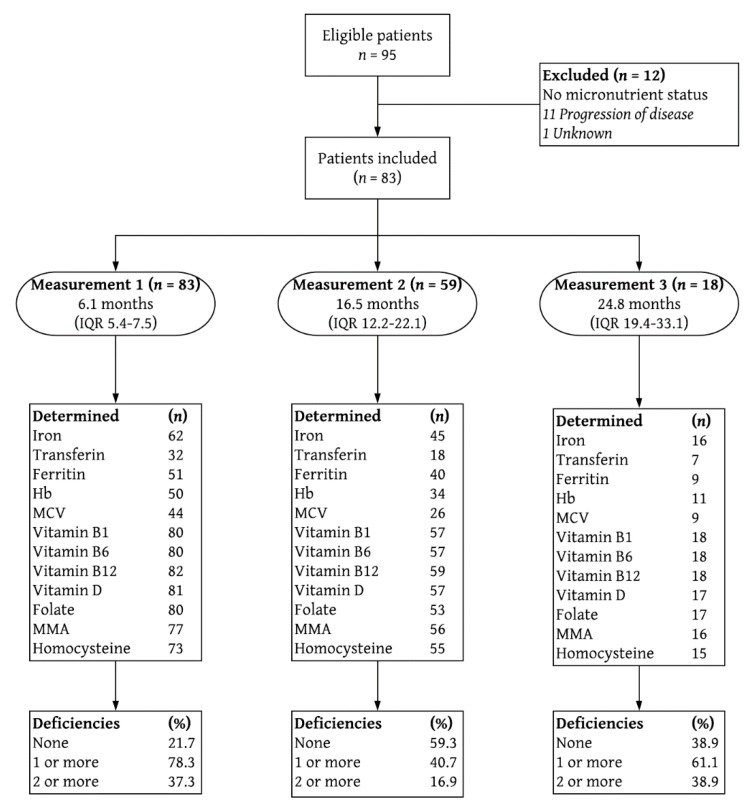
Over the past decades, survival rates for patients with resectable esophageal cancer have improved significantly. Consequently, the sequelae of having a gastric conduit, such as development of micronutrient deficiencies, become increasingly apparent. This study investigated postoperative micronutrient trends in the follow-up of patients following a minimally invasive esophagectomy (MIE) for cancer. Patients were included if they had at least one postoperative evaluation of iron, ferritin, vitamins B1, B6, B12, D, folate or methylmalonic acid. Data were available in 83 of 95 patients. Of these, 78.3% (65/83) had at least one and 37.3% (31/83) had more than one micronutrient deficiency at a median of 6.1 months (interquartile range (IQR) 5.4-7.5) of follow-up. Similar to the results found in previous studies, most common deficiencies identified were: iron, vitamin B12 and vitamin D. In addition, folate deficiency and anemia were detected in a substantial amount of patients in this cohort. At 24.8 months (IQR 19.4-33.1) of follow-up, micronutrient deficiencies were still common, however, most deficiencies normalized following supplementation on indication. In conclusion, patients undergoing a MIE are at risk of developing micronutrient deficiencies as early as 6 up to 24 months after surgery and should therefore be routinely checked and supplemented when needed.
在过去的几十年中,可切除食管癌患者的生存率有了显著提高。因此,胃管的后遗症,如微量营养素缺乏症的发展,变得越来越明显。本研究调查了微创食管癌切除术(MIE)后患者随访期间术后微量营养素的趋势。如果患者至少有一次铁、铁蛋白、维生素 B1、B6、B12、D、叶酸或甲基丙二酸的术后评估,则将其纳入研究。83 例患者中有数据可用。其中,78.3%(65/83)至少有一种,37.3%(31/83)有多种微量营养素缺乏症,中位数随访时间为 6.1 个月(IQR 5.4-7.5)。与之前研究的结果相似,最常见的缺乏症是:铁、维生素 B12 和维生素 D。此外,在本队列中,相当数量的患者检测到叶酸缺乏症和贫血。在 24.8 个月(IQR 19.4-33.1)的随访中,仍然存在微量营养素缺乏,但大多数缺乏症在有指征时通过补充后恢复正常。总之,接受 MIE 的患者在手术后 6 至 24 个月内就有发生微量营养素缺乏的风险,因此应定期检查并在需要时进行补充。