From the Department of Neurology (H.K., E.-J.L., S.K., L.-K.C., K.K., H.W.K., K.-K.K., Y.-M.L.) and Asan Medical Institute of Convergence Science and Technology (E.-J.L., S.K.), Asan Medical Center, University of Ulsan College of Medicine, Seoul, South Korea.
Neurol Neuroimmunol Neuroinflamm. 2020 Mar 17;7(3). doi: 10.1212/NXI.0000000000000708. Print 2020 May.
To test the hypothesis that the pattern of serum biomarkers of disease activity and disability in myelin oligodendrocyte glycoprotein antibody-associated disease (MOGAD) will be different from those in neuromyelitis optica spectrum disorder (NMOSD) with anti-aquaporin-4 antibodies (AQP4-Abs).
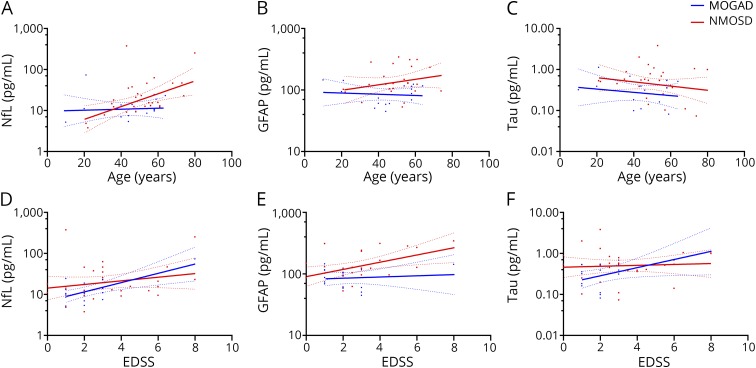
Using ultrasensitive single-molecule array assays, we measured neurofilament light chain (NfL), glial fibrillary acidic protein (GFAP), and tau in the sera of consecutive patients with MOGAD (n = 16) and NMOSD with AQP4-Ab (n = 33). Serum biomarker levels were compared between patients in relapse and remission states, and correlations between the levels of these biomarkers and Expanded Disability Status Scale (EDSS) scores were analyzed within each group.
In the MOGAD group, the serum tau level was higher in a relapse state than in a remission state (relapse vs remission: 0.5 [0.4-0.5] vs 0.2 [0.1-0.3] pg/mL, = 0.027). Both serum levels of NfL and tau correlated with the EDSS score (NfL: r = 0.684, = 0.003; tau: r = 0.524, = 0.045). Meanwhile, in the NMOSD group, serum NfL and GFAP levels were higher in a relapse state than in a remission state (relapse vs remission: NfL, 34.8 [12.2-62.3] vs 13.0 [11.3-20.0] pg/mL, = 0.010; GFAP, 253.8 [150.6-303.0] vs 104.4 [93.9-127.9] pg/mL, = 0.016). Only the serum GFAP level correlated with the EDSS score (r = 0.485, = 0.012).
The pattern of serum biomarkers of disease activity and disability in MOGAD showed a distinct feature from those in NMOSD with AQP4-Ab, which implicates different pathogeneses between the 2 diseases.
验证髓鞘少突胶质细胞糖蛋白抗体相关性疾病(MOGAD)患者的血清疾病活动和残疾生物标志物模式与水通道蛋白 4 抗体(AQP4-Ab)阳性的视神经脊髓炎谱系疾病(NMOSD)患者不同的假设。
采用超敏单分子阵列检测,连续检测 16 例 MOGAD 患者和 33 例 NMOSD 伴 AQP4-Ab 患者的血清神经丝轻链(NfL)、胶质纤维酸性蛋白(GFAP)和 tau。比较患者在缓解期和复发期的血清生物标志物水平,并在每组内分析这些标志物水平与扩展残疾状态量表(EDSS)评分的相关性。
在 MOGAD 组中,复发期血清 tau 水平高于缓解期(复发期 vs 缓解期:0.5[0.4-0.5] vs 0.2[0.1-0.3] pg/mL,=0.027)。血清 NfL 和 tau 水平均与 EDSS 评分相关(NfL:r=0.684,=0.003;tau:r=0.524,=0.045)。同时,在 NMOSD 组中,复发期血清 NfL 和 GFAP 水平高于缓解期(复发期 vs 缓解期:NfL,34.8[12.2-62.3] vs 13.0[11.3-20.0] pg/mL,=0.010;GFAP,253.8[150.6-303.0] vs 104.4[93.9-127.9] pg/mL,=0.016)。只有血清 GFAP 水平与 EDSS 评分相关(r=0.485,=0.012)。
MOGAD 患者血清疾病活动和残疾生物标志物的模式与 AQP4-Ab 阳性 NMOSD 患者明显不同,提示这两种疾病的发病机制不同。