Department of Clinical Nursing, Muhimbili University of Health and Allied Sciences (MUHAS), P.O BOX 65001, Dar es Salaam, Tanzania.
Department of Community Nursing, MUHAS, Dar es Salaam, Tanzania.
BMC Emerg Med. 2020 Mar 18;20(1):21. doi: 10.1186/s12873-020-00317-y.
An overwhelming proportion of road traffic deaths and injuries in low- and middle-income countries (LMICs) occur in prehospital environments. Lay first responders such as police officers play an important role in providing initial assistance to victims of road traffic injuries either alone or in collaboration with others. The present study evaluated a postcrash first aid (PFA) educational program developed for police officers in Tanzania.
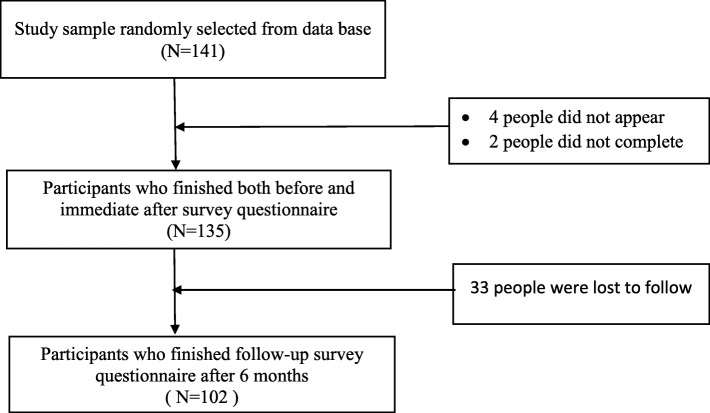
A 16-h PFA educational program was conducted in Dar es Salaam, Tanzania, for 135 police officers. Participants completed training surveys before, immediately and 6 months after the training (before, N = 135; immediately after, N = 135; after 6 months, N = 102). The primary outcome measures were PFA knowledge, perceived skills confidence, and skills utilization. Parametric and nonparametric tests were used to analyse changes in outcome.
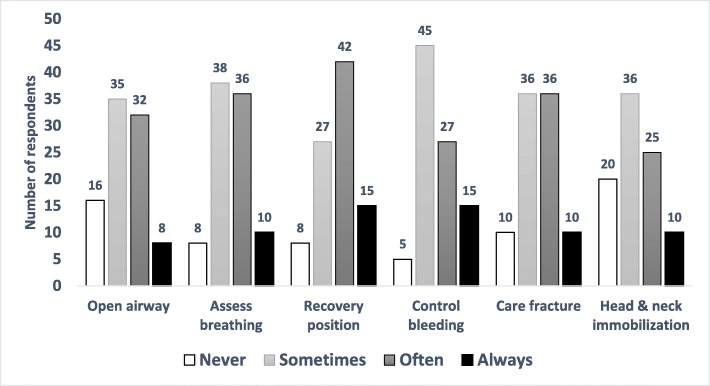
The mean PFA knowledge score increased from 44.73% before training (SD = 20.70) to 72.92% 6 months after training (SD = 18.12), p < .001, N = 102. The mean PFA perceived skills confidence score (measured on a 1-5 Likert scale) increased from 1.96 before training (SD = 0.74) to 3.78 6 months after training (SD = 0.70), p < .001, N = 102. Following training, application of the recovery position skill (n = 42, 46%) and application of the bleeding control skill (n = 45, 49%) were reported by nearly half of the responding officers. Less than a quarter of officers reported applying head and neck immobilization skills (n = 20, 22%) following training.
A PFA educational program has shown to improve police officers' knowledge and perceived skills confidence on provision of first aid. However qualitative research need to be conducted to shed more light regarding reasons for low utilization of trained first aid skills during follow-up.
在低收入和中等收入国家(LMICs),道路交通事故造成的死亡和伤害绝大多数发生在院前环境中。一线急救员(如警察)在为道路交通事故伤员提供初步援助方面发挥着重要作用,他们可以单独或与他人合作提供援助。本研究评估了为坦桑尼亚警察开发的一项车祸后急救(PFA)教育计划。
在坦桑尼亚达累斯萨拉姆为 135 名警察进行了 16 小时的 PFA 教育计划。参与者在培训前(n=135)、培训后即刻(n=135)和 6 个月后(n=102)完成培训调查问卷。主要结局指标为 PFA 知识、感知技能信心和技能应用。使用参数和非参数检验分析结果变化。
PFA 知识评分从培训前的 44.73%(SD=20.70)增加到 6 个月后的 72.92%(SD=18.12),p<0.001,n=102。PFA 感知技能信心评分(采用 1-5 分 Likert 量表)从培训前的 1.96(SD=0.74)增加到 6 个月后的 3.78(SD=0.70),p<0.001,n=102。培训后,有 42 名(46%)警察报告应用了复苏体位技能,45 名(49%)警察报告应用了止血控制技能。不到四分之一的警察(20 名,22%)报告在培训后应用了头颈部固定技能。
PFA 教育计划已证明可提高警察提供急救的知识和感知技能信心。然而,需要进行定性研究,以更深入地了解培训后的急救技能利用率低的原因。