Department of Clinical Laboratory, Chengdu Women's and Children's Central Hospital, School of Medicine, University of Electronic Science and Technology of China, Chengdu, 611731, China.
, Chengdu, China.
BMC Pregnancy Childbirth. 2020 Mar 18;20(1):176. doi: 10.1186/s12884-020-02860-9.
Hyperhomocysteinemia may be a risk factor for endothelial dysfunction. Folate and vitamin B12 regulate the homocysteine metabolic process. This study aimed to evaluate the associations between subsequent events of adverse pregnancy outcome and early variables of homocysteine, folate, and vitamin B12 in pregnant women.
This multicenter, retrospective, case-control study involved 563 pregnant women with adverse pregnancy outcome and 600 controls. Adverse pregnancy outcomes included one or more of the following events: preeclampsia, preterm birth, low birth weight, and stillbirth. The associations between subsequent events of adverse pregnancy outcome and early variables of homocysteine, folate, and vitamin B12; metabolic parameters; inflammatory markers; anthropometrics; and lifestyle habits at 11-12 weeks of gestation were analyzed using the logistic regression model.
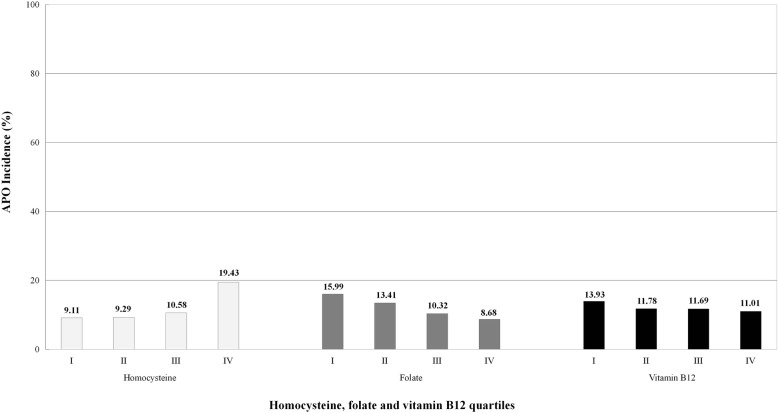
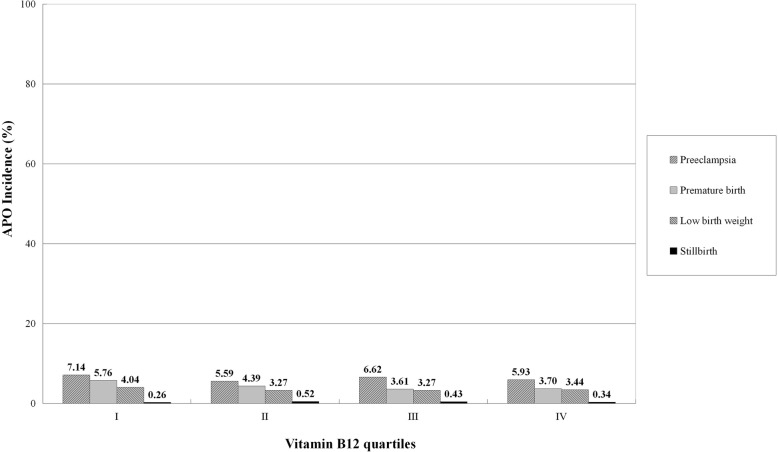
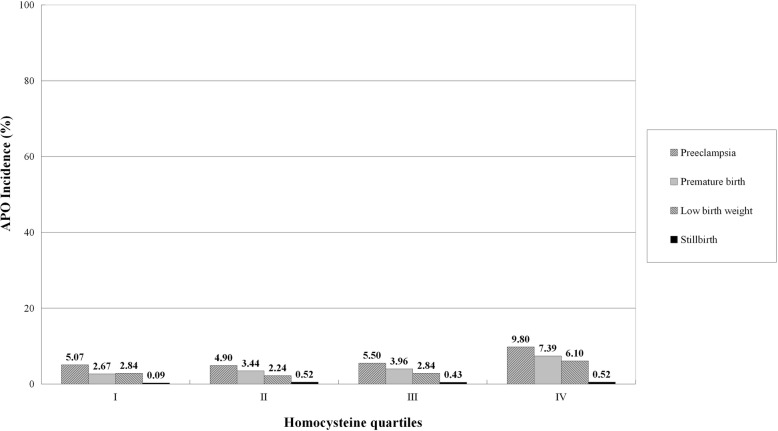
Compared to the lower quartile homocysteine concentrations, the upper quartile homocysteine concentrations were associated with preeclampsia, preterm birth and low birth weight. On the contrary, the lower quartile folate concentrations were associated with preeclampsia, preterm birth and low birth weight compared with the upper quartile folate concentrations. The incidence of adverse pregnancy outcome increased progressively from the first to fourth homocysteine quartiles but decreased progressively from the first to fourth folate quartiles. After adjusting for confounding factors, multivariate logistic regression analysis showed that besides systolic blood pressure, diastolic blood pressure, body mass index and age, homocysteine (IV vs I quartile, aOR 5.89, 95% CI 4.08-8.51, P < 0.001), folate (IV vs I quartile, aOR 0.35, 95% CI 0.25-0.50, P < 0.001), folate supplementation (yes vs no, aOR 0.55, 95% CI 0.35-0.86, P = 0.010) during early pregnancy were independently associated with subsequent events of adverse pregnancy outcome, and vitamin B12 was rejected. Of these, the homocysteine revealed the highest odds ratio in all risk variables, and folate showed the lowest odds ratio in all protective variables.
Higher homocysteine concentration and lower folate level during early pregnancy were associated with adverse pregnancy outcome. However, no association was found between vitamin B12 and adverse pregnancy outcome. Supplementation with folate in early pregnancy may reduce adverse pregnancy outcome.
高同型半胱氨酸血症可能是内皮功能障碍的一个危险因素。叶酸和维生素 B12 调节同型半胱氨酸的代谢过程。本研究旨在评估孕妇同型半胱氨酸、叶酸和维生素 B12 的早期变量与不良妊娠结局的后续事件之间的关系。
这是一项多中心、回顾性、病例对照研究,共纳入 563 名有不良妊娠结局的孕妇和 600 名对照。不良妊娠结局包括子痫前期、早产、低出生体重和死胎。使用逻辑回归模型分析 11-12 周妊娠时同型半胱氨酸、叶酸和维生素 B12 的早期变量、代谢参数、炎症标志物、人体测量学和生活方式习惯与不良妊娠结局后续事件之间的关系。
与较低四分位数的同型半胱氨酸浓度相比,较高四分位数的同型半胱氨酸浓度与子痫前期、早产和低出生体重有关。相反,与较高四分位数的叶酸浓度相比,较低四分位数的叶酸浓度与子痫前期、早产和低出生体重有关。不良妊娠结局的发生率从同型半胱氨酸四分位的第一到第四位逐渐增加,但从叶酸四分位的第一到第四位逐渐降低。在调整混杂因素后,多变量逻辑回归分析显示,除了收缩压、舒张压、体重指数和年龄外,同型半胱氨酸(IV 与 I 四分位数,aOR 5.89,95%CI 4.08-8.51,P<0.001)、叶酸(IV 与 I 四分位数,aOR 0.35,95%CI 0.25-0.50,P<0.001)、孕早期叶酸补充(是 vs 否,aOR 0.55,95%CI 0.35-0.86,P=0.010)与不良妊娠结局的后续事件独立相关,而维生素 B12 被拒绝。在所有风险变量中,同型半胱氨酸的比值比最高,在所有保护变量中,叶酸的比值比最低。
孕早期同型半胱氨酸浓度升高和叶酸水平降低与不良妊娠结局有关。然而,维生素 B12 与不良妊娠结局之间没有关联。孕早期补充叶酸可能会降低不良妊娠结局的发生。