Department of Neurosurgery, Stanford University Hospitals and Clinics, Stanford, California, USA.
Department of Neurosurgery, University Hospital Zurich, Zurich, Switzerland.
Sci Rep. 2020 Mar 18;10(1):4939. doi: 10.1038/s41598-020-61893-4.
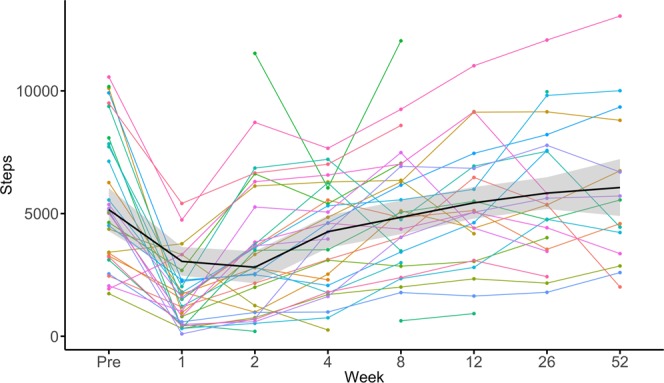
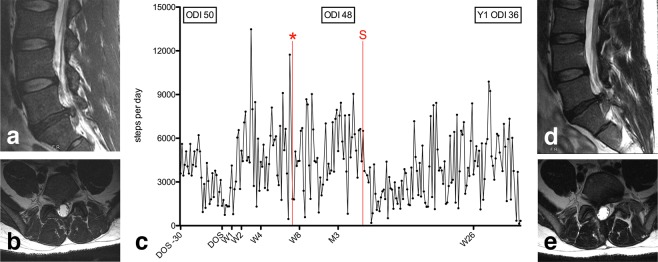
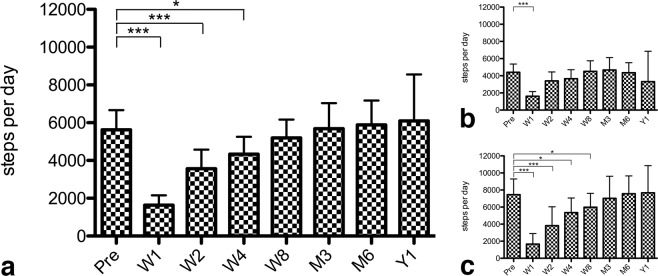
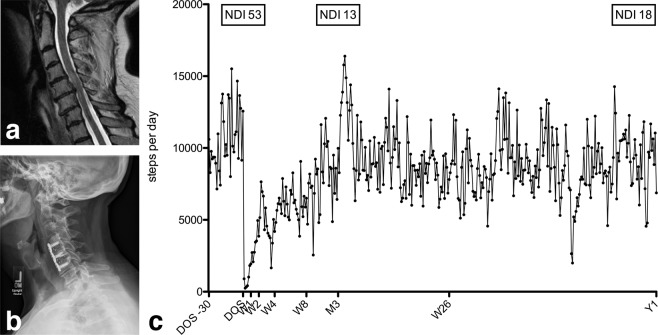
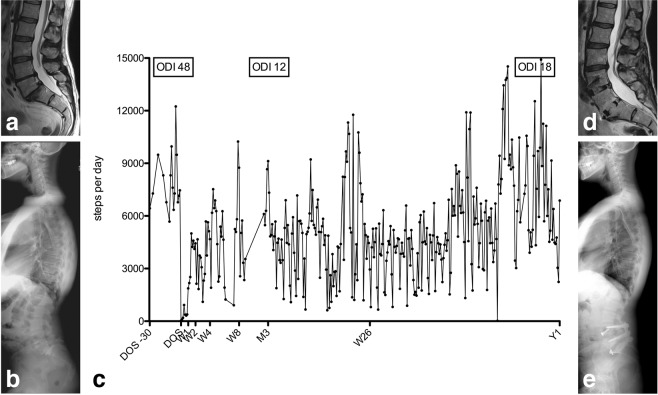
Patient-reported outcome measures (PROMs) are commonly used to estimate disability of patients with spinal degenerative disease. Emerging technological advances present an opportunity to provide objective measurements of activity. In a prospective, observational study we utilized a low-cost consumer grade wearable accelerometer (LCA) to determine patient activity (steps per day) preoperatively (baseline) and up to one year (Y1) after cervical and lumbar spine surgery. We studied 30 patients (46.7% male; mean age 57 years; 70% Caucasian) with a baseline activity level of 5624 steps per day. The activity level decreased by 71% in the 1 postoperative week (p < 0.001) and remained 37% lower in the 2 (p < 0.001) and 23% lower in the 4 week (p = 0.015). At no time point until Y1 did patients increase their activity level, compared to baseline. Activity was greater in patients with cervical, as compared to patients with lumbar spine disease. Age, sex, ethnic group, anesthesia risk score and fusion were variables associated with activity. There was no correlation between activity and PROMs, but a strong correlation with depression. Determining activity using LCAs provides real-time and longitudinal information about patient mobility and return of function. Recovery took place over the first eight postoperative weeks, with subtle improvement afterwards.
患者报告的结局测量(PROMs)常用于评估脊柱退行性疾病患者的残疾程度。新兴技术的进步为提供活动的客观测量提供了机会。在一项前瞻性、观察性研究中,我们使用低成本的消费级可穿戴加速度计(LCA)来确定颈椎和腰椎手术后患者的活动量(每天的步数),术前(基线)和术后一年(Y1)。我们研究了 30 名患者(46.7%为男性;平均年龄 57 岁;70%为白种人),基线活动水平为每天 5624 步。术后第 1 周活动量下降了 71%(p<0.001),第 2 周和第 4 周分别下降了 37%(p<0.001)和 23%(p=0.015)。在 Y1 之前,与基线相比,患者没有增加活动水平。与腰椎疾病患者相比,颈椎疾病患者的活动量更大。年龄、性别、种族、麻醉风险评分和融合是与活动相关的变量。活动与 PROMs 之间没有相关性,但与抑郁有很强的相关性。使用 LCA 确定活动量可提供有关患者活动能力和功能恢复的实时和纵向信息。恢复发生在术后的前 8 周,随后有细微改善。